
(Originally published in Divya Marathi in Marathi on 30/3/2025)
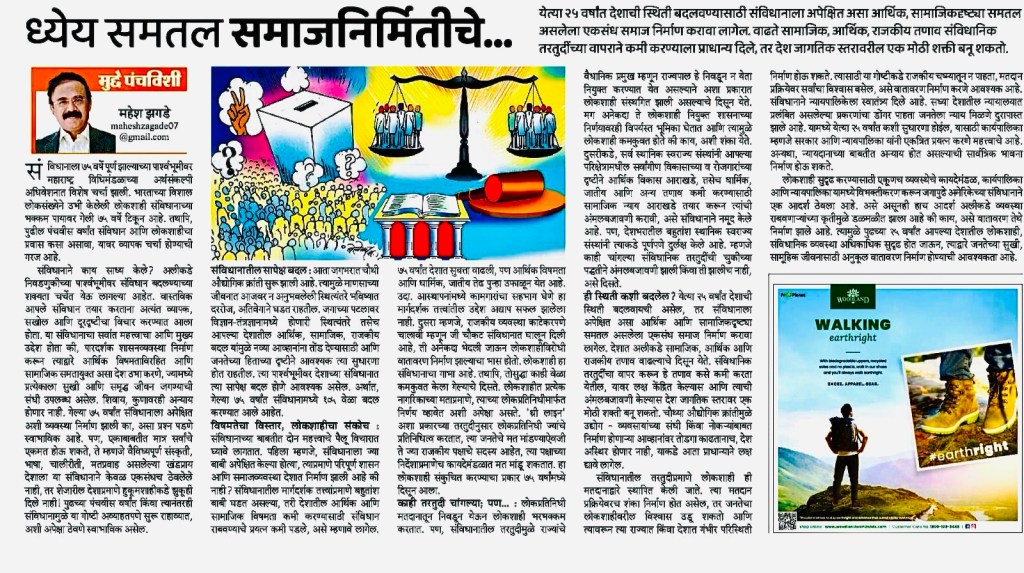
As the Indian Republic commemorates seventy-five years of its Constitution, the Maharashtra Legislative Assembly has undertaken a significant discussion on its journey and the course it must chart for the next twenty-five years. The Constitution, the bedrock of the world’s largest democracy, has not only provided a stable framework for governance but has also ensured that the nation—despite its vast and diverse populace—remains steadfastly united, resisting the perils of authoritarianism that have engulfed many of its neighbors.
Yet, amidst this celebration of constitutional endurance, murmurs of unease have surfaced. Political discourses have, of late, been rife with assertions that certain factions seek to alter the constitutional framework or draft a parallel charter. Such rhetoric, whether driven by genuine intent or political maneuvering, demands deeper contemplation.
The Constitutional Promise: A Dream Fulfilled or Deferred?
When the framers of the Indian Constitution meticulously sculpted this monumental document, they envisioned a nation governed with transparency, where justice reigned supreme, and economic disparities did not hinder social harmony. It was designed to be a charter of equality, ensuring every citizen an opportunity for a dignified existence, free from oppression.
And yet, as we stand at this juncture, it is only natural to ask—has India realized the aspirations embedded in its founding document? The answer, like the democracy it nurtures, is complex. While the Constitution has undeniably kept the nation unified and prevented a descent into autocracy, it has struggled to eradicate deep-seated economic and social inequalities. Though prosperity has expanded, so too has disparity, and the specters of caste and communal discord, which the Constitution sought to dissolve, have begun resurfacing with unsettling prominence.
The Constitution as a Living Document
Over the past seventy-five years, the Indian Constitution has undergone 105 amendments—averaging 1.4 amendments per year—testament to its adaptability. Indeed, it was never meant to be an immutable relic but a living document, evolving to meet the demands of a changing world. As the Fourth Industrial Revolution accelerates, heralding transformations in ways never before witnessed by humankind, constitutional frameworks, too, must remain attuned to these shifts. The rapid advancements in artificial intelligence, automation, and biotechnology may soon redefine human civilization itself, necessitating a legal and ethical structure that keeps pace with such seismic changes.
Yet, constitutional evolution must be guided by principle rather than political expediency. The true measure of progress lies not merely in amendments but in whether they serve the founding ideals of justice, liberty, and fraternity.
Constitutional Implementation: Shortcomings and Challenges
Beyond its adaptability, the effectiveness of a constitution is judged by the fidelity with which its provisions are implemented. Here, India’s record presents a paradox. While the Directive Principles of State Policy have guided governance, certain fundamental objectives remain unfulfilled. For instance, the principle of involving laborers in industrial decision-making, a vision enshrined in the Constitution, remains largely unrealized. The rigidity of party politics has, at times, overridden the autonomy of elected representatives, particularly through mechanisms like the “Three-Line Whip,” which binds legislators to their party’s stance rather than their constituents’ interests.
Moreover, while democracy is fortified through direct elections—from the Gram Panchayat to the office of the President—there exists an anomaly in the gubernatorial system. Governors, who serve as constitutional heads of states, are not elected but appointed, often leading to friction between elected state governments and the central authority. This raises critical questions about the role of gubernatorial discretion in a federal democracy.
Equally troubling is the neglect of constitutional mandates regarding local governance. The 73rd and 74th Constitutional Amendments entrusted local bodies with the responsibility of economic planning, employment generation, and social harmony, yet, across the country, these directives have been largely ignored. The failure to empower grassroots democracy remains one of the starkest gaps in constitutional implementation.
Strengthening Democracy: The Next Twenty-Five Years
As India marches towards its centenary as a Republic, the next twenty-five years will be pivotal in shaping its democratic destiny. The fundamental challenge will be to forge a more equitable society—one where economic disparities do not translate into social divides. The rising political, economic, and social tensions must be addressed through constitutional means rather than extra-legal maneuvers. A robust, transparent, and inclusive governance model is essential to ensuring that India does not merely remain a democracy in form but flourishes as one in spirit.
Technological upheavals, particularly in employment and industry, pose another looming challenge. With automation threatening traditional livelihoods, a strategic roadmap is required to prevent economic instability. The Constitution must not only safeguard political democracy but also extend its vision to economic resilience, ensuring that technological progress does not come at the cost of widespread dislocation.
Further, electoral credibility must remain sacrosanct. The very essence of democracy hinges on the people’s faith in the voting process. Any erosion of this trust—whether through doubts over electoral integrity or coercive political practices—can imperil the entire democratic framework. Thus, fostering an unimpeachable electoral system, free from partisan interference, is imperative.
The Role of Institutions and Judiciary
The accountability of governance structures must also be reinforced. Every year, the central, state, and local governments must present an honest appraisal of their constitutional obligations—what has been achieved and what remains unfulfilled. This will not only enhance transparency but also instill a culture of accountability.
Likewise, the judiciary, entrusted with upholding constitutional sanctity, must address the mounting backlog of cases that has rendered justice a distant dream for many. The legal system must undergo urgent reforms to ensure that justice delayed does not become justice denied. The coming decades must witness a collaborative effort between the legislature, executive, and judiciary to enhance judicial efficiency without compromising its independence.
The American Parallel: Lessons and Cautions
Globally, the American Constitution has long been revered for its robust system of checks and balances. However, even in the United States, recent years have seen deep fissures in the democratic framework, raising concerns about institutional resilience. If the world’s once strongest democracy is not immune to political and constitutional instability, India, too, must remain vigilant. The constitutional edifice must not only be preserved but fortified against forces that seek to undermine it—be they internal political dynamics or external pressures.
The Constitution as a Guardian of the Future
As India stands at the threshold of its next constitutional era, it must reaffirm its commitment to democracy, social justice, and economic parity. The Constitution, more than just a legal document, is a covenant between the state and its people—a promise of a just and equitable society.
For this promise to endure, both the ruling establishment and the citizenry must act as its vigilant custodians. Only through an unwavering commitment to its principles can India ensure that, in its hundredth year as a Republic, it does not merely celebrate constitutional longevity but exemplifies constitutional excellence.
— Mahesh Zagade
 Mahesh Zagade, IASx