भ्रष्टाचार : लोकशाहीला पोखरणारा अमर विषाणू

(सौजन्य: सामना दिवाळी अंक २०२५)

भ्रष्टाचार हा विषय म्हणजे कधीही न संपणारा एक अखंडकाळ चालणारा महाभारताचा युद्धप्रसंग आहे. अलीकडेचप्रसिद्ध झालेल्या आकडेवारीनुसार महाराष्ट्र पुन्हा एकदा भ्रष्टाचाराच्या बाबतीत देशात अव्वल ठरला आहे—हा‘क्रमांक एक’चा बहुमान मात्र दुर्दैवाने गौरवाचा नाही, तर लज्जेचा आहे. ट्रान्सपरन्सी इंटरनॅशनलच्या अहवालानुसार, 2024 मध्ये भारताचा पारदर्शकतेच्या बाबतीत 180 देशांपैकी क्रमांक 96 असून तो 2003 च्या तुलनेत तीन अंकांनीघसरलेला आहे. म्हणजे भारताचा प्रवास प्रगतीकडे नसून भ्रष्टाचाराकडे सरकतो आहे—आणि हा प्रवास गतीमान होतचालला आहे.

भ्रष्टाचार हा लोकशाहीला लागलेला अमर शाप आहे. लोकशाहीमध्ये जनतेला ‘राजा’ म्हटले जाते, पण ह्या राजालाराज्यकारभार चालवण्याचा अवकाश नाही; म्हणूनच प्रतिनिधी या नावाने काही निवडक व्यक्तींना अधिकार सोपवलेजातात. परंतु, जे ‘सेवक’ म्हणून निवडून येतात, तेच हळूहळू ‘स्वामी’ बनतात, आणि मग जनतेचा राजाच गुलाम होऊनबसतो. जनतेला सुशासन हवे असते; त्यांना मिळतो भ्रष्टाचाराचा दुर्गंध. लोकशाहीचे मूळ तत्त्व म्हणजे पारदर्शकता, जबाबदारी आणि जनकल्याण — पण या तीनही गोष्टी भ्रष्टाचाराच्या मळभात हरवून गेल्या आहेत.

भ्रष्टाचार हा काही आज जन्मलेला नाही; तो मानवाच्या चेतनेत पुरातन काळापासून रुजलेला आहे. तो कोणत्याहीएकाच कालखंडाचा किंवा प्रदेशाचा रोग नाही — तो मानवजातीच्या सामाजिक, आर्थिक आणि नैतिक जीवनातशिरलेला एक घातक परजीवी आहे. मानवी स्वभावातील लोभ, लालसा, सत्तेची मोहिनी, आणि स्वार्थाची अस्मितायांचा संयोग झाला की भ्रष्टाचाराची पाळेमुळे घट्ट रोवली जातात.

आपल्या पौराणिक कथांमध्ये सुद्धा भ्रष्टाचाराचा शिडकावा टाळला गेलेला नाही. जर आपल्या महाकाव्यांमध्येभ्रष्टाचारविरहित समाजाचे आदर्श चित्र रंगविले असते, तर कदाचित आजची भारतीय समाजरचना अधिक प्रबुद्धअसती. पण, सुमारे ३८०० वर्षांपूर्वी जेव्हा सांस्कृतिक संक्रमण झाले, तेव्हा मानवी मनातील मत्सर, स्पर्धा, कपट आणिसत्तेची आस यांना समाजमान्यता मिळू लागली. महाभारतामधील दुर्योधन आणि शकुनी यांच्या कृत्यांमधूनसत्तालालसेचे कुरूप दर्शन घडते, तर रामायणात रावणाचे भ्रष्ट आचरण दाखवूनच रामाचे तेज अधिक उजळवलेजाते.कौटिल्याच्या अर्थशास्त्रात तर राजाच्या नीतीत भ्रष्टाचार, लंपटपणा आणि त्यावरील नियंत्रण याचे विलक्षणसखोल विवेचन आहे.

यावरून हे निर्विवाद सिद्ध होते की भ्रष्टाचार हा आधुनिक काळातील नव्हे, तर मानवजातीच्या नैतिक आणि जैविकरचनेत खोलवर रुजलेला एक अनुवंशिक दोष आहे.

संविधान निर्मात्यांनी भ्रष्टाचारविरहित, पारदर्शक आणि उत्तरदायी शासनव्यवस्था उभारण्याची स्पष्ट इच्छा व्यक्त केलीहोती. त्या भावनेतूनच कायद्यांचा सांगाडा तयार झाला आहे. पण माझ्या प्रशासनातील साडेतीन दशकांच्याअनुभवावरून सांगतो — जर संविधानातील तत्त्वे, तरतुदी आणि कायदे अक्षरशः अंमलात आणले गेले असते, तरदेशात आणि महाराष्ट्रात भ्रष्टाचार शोधूनही सापडला नसता. दुर्दैवाने, मानवी लोभाने आता भ्रष्टाचाराचे समांतरसाम्राज्य उभारले आहे — आणि अधिक भयानक म्हणजे, आता त्याला सामाजिक मान्यता मिळू लागली आहे.

आज समाजाच्या नजरेत ‘हुशारी’ आणि ‘चतुराई’ म्हणून जे गौरवले जाते, ते बहुधा भ्रष्टाचाराचे दुसरे नाव असते. काहींना पद मिळते, काहींना पैसा; आणि दोघांनाही प्रतिष्ठा मिळते. अशा समाजात प्रामाणिकपणाच संशयास्पदठरतो आणि प्रामाणिक माणूस मूर्ख समजला जातो.

समाजाने जर ही प्रवृत्ती थोपवली नाही, तर लोकशाहीचा विध्वंस हा फक्त वेळेचा प्रश्न आहे. भ्रष्टाचार हा केवळआर्थिक गुन्हा नाही — तो राष्ट्राच्या नैतिक कणाचाच क्षय करणारा भस्मासुर आहे. आणि आज आपण त्याभस्मासुराला दररोज नवे अर्पण करत आहोत — पदे, पैसे, आणि कधी कधी आपली आत्मादेखील.


भ्रष्टाचाराचे भारुड : एक न संपणारे नाट्य

या देशातील भ्रष्टाचाराचे संपूर्ण भारुड लिहायचे ठरवले, तर त्याचे कित्येक खंड होतील — इतकी त्याची व्याप्ती, विविधता, दृश्य आणि अदृश्य रूपे आहेत. तो इतका सर्वव्यापी झाला आहे की आता भ्रष्टाचार ‘असतो’ हे वाक्य नव्हे, तर ‘असावाच’ हे नियम झाले आहे. एका लेखात त्याची सर्व रूपे सामावणे अशक्य आहे. म्हणून हा लेख म्हणजे त्यामहासागरातील फक्त एक थेंब — तरी तो गंध पुरेसा दुर्गंधी आहे.

भ्रष्टाचाराची व्याख्या करणे सोपे नाही. सर्वसामान्यांच्या दृष्टीने तो म्हणजे — शासकीय कामकाज करवून घेण्यासाठीदिली जाणारी ‘लाच’. पण ही केवळ बाह्य ओळख आहे. आज भ्रष्टाचाराचे मूळ स्वरूप इतके खोलवर रुजले आहे कीतो केवळ पैशातच नाही, तर मनात, विचारात, आणि धोरणांमध्येही आहे. उच्च पातळीवरील भ्रष्टाचार आता विरोधीपक्ष, प्रसारमाध्यमे, आणि काही सामाजिक कार्यकर्त्यांच्या चर्चेत येऊ लागल्याने थोडाफार जनजागृतीचा भास होतो— पण वस्तुस्थिती अशी आहे की भ्रष्टाचार आता समाजाच्या आत्म्यात मिसळलेला आहे.

संविधानिक भ्रष्टाचार – भ्रष्टाचाराची जननी

भ्रष्टाचाराचा उगमच त्या प्रश्नात आहे की — त्या देशाचे संविधान खरेच कोणासाठी लिहिलेले आहे? जर संविधान सर्वनागरिकांना समान हक्क, समान आर्थिक संधी, अन्यायापासून संरक्षण, आणि सन्मानाने जगण्याचा अधिकार देते, तरत्याचे पालन सुनिश्चित करणे ही प्रत्येक शासनाची पवित्र जबाबदारी ठरते. पण जर या तरतुदी स्वतःच्या किंवाआपल्या गटाच्या फायद्यासाठी वाकवल्या, मोडल्या किंवा रद्द केल्या, तर तोच सर्वात घातक, सर्वात अदृश्य आणिसर्वात विनाशकारी भ्रष्टाचार ठरतो.

अनेक देशांमध्ये हा संविधानिक भ्रष्टाचार प्रत्यक्ष पाहायला मिळतो. उदाहरणार्थ, रशियात एक व्यक्ती दोनपेक्षा जास्तकार्यकाळ राष्ट्राध्यक्ष राहू शकत नाही, अशी तरतूद होती. पण सत्ता मोहाने अंध झालेल्या पुतीन यांनी संविधानचबदलून आपल्यासाठी अनंत कार्यकाळांचे दार उघडले. हेच सर्वात उघड आणि भयंकर संविधानिक भ्रष्टाचाराचेउदाहरण आहे.

काही देशांमध्ये धर्मनिरपेक्षतेची तरतूद आहे, पण काही कट्टरपंथी प्रवृत्ती त्या तरतुदींना नाकारतात, आणि मग देशाचासमाजधागाच तुटतो. विचारांचा भ्रष्टाचार हा सर्वात धोकादायक — कारण तो डोळ्यासमोर दिसत नाही, पण राष्ट्राच्याविवेकबुद्धीचा गळा आवळतो.

लोकशाहीतील निवडणूक भ्रष्टाचार – प्रजेचा मूक वध

लोकशाहीतील दुसरा मोठा भ्रष्टाचार म्हणजे निवडणूक प्रक्रियेचा भ्रष्टाचार. जेव्हा निवडणुका मुक्त, पारदर्शक आणिप्रामाणिक न राहता ‘व्यवस्थापित’ होतात, तेव्हा लोकशाहीचा आत्माच मरतो. चुकीच्या मार्गांनी निवडून आलेलीसरकारे, पैशाने, सत्तेने, धमक्यांनी किंवा खोट्या प्रचाराने मिळवलेली सत्ता — हे सर्व एकत्र मिळून लोकशाहीलामृत्यूच्या दिशेने ढकलतात. जेव्हा सत्तेचे सौदे मतपेटीत होतात, तेव्हा जनतेच्या भविष्याचे सौदे संसदेत होतात.

न्यायव्यवस्थेतील स्थगित न्याय – एक सुसंस्कृत अत्याचार

न्यायालये दिसायला भ्रष्टाचारमुक्त असतात, पण प्रलंबित न्याय ही सुद्धा भ्रष्टाचाराचेच एक रूप आहे. कोट्यवधीप्रकरणे वर्षानुवर्षे धुळ खात पडून राहतात, आणि न्याय मिळत नाही. न्याय विलंबाने मिळतो, म्हणजे न्याय नाकारलाजातो — हा न्यायव्यवस्थेचा नव्हे तर समाजव्यवस्थेचा मौन भ्रष्टाचार आहे.

या प्रकरणांपैकी बहुसंख्य प्रकरणे प्रशासनाच्या चुकीच्या निर्णयांमुळे निर्माण होतात. सरकारच्या निर्णयातील त्रुटीओळखण्याची आणि दुरुस्तीची इच्छाच नसेल, तर तो ‘संस्थात्मक भ्रष्टाचार’ ठरतो.

प्रशासनातील व्यावहारिक भ्रष्टाचार – लाचखोरीचे यंत्र

भ्रष्टाचाराचे सर्वात दैनंदिन रूप म्हणजे — काम करवून घेण्यासाठी लाच देणे. नागरिकांना त्यांच्या वैधअधिकारांसाठीच भ्रष्टाचाराच्या नखांखाली जायला लागते. यंत्रणा काम ‘नियमाने’ करत नाही, तर ‘दराने’ करते. कामाची किंमत नसते, पण काम होण्याची दरपत्रक असते.

ही लाचेची रक्कम कोट्यवधींमध्ये असते, आणि तिचा हिशोब कधी घेतलाच जात नाही. मी परिवहन आयुक्तअसताना, आरटीओ एजंटमार्फत होणारा हा काळाबाजार मी राज्य शासनाकडे मांडला होता — ती रक्कम शेकडोकोटींमध्ये होती. वस्तुतः, त्या खात्यात भ्रष्टाचाराची गरजच नाही. सर्व प्रक्रिया पारदर्शकपणे, डिजिटल पद्धतीने सुलभकरता येतात. पण जेव्हा भ्रष्टाचार संस्कृती बनतो, तेव्हा पारदर्शकता ‘अडथळा’ वाटू लागते.

याचप्रमाणे, बांधकाम परवानग्या, विकास परवाने, जमीन रूपांतरण इत्यादींमध्ये भ्रष्टाचार म्हणजे एक परंपरा झालीआहे. बांधकाम व्यावसायिक देखील हे ‘नियम’ म्हणूनच स्वीकारतात, कारण शेवटी तो पैसा घरखरेदीदारांकडून वसूलकेला जातो. म्हणजे भ्रष्टाचार शेवटी नागरिकांच्या घरांच्या भिंतींसोबतच बांधला जातो.

निविदा प्रक्रियेतील उघड चोरी – सार्वजनिक पैशाचा चौरस लिलाव

शासनातील आणखी एक मोठे भ्रष्ट केंद्र म्हणजे निविदा प्रक्रिया. ‘किती टक्के कुणाला’ हे आता उघड गुपित झालेआहे. सरकारे बदलतात, पक्ष बदलतात, पण टक्केवारी मात्र तशीच राहते — फक्त खातेदार बदलतात.

आर्थिक शुद्धतेसाठी Canons of Financial Propriety म्हणजेच ‘आर्थिक प्रामाणिकतेचे तत्त्व’ सांगते कीसार्वजनिक पैसा वैयक्तिक पैशासारखा जपावा. पण प्रत्यक्षात, सार्वजनिक पैशाला कोणी स्वतःचा मानत नाही, म्हणूनच त्याचा वापर स्वार्थासाठी मोकळेपणाने होतो.

सार्वजनिक पैसा म्हणजे जनतेच्या घामाचे संचित. आणि तोच पैसा जर काही मोजक्या लोकांच्या भ्रष्ट हातात गेला, तर समाजाचा पाया सडतो. आज देशात आणि राज्यात शासनाच्या प्रत्येक स्तरावर भ्रष्टाचाराचे गट्ठे जमा झाले आहेत, आणि तोच पैसा विकासाच्या नावाखाली नष्ट होतो.


भ्रष्टाचाराचे शास्त्र : चेक्स अँड बॅलन्स की चेक्स अँड ब्लॅंक चेक्स?

शासनव्यवस्थेतील एक मूलभूत तत्त्व म्हणजे checks and balances — म्हणजेच परस्पर नियंत्रण आणि संतुलन. हेतत्त्व जिवंत असेल, तर भ्रष्टाचार श्वास घेऊ शकत नाही. पण दुर्दैवाने, आज या ‘चेक्स अँड बॅलन्सेस’ना चेक्स अँडब्लॅंक चेक्स बनवण्यात आले आहे — म्हणजे कोणालाही हवे तितके, हवे तिथे, आणि हवे तसे खर्च करण्याचे मुक्तस्वातंत्र्य.

पूर्वी सर्व निविदा या विभागीय किंवा प्रादेशिक कार्यालयांतूनच मागविल्या जात असत. त्या स्थानिक पातळीवर होतअसल्याने त्यावर राज्य शासनाचा पर्यवेक्षणात्मक नियंत्रण असायचे. म्हणजे, जर काही गैरप्रकार झाले, तर शासन त्याअधिकाऱ्यांना जबाबदार धरू शकत होते. पण आता परिस्थिती उलटी झाली आहे. राज्य शासन स्वतःच अनेकदा थेटनिविदा काढते. मग त्याच शासनावर प्रश्न विचारणारा कोण? परिणामतः — भ्रष्टाचाराचे वादळ उठते, काही दिवसगोंधळ होतो, राजकीय आरोप-प्रत्यारोप होतात, आणि मग नेहमीप्रमाणे सर्व शांत. शांततेचा हा अर्थ म्हणजे गुन्ह्याचीसंस्थात्मक मान्यता.

तांत्रिक मान्यता – विज्ञानाच्या वस्त्रात लपलेले अनैतिक सौदे

प्रत्येक निविदा प्रक्रियेतील दोन अत्यंत महत्त्वाचे घटक म्हणजे तांत्रिक मान्यता आणि प्रशासकीय मान्यता. तांत्रिकमान्यता म्हणजे — काम गरजेचे आहे का, तांत्रिक दृष्ट्या योग्य आहे का, भविष्यात समस्या निर्माण होणार नाहीत का, आणि निधीचा वापर न्याय्य आहे का याची सखोल तपासणी.
पण वास्तव हे की, तांत्रिक मान्यता ही आज बहुधा कंत्राटदारांना सुखावण्यासाठी दिली जाते, कामाच्या गुणवत्तेसाठीनव्हे.

सन 1998–99 मध्ये सोलापूर जिल्ह्यातील कोल्हापूर बंधारा आणि निदल प्रकल्पात मी प्रत्यक्ष पाहिले की, तांत्रिकमान्यतेच्या पंखाखाली भ्रष्टाचाराने उड्डाण घेतले होते. आयटीआय सारख्या बाह्य संस्थेकडून तपासणी केली असताउघड झाले की तांत्रिक मान्यता म्हणजे फक्त कंत्राटदारांच्या नफ्याची मुक्तहस्ते मंजुरी होती. पुढे त्यावरएफ.आय.आर. व सीआयडी चौकशी झाली, पण अशा हजारो प्रकरणांचा पत्ता आजवर लागलेलाच नाही. कारणतांत्रिक मान्यता हा शब्दच ‘पवित्र’ मानला जातो, आणि त्या पवित्रतेत पापांचे स्फोट होत असतात.

प्रशासकीय मान्यता – गरज की गडबड?

प्रशासकीय मान्यता म्हणजे कामाची खरी गरज काय आहे, निधी पुरेसा आहे का, आणि निविदेच्या अटी स्पर्धात्मकआहेत का, हे तपासणे. पण अनेकदा अटी अशा तयार केल्या जातात की फक्त ठराविक कंत्राटदार पात्र ठरतील. स्पर्धानामशेष, पारदर्शकता कालबाह्य, आणि जनहित फक्त कागदावर.
प्रशासकीय मान्यता म्हणजे आता कायदेशीर भ्रष्टाचाराचे शिलालेख बनले आहे.

जर या दोन्ही — तांत्रिक आणि प्रशासकीय मान्यता — काटेकोर व पारदर्शकपणे दिल्या गेल्या, तर भ्रष्टाचारालामोठा आळा बसू शकतो. अशा उदाहरणे काही राज्यांमध्ये पाहायला मिळतात. पण महाराष्ट्रात, ‘आळा’ बसण्याऐवजी‘आळशीपणा’ बसला आहे.

नोकरशाहीची जबाबदारी – आणि पलायनवाद

अशा प्रकारच्या भ्रष्टाचारांना मी नेहमीच एकच दोषी मानतो — नोकरशाहीचा पलायनवाद. राजकारणी दबावआणण्याचा प्रयत्न करू शकतील पण त्यांना तांत्रिक वा प्रशासकीय सखोल ज्ञान असावे असे अभिप्रेत नाही नाही. पणनोकरशाही, जी निर्णयांची खऱ्या अर्थाने मूलभूत व्यवस्था असते, ती जर स्वार्थासाठी किंवा राजकीय दबावाखालीझुकली, तर प्रणालीच झुकते.

व्यवस्थेला हवे त्या अटी, हवे ते कंत्राटदार, हवे ते दर, आणि हवे ते फायदे — हे सर्व नोकरशाहीच्या हातांनीच साधलेजाते. त्यामुळे भ्रष्टाचार हा ‘सामूहिक गुन्हा’ ठरतो — एक कॉर्पोरेट क्राइम सिंडिकेट, ज्यात सत्ता, पैसा आणि अधिकारहे तिघे एकाच परिघात वावरतात.

राज्य सरकारने ठरविलेल्या निविदा धोरणांमध्ये अनेकदा जाणीवपूर्वक छिद्रे ठेवली जातात — म्हणजे भ्रष्टाचारालाकायदेशीर हवा मिळावी. काही वेळा धोरण तगडे असले तरी त्या विसंगत अल्प मुदतीत प्रचंड निधीच्या निविदाकाढल्या जातात, जेणेकरून स्पर्धाच होऊ नये. या सर्व कृती म्हणजे राज्याच्या अर्थव्यवस्थेच्या छातीवरून चालणाराकंत्राटी बुलडोझर.

संविधान, अनुच्छेद 166 आणि सचिवांची वैधानिक जबाबदारी

खरे म्हणजे, भ्रष्टाचार होऊ नये अशी व्यवस्था संविधानातच बांधलेली आहे. पण अंमलबजावणी न झाल्याने ती फक्तशिलालेख राहते. अनुच्छेद 166 नुसार राज्य शासनाची कार्यपद्धती ठरविण्यासाठी नियम बनविण्याची तरतूद आहे. महाराष्ट्रात ही शासनकार्य नियमावली 1975 पासून अस्तित्वात आहे.

या नियमांनुसार प्रत्येक खात्याला एक सचिव असावा, जो त्या खात्याचा प्रशासकीय प्रमुख असेल. म्हणजे त्याखात्यातील सर्व दैनंदिन कामकाज, अमलबजावणी आणि आर्थिक व्यवहारावर देखरेख आणि नियंत्रण — हे सर्वत्याच्या जबाबदारीखाली येतात. त्यामुळे तो केवळ अधिकारी नसून, संविधानाचा संरक्षक ठरतो.

जर हे सचिव सर्व कायदे, नियम आणि धोरणे काटेकोरपणे राबवतील, तर भ्रष्टाचार होणे जवळपास अशक्य आहे. अर्थात, असे केल्यास त्यांची बदली होईल — पण जर सर्व सचिवांनीच प्रामाणिकतेचा निर्धार केला, तर ‘बदली’ हेशस्त्र बोथट ठरेल आणि व्यवस्था नव्याने जागी होईल.

अनेकदा जेव्हा भ्रष्टाचाराची मोठी प्रकरणे बाहेर येतात, तेव्हा मंत्र्यांना तांत्रिक नियमांचे ज्ञान नसते आणि ती जबाबदारीसचिवांची आहे असा पवित्रा घेतला जातो आणि जबाबदारी शेवटी सचिवांवरच येते. म्हणून, सचिवांची सामूहिकनैतिक जागृती ही भ्रष्टाचारावरील अंतिम आणि प्रभावी लस ठरू शकते.

भ्रष्टाचार प्रतिबंधक कायदा, लोकायुक्त, लोकपाल — या संस्था म्हणजे आजार झाल्यावर दिल्या जाणाऱ्या औषधी. पण सचिवाची भूमिका म्हणजे लस — जी आजारच होऊ देत नाही. दुर्दैवाने, आज लस दिली जात नाही, कारणरोगातून काहींना राजकीय आणि आर्थिक पोषण मिळते.


भ्रष्टाचार म्हणजे आज केवळ गुन्हा नाही — तो एक संघटित सवय झाली आहे. आणि जेव्हा सवयींना संरक्षण मिळते, तेव्हा न्याय, नीतिमत्ता आणि संविधान — हे सगळे ‘प्रतीकात्मक’ होतात.


तंत्रज्ञानाने आलेली फसवणूक — पारदर्शकतेचा बहाणा आणि अधिकारांची हातचलाखी

नवीन तंत्रज्ञान, सेवा हमी कायदे आणि ऑनलाईन सेवा ह्या सर्वांचा उद्धारक म्हणून प्रचार केला जातो— आणि वस्तुतः या माध्यमांनी भ्रष्टाचार कमी करण्याचे काही प्रयत्न शक्य केले हे खरे आहे. पण हादावा इतका नीरसा आणि सौम्य आहे की त्याने भ्रष्टाचाराचा प्रश्न अत्यल्प पातळीवरच हलविला आहे— त्याचा खरा स्वरूप अविकसितच राहिला. कारण प्रत्यक्षात तंत्रज्ञानाचा वापर हा कधीही स्वतःचाउद्देश नसतो; तो राजकीय आणि प्रशासकीय अधिकार टिकवण्याचा एक नवा कवच बनला आहे.

ऑनलाईन व्यवस्था राबवताना एक प्रश्न सतत दिसून येतो — ती व्यवस्था खरोखरच पारदर्शक आहे की केवळकागदावरून सायबर स्पेस मध्ये झालेले स्थलांतर ?अनेकदा या ऑनलाईन पोर्टल्स, डेटाबेसेस आणि ‘इंडेक्स-२’ किंवा‘सातबारा’ सारख्या प्रणालींना तंत्रज्ञानाच्या चमकदारपणा देऊन नागरिकांना काहीतरी नवीन दिले हे दाखविले जाते. प्रत्यक्ष निर्णय आणि अधिकार लपवले जातात. प्रगत संगणकीय साधने दाखवून देतात की आपण डिजिटल युगातआहोत, पण त्या तंत्रज्ञानाच्या आतली रचना ही प्रशासनाच्या नियंत्रणाखाली कशी राहील, हे अगदी नियोजित पद्धतीनेकरण्यात आलेले असते.

उदाहरणार्थ, ‘सातबारा’ किंवा जमीन नोंदणीसंदर्भातील अनेक प्रक्रियांचे डिजिटायझेशन झाले तरी एक मूलभूत प्रश्नमांडण्यास कोणी धाडस करत नाही — २१व्या शतकात ‘सातबारा’ या मध्ययुगीन कागदाची वास्तविक गरज कायआहे? तिच्या पारंपारिक स्वरूपाला पारदर्शक, भ्रष्टाचारमुक्त आणि शेअर प्रमाणपत्रासारखे सुलभ आणि सुरक्षितबनवता येणार नाही का? तंत्रज्ञान उपलब्ध असूनही, अशा मूलभूत सुधारणांवर विचारच न करणे म्हणजे प्रशासनालास्वतःचे अधिकार टिकवायचे असतात — कारण पारदर्शकतेने त्यांचे हस्तक्षेप आणि वैयक्तिक लाभ कमी होतील. त्यामुळे नव्या प्रणालींचे विकसन करताना तेच अधिकार डिजिटल आच्छादनाखाली गुप्तरीत्या टिकवून ठेवण्याचाप्रयत्न दिसतो.

हे खरंच देहातल्या शक्‍तीने केलेले मुखवटा आहे — लोकांना डिजिटल सुविधा देऊन त्यांना सांगेले जाते की “तुमचेहक्क आता ऑनलाईन सुरक्षित आहेत”, आणि त्याच वेळी प्रशासनाने आपले जुने सुप्त -धंदे तिथेच मोठ्या प्रमाणातकायम ठेवलेले असतात. त्यामुळे तंत्रज्ञान वरच्या वर पारदर्शकता देत असते, पण वास्तविकता अशी की ते केवळभ्रष्टाचाराचे स्वरूप बदलते — 

परिस्थिती बदलायची आहे? मोठे नवे कायदे नव्हेत तर काटेकोर अंमलबजावणी हवी!

खरी आश्चर्याची गोष्ट म्हणजे —  नवे कायदे, नवे नियम किंवा नवकल्पना यांची गरज इतकी मोठी नसते जितकीगरज ती असते की विद्यमान कायदे, नियम आणि तंत्रे काटेकोरपणे अंमलात येतील. हे महाकाय राक्षस संपवण्यास नवेआयटी प्रणाल्या किंवा अधिक कायदे नको; तर जे काय आधीपासून अस्तित्वात आहे — त्या नियमांचे कठोर पालन, प्रक्रियेचे शुद्धीकरण, आणि अधिकार्‍यांची जबाबदारी ठाम करणे अपेक्षित आहे.

जर प्रशासकीय यंत्रणा स्वतःच्या अधिकारांचे भोग करून ठेवण्यापेक्षा जनसेवेला प्राधान्य देईल; जर सचिव-पातळीतूनकठोर, पारदर्शक आणि जबाबदार अंमलबजावणी सुरू झाली — तर भ्रष्टाचाराचे मोठे प्रमाण नष्ट करता येईल. डिजिटल तंत्रज्ञानाला सामर्थ्य देण्याऐवजी त्याला चाचणी, संतुलन आणि स्वचलनशीलता अशा तऱ्हेने राबवायला हवे— म्हणजे तंत्रज्ञान हे अनुषंगिक साधन असावे, अधिकार टिकवण्याचा नव्हे.

सारांश असा की — तंत्रज्ञानाने दिलेला फायदाच उपयोगात आणायचा असेल तर त्याची रचना ही नागरिकांचेअधिकार व पारदर्शकता सुनिश्चित करण्यास असावी; अन्यथा तंत्रज्ञान हे भ्रष्टाचाराला नवे मुखवटे आणि नवीशिफ्टिंग बॉक्स देऊन अधिक कुशल बनवेल. आणि आपण ते पाहत आहोत — तंत्रज्ञानाचा उपयोग होत आहे, पणव्यवस्थेचा हेतू बदलला नाही. म्हणून भ्रष्टाचार फारसा कमी झालेला नाही — तो फक्त, अधिक सूक्ष्म आणि अधिकधोखेबाज स्वरूपात उभा राहिला आहे.

-महेश झगडे
Standard

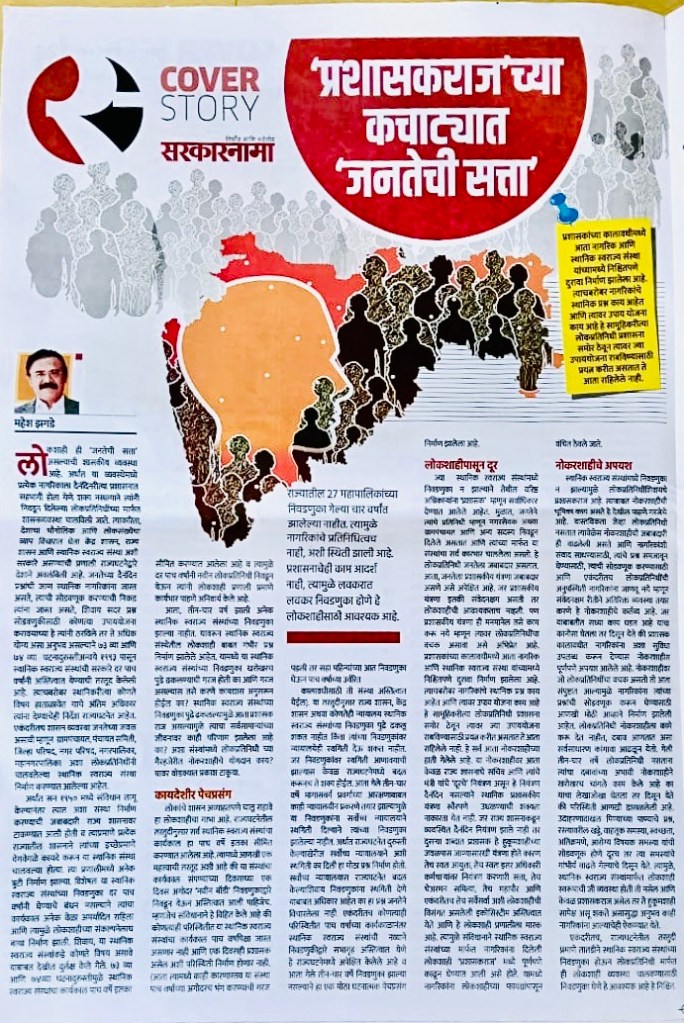
‘प्रशासकराज’ च्या कचाट्यात ‘जनतेची सत्ता’

(सौजन्य: हा लेख सरकारनामा या वृत्तपत्राची COVER STORY म्हणून प्रकाशित झाला होता.)

लोकशाही ही “जनतेची सत्ता” असल्याची शासकीय व्यवस्था आहे. अर्थात या व्यवस्थेमध्ये प्रत्येक नागरिकाला दैनंदिनरीत्या प्रशासनात सहभागी होता येणे शक्य नसल्याने त्यांनी निवडून दिलेल्या लोकप्रतिनिधींच्या मार्फत शासन व्यवस्था चालवली जाते. त्याकरिता, देशाचा भौगोलिक आणि लोकसंख्येचा व्याप विचारात घेता केंद्र शासन, राज्य शासन आणि स्थानिक स्वराज्य संस्था अशी सरकारे असण्याची प्रणाली संविधानाद्वारे देशाने अवलंबिली आहे. जनतेच्या दैनंदिन प्रश्नांची जाण स्थानिक नागरिकांना जास्त असते, त्याची सोडवणूक करण्याची निकड त्यांना जास्त असते, शिवाय सदर प्रश्न सोडवणुकीसाठी कोणत्या उपाययोजना करावयाच्या हे त्यांनी ठरविले तर ते अधिक योग्य असा अनुभव असल्याने ७३ व्या आणि ७४ व्या घटनादुरुस्तीअन्वये १९९३ पासून स्थानिक स्वराज्य संस्थांची सरकारे दर पाच वर्षांनी अस्तित्वात येण्याची तरतूद केलेली आहे. त्याचबरोबर संविधानात त्यांना स्थानिक रित्या कोणते विषय हाताळावेत याचे अंतिम अधिकार देण्याचेही निर्देश आहेत. एकंदरीतच शासन व्यवस्था जनतेच्या जवळ असावी म्हणून ग्रामपंचायत, पंचायत समिती, जिल्हा परिषद, नगर परिषद, नगरपालिका, महानगरपालिका अशा लोकप्रतिनिधींनी चालवलेल्या स्थानिक स्वराज्य संस्था निर्माण करण्यात आलेल्या आहेत.

अर्थात सन १९५० मध्ये संविधान लागू केल्यानंतर त्यात अशा संस्था निर्माण करण्याची जबाबदारी राज्य शासनावर टाकण्यात आली होती व त्याप्रमाणे प्रत्येक राज्यातील शासनाने त्यांच्या इच्छेप्रमाणे वेगवेगळे कायदे करून या स्थानिक संस्था चालवल्या होत्या. त्या प्रणालीमध्ये अनेक त्रुटी निर्माण झाल्या. विशेषतः या स्थानिक स्वराज्य संस्थांच्या निवडणुका दर पाच वर्षांनी घेण्याचे बंधन नसल्याने त्यांचा कार्यकाल अनेक वेळा अमर्यादित राहिला आणि त्यामुळे लोकशाहीच्या संकल्पनेलाच बाधा निर्माण झाली. शिवाय, या स्थानिक स्वराज्य संस्थांकडे कोणते विषय असावे याबाबत देखील दुर्लक्ष केले गेले. ७३ व्या आणि ७४व्या घटनादुरुस्तीमुळे स्थानिक स्वराज्य संस्थांचा कार्यकाल पाच वर्षे इतका सीमित करण्यात आलेला आहे व त्यामुळे दर पाच वर्षांनी नवीन लोकप्रतिनिधी निवडून येऊन त्यांनी लोकशाही प्रणाली प्रमाणे कार्यभार पाहणे अनिवार्य केले आहे.

आता, तीन-चार वर्ष झाली अनेक स्थानिक स्वराज्य संस्थांच्या निवडणुका झाल्या नाहीत. यावरून स्थानिक स्वराज्य संस्थेतील लोकशाही बाबत गंभीर प्रश्न निर्माण झालेले आहेत. यामध्ये या स्थानिक स्वराज्य संस्थांच्या निवडणुका खरोखरच पुढे ढकलण्याची गरज होती का आणि गरज असल्यास तसे करणे कायद्यास अनुसरून होईल का? स्थानिक स्वराज्य संस्थांच्या निवडणुका पुढे ढकलल्यामुळे आता प्रशासक राज असल्यामुळे त्याचा सर्वसामान्यांच्या जीवनावर काही परिणाम झालेला आहे का? अशा संस्थांमध्ये लोकप्रतिनिधी च्या गैरहजेरीत नोकरशाहीचे योगदान काय? यावर थोडक्यात प्रकाश टाकूया.

लोकांचे शासन अव्यहातपणे चालू राहावे हा लोकशाहीचा गाभा आहे. संविधानातील तरतुदीनुसार सर्व स्थानिक स्वराज्य संस्थांचा कार्यकाल हा पाच वर्षे इतका सीमित करण्यात आलेला आहे. त्यामध्ये आणखी एक महत्त्वाची तरतूद अशी आहे की या संस्थांचा कार्यकाल संपण्याच्या दिवसाच्या एक दिवस अगोदर नवीन बॉडी निवडणुकाद्वारे निवडून येऊन अस्तित्वात आली पाहिजेच. म्हणजेच संविधानाने हे विहित केले आहे की कोणत्याही परिस्थितीत या स्थानिक स्वराज्य संस्थांचा कार्यकाल पाच वर्षापेक्षा जास्त असणार नाही आणि एक दिवसही प्रशासक असेल अशी परिस्थिती निर्माण होणार नाही.(आता त्यामध्ये काही कारणास्तव या संस्था पाच वर्षांच्या अगोदरच भंग करण्याची गरज पडली तर सहा महिन्याच्या आत निवडणुका घेऊन पाच वर्षाच्या उर्वरित कालावधीसाठी ती संस्था अस्तित्वात येईल). या तरतुदीनुसार राज्य शासन, केंद्र शासन अथवा कोणतेही न्यायालय स्थानिक स्वराज्य संस्थांच्या निवडणुका पुढे ढकलू शकत नाहीत किंवा त्यांच्या निवडणुकांवर न्यायालयेही स्थगिती देऊ शकत नाहीत. जर निवडणुकावर स्थगिती आणावयाची झाल्यास केवळ संविधानामध्ये बदल करूनच ते शक्य होईल. आता गेले तीन-चार वर्ष मागासवर्ग प्रवर्गाच्या आरक्षणाबाबत काही न्यायालयीन प्रकरणे तयार झाल्यामुळे या निवडणुकांना सर्वोच्च न्यायालयाने स्थगिती दिल्याने त्यांच्या निवडणुका झालेल्या नाहीत. अर्थात संविधानात दुरुस्ती केल्या खेरीज सर्वोच्च न्यायालयाने अशी स्थगिती का दिली हा मोठा प्रश्न निर्माण होतो. सर्वोच्च न्यायालयास संविधानात बदल केल्याशिवाय निवडणुकांना स्थगिती देणे याबाबत अधिकार आहेत का हा प्रश्न जनतेने विचारलेला नाही. एकंदरीतच कोणत्याही परिस्थितीत पाच वर्षाच्या कार्यकाळानंतर स्थानिक स्वराज्य संस्थांची नव्याने निवडणुकाद्वारे बॉडी अस्तित्वात येणे हे संविधानामध्ये अपेक्षित केलेले आहे व आता गेले तीन-चार वर्ष निवडणुका झाल्या नसल्याने हा एक मोठा घटनात्मक पेचप्रसंग निर्माण झालेला आहे.

ज्या स्थानिक स्वराज्य संस्थांमध्ये निवडणुका न झाल्याने तेथील वरिष्ठ अधिकाऱ्यांना “प्रशासक” म्हणून सर्वाधिकार देण्यात आलेले आहेत. मुळात, जनतेने त्यांचे प्रतिनिधी म्हणून नगरसेवक अथवा ग्रामपंचायत आणि अन्य सदस्य निवडून दिलेले असतात आणि त्यांच्या मार्फत या संस्थांचा सर्व कारभार चाललेला असतो. हे लोकप्रतिनिधी जनतेला जबाबदार असतात. आता, जनतेला प्रशासकीय यंत्रणा जबाबदार असणे असे अपेक्षित आहे. जर प्रशासकीय यंत्रणा इतकी संवेदनक्षम असती तर लोकशाहीची आवश्यकताच नव्हती. पण प्रशासकीय यंत्रणा ही मनमानेल तसे काम करू नये म्हणून त्यावर लोकप्रतिनिधींचा वचक असावा असे अभिप्रेत आहे. प्रशासकांच्या कालावधीमध्ये आता नागरिक आणि स्थानिक स्वराज्य संस्था यांच्यामध्ये निश्चितपणे दुरावा निर्माण झालेला आहे. त्याचबरोबर नागरिकांचे स्थानिक प्रश्न काय आहेत आणि त्यावर उपाय योजना काय आहे हे सामूहिकरित्या लोकप्रतिनिधी प्रशासना समोर ठेवून त्यावर ज्या उपाययोजना राबविण्यासाठी प्रयत्न करीत असतात ते आता राहिलेले नाही. हे सर्व आता नोकरशाहीच्या हाती गेलेले आहे. या नोकरशाहीवर आता केवळ राज्य शासनाचे सचिव आणि त्यांचे मंत्री यांचे “दूरचे” नियंत्रण असून हे नियंत्रण दैनंदिन नसल्याने स्थानिक प्रशासकीय यंत्रणा स्वैरपणे  उधळण्याची शक्यता नाकारता येत नाही. जर राज्य शासनाकडून व्यवस्थित दैनंदिन नियंत्रण झाले नाही तर दुसऱ्या शब्दात प्रशासक हे हुकूमशाहीच्या जवळपास जाण्यासारखी यंत्रणा होते कारण तेच स्वतः आयुक्त, तेच स्वतः इतर अधिकारी कर्मचाऱ्यांवर नियंत्रण करणारी सत्ता, तेच चेअरमन समित्या, तेच महापौर आणि एकंदरीतच तेच सर्वेसर्वा अशी लोकशाहीची विसंगत असलेली इकोसिस्टीम अस्तित्वात येते आणि हे लोकशाही प्रणालीला मारक आहे. त्यामुळे संविधानाने स्थानिक स्वराज्य संस्थांच्या मार्फत नागरिकांना दिलेली लोकशाही “प्रशासकराज” मध्ये पूर्णपणे काढून घेण्यात आली असे होते. यामध्ये नागरिकांना लोकशाहीचे फायदे यापासून वंचित ठेवले जाते.

स्थानिक स्वराज्य संस्थांमध्ये निवडणुका न झाल्यामुळे लोकप्रतिनिधीशिवायचे प्रशासकराज आहे. त्याबाबत नोकरशाहीची भूमिका काय असते हे देखील पाहणे गरजेचे आहे. वास्तविकता जेव्हा लोकप्रतिनिधी नसतात त्यावेळेस नोकरशाहीची जबाबदारी ही वाढलेली असते आणि नागरिकांशी संवाद साधण्यासाठी, त्यांचे प्रश्न समजावून घेण्यासाठी, त्याची सोडवणूक करण्यासाठी आणि एकंदरीतच लोकप्रतिनिधींची अनुपस्थिती नागरिकांना जाणू नये म्हणून संवेदनक्षम रीतीने अतिरिक्त व्यवस्था तयार करणे हे नोकरशाहीचे कर्तव्य आहे. जर याबाबतीत सध्या काय घडत आहे याचा कानोसा घेतला तर दिसून येते की प्रशासक कालावधीत नागरिकांना अशा सुविधा उपलब्ध करून देण्यास नोकरशाहीस पूर्णपणे अपयश आलेले आहे. नोकरशाहीवर जो लोकप्रतिनिधींचा वचक असतो तो आता संपुष्टात आल्यामुळे नागरिकांना त्यांच्या प्रश्नांची सोडवणूक करून घेण्यासाठी आणखी मोठी आव्हाने निर्माण झालेली आहेत. लोकप्रतिनिधी नोकरशाहीला कामे करू देत नाहीत, दबाव आणतात असा सर्वसाधारण कांगावा आढळून येतो. गेले तीन-चार वर्ष लोकप्रतिनिधी नसताना त्यांचा दबावांच्या अभावी नोकरशाने खरोखरच चांगले काम केले आहे का ह्याचा लेखाजोखा घेतला तर दिसून येते की परिस्थिती आणखी ढासळलेली आहे. उदाहरणादाखल पिण्याच्या पाण्याचे प्रश्न, रस्त्यावरील खड्डे, वाहतूक समस्या, स्वच्छता, अतिक्रमणे, आरोग्य विषयक समस्या यांची सोडवणूक होणे दुरच तर त्या समस्यांचे गांभीर्य वाढले गेल्याचे दिसून येते. त्यामुळे, स्थानिक स्वराज्य संस्था मार्फत लोकशाही स्वरूपाची जी व्यवस्था होती ती नसेल आणि केवळ प्रशासकराज असेल तर ते हुकूमशाही सापेक्ष असू शकते असा सुद्धा अनुभव काही नागरिकांना आल्याचेही ऐकण्यात येते.

एकंदरीतच, संविधानातील तरतुदी प्रमाणे तातडीने स्थानिक स्वराज्य संस्थांच्या निवडणुका होऊन लोकप्रतिनिधी मार्फत ही लोकशाही व्यवस्था चालवण्यासाठी निवडणुका घेणे हे आवश्यक आहे हे निश्चित.

-महेश झगडे, IAS (नि)

Standard

One Nation, One Election: A Necessity and a Feasibility.

The notion of holding elections to the Lok Sabha and the state assemblies at separate intervals, rather than concurrently, has been a matter of frequent debate within the nation. The idea of “One Nation, One Election,” long discussed in political corridors, recently gained renewed momentum. On the 1st of September, 2023, the Union Minister for Parliamentary Affairs, Shri Pralhad Joshi, announced the formation of a committee under the esteemed chairmanship of former President Shri Ram Nath Kovind. This committee was charged with the task of considering the feasibility of simultaneous elections, and it has been urged to deliver its recommendations expeditiously.

The concept itself is far from novel. Since 2014, the Bharatiya Janata Party and Prime Minister Shri Narendra Modi have consistently championed the cause. Notably, in his 2019 Independence Day address, the Prime Minister remarked that, following the successful implementation of ‘One Nation, One Tax’ in the form of the Goods and Services Tax (GST), the demand for ‘One Nation, One Election’ had gained considerable traction. He reiterated this position in discussions with various political parties after returning to power and underscored the necessity of this electoral reform during a meeting of presiding officers in November 2020, declaring it not merely a subject of debate, but a pressing national need.

Additionally, the Law Commission has engaged with this subject in recent years. Its draft report from August 2018 touched upon the need for unified elections, while an earlier report by the Commission, chaired by Justice B. P. Jeevan Reddy, had raised the matter as early as 1999 in its 170th report. In that report, the Commission noted that such a reform would require careful and deliberate execution. Moreover, the Parliamentary Standing Committee has also voiced its support for this initiative, echoing the broader call for synchronised elections across the country.

History reveals that the idea of simultaneous elections is, in truth, deeply rooted in India’s democratic past. From the inaugural elections after independence until the year 1967, both Lok Sabha and state assembly elections were conducted together, thus making the concept of “One Nation, One Election” a reality for nearly two decades. However, the dissolution of certain state assemblies in 1968 and 1969 necessitated fresh elections at different intervals, effectively disrupting this practice. Since that time, India has held elections in staggered phases, a divergence from its earlier uniformity.

Thus, the discussion today seeks not to introduce an unprecedented idea, but rather to revive a practice that was once integral to the electoral framework of the country. Is the concept of ‘One Nation, One Election’ truly a necessity for the country and its citizens, or is it merely a matter of political or administrative convenience? Such a question naturally arises in the minds of the common populace. The ruling Bharatiya Janata Party has been a steadfast advocate for this notion. In contrast, the principal opposition party, the Indian National Congress, has generally assumed an adversarial stance, arguing that India’s federal structure could be imperiled by such an arrangement. Congress has hinted that the very essence of the federal system may be eroded, a stance that, perhaps, betrays a certain opportunism in their political calculus.

Regional parties, too, have expressed varying degrees of opposition. Some have outright rejected the proposal, while others tread more cautiously. Proponents of the idea cite fiscal prudence, suggesting that the unification of elections would drastically curtail the expenses associated with frequent electoral cycles. Moreover, they argue that such a reform would liberate the administrative machinery from the perpetual state of electoral engagement.

However, the detractors of this idea contend that simultaneous elections might disproportionately shift the electorate’s focus towards national issues, thereby eclipsing the significance of state-level concerns. There is a palpable fear that regional identities may become secondary and that the party with a charismatic national leader would gain undue advantage. At present, the opposition’s contention is that, with the Bharatiya Janata Party boasting a leader of Prime Minister Narendra Modi’s stature, the party would inevitably reap benefits, not only in the Lok Sabha elections but also in the state assembly contests. Thus, it becomes imperative to examine, beyond the veil of politics, whether the concept of ‘One Nation, One Election’ serves the interests of democracy itself and, more crucially, the citizens for whom this system exists.

To gain clarity, one might reflect upon the origins of democracy, which trace back to ancient Greece, nearly two and a half millennia ago. The foundational principle of this system was that governance ought not to reside in the hands of monarchs or a privileged few, nor should it be indifferent to the plight of the citizenry. Instead, the collective will of the people was to guide the administration, embodying the very essence of democracy. In Athens, where the earliest experiments with this form of governance were conducted, the population was modest, allowing for the direct involvement of all citizens in decision-making processes. As populations swelled, however, this direct democracy gave way to representative governance, where citizens elected individuals to act on their behalf.

In the course of time, constitutions were drafted, and laws enacted to regulate this system, but at its core lay the process of election. This electoral mechanism, the very heartbeat of democracy, became the indispensable method through which representatives were chosen. In modern times, elections remain the bedrock of any democratic society, as no other system can so effectively ensure the selection of a government reflective of the people’s will.

In a country as vast and diverse as India, the complexity of holding elections cannot be overstated. At present, the nation is almost perpetually engaged in the electoral process, with direct and indirect elections being held for the President, Lok Sabha, Rajya Sabha, state legislative assemblies, and various local bodies including gram panchayats, municipal corporations, and more. Given this constant engagement, one might say that India is in a permanent state of electoral motion.

Thus, the question of ‘One Nation, One Election’ calls for an in-depth, impartial analysis. While the merits and demerits of this idea are hotly debated, one must ponder whether it strengthens the democratic fabric or risks undermining the very pluralism that defines the Indian state. The process of conducting elections involves an array of intricate tasks: registering voters, annually updating these lists, addressing objections, recording voter migrations, removing the names of deceased voters, classifying the voter lists by booths, and publishing them. Additionally, the issuance of voter identification cards and the maintenance of an enormous database of nearly 950 million eligible voters, within a population of 1.4 billion, requires not only precision but also the capacity to deploy this information efficiently at any given time. Alongside this, the Election Commission must remain vigilant in adhering to the electoral schedule, issuing statutory notifications, and determining and publicizing election timelines. It must implement and enforce the Model Code of Conduct, accept and scrutinize candidate nominations, conduct the elections, oversee the counting of votes, and declare the results. In truth, the governmental machinery is ensnared, or rather ‘entangled,’ in these innumerable responsibilities.

Though there exists an independent Election Commission for national elections and state Election Commissioners for the states, there is no separate administrative apparatus dedicated solely to the election process across the nation. Instead, officers and staff from the revenue, education, and various other departments are deployed to carry out electoral duties. This, naturally, disrupts their routine work and the public services they are meant to deliver, causing a significant adverse impact on daily administration. Furthermore, the cost incurred for these electoral activities is enormous.

This speaks to the administrative entanglement, but the repercussions stretch even further. Due to the constant cycle of elections, the Model Code of Conduct remains perpetually in place, leading to the suspension of various development projects. This halt in progress leaves a lasting, detrimental impression on the public psyche. These are merely the consequences within the governmental sphere, where the election machinery operates in perpetual motion. Yet, within the political arena, the winds of electioneering blow year-round, raising pressing social concerns and casting doubt upon whether democracy has veered towards an unhealthy distortion. Has the democratic spirit succumbed to a distorted reality?

Ideally, democracy is a system of governance that ought to be driven by the collective unity of all citizens. Yet, of late, political parties, their ideologies, the lust for power, and the pursuit of financial and other benefits have become the defining traits of the political landscape. Democracy has evolved beyond the mere concept of ‘people’s representatives.’ It has expanded to encompass the vast structure of ‘political workers,’ with party members, office bearers, booth representatives, and state and national organizers forming a sprawling network. This political apparatus, fueled by incessant elections, remains active round-the-clock, twelve months a year.

So deeply entrenched is this culture of political workers that one may even question whether many of these individuals engage in any other form of livelihood. It is not unreasonable to assume that political parties must spend enormous sums of money to sustain this cadre of workers. In fact, the entire political machinery, through its ever-expanding network of operatives, seems to have morphed into a business enterprise of sorts. The money required to sustain these operations is often derived from donations or electoral bonds, channeled by industrialists and businesspersons. 

Yet, this is no benign transaction. For the funds that political parties receive, ostensibly in the form of donations or bonds, are drawn from the profits of businesses, which, in turn, are generated from the goods and services purchased by the public. It is as clear as daylight that, ultimately, the vast sums of money fueling political activities, which run non-stop throughout the year, come from the pockets of the people themselves! It must be acknowledged that the entire expenditure borne by the government and political parties during elections is ultimately sourced from the pockets of the citizens. According to a survey report conducted by the Center for Media Studies, political parties expended a staggering sum of approximately ₹55,000 crores during the 2019 Lok Sabha elections. If we were to consider an estimate of the overall expenditure for elections to the Lok Sabha, Vidhan Sabha, and local governing bodies, it might well account for between one to two percent of India’s Gross Domestic Product (GDP). This inevitable deployment of political workers ensures that the costs of politics and elections persist across the entire five-year cycle.

Secondly, in a democracy, once the people’s representatives have been elected and have formed a government, they cease to be mere representatives of their political parties. Instead, they ascend to the role of custodians of the central, state, or local self-governance bodies, and are no longer expected to engage in partisan politics. However, the relentless cycle of elections forces these representatives to continue operating as party spokespersons or leaders, constantly engaging in campaign mode. As a result, governance, far from remaining the neutral administration it ought to be, morphs into a perpetual form of political maneuvering—leading not to true democracy, but to what may more accurately be termed as “politicism.”

A third, and equally significant concern, is the absence of an independent administrative apparatus exclusively dedicated to conducting elections. This lack of dedicated machinery means that the government’s resources are perennially diverted to managing electoral processes throughout the year. More dangerously, the imposition of the Model Code of Conduct repeatedly halts developmental projects, adversely affecting the smooth functioning of day-to-day administration, stalling economic progress, and, ultimately, harming democracy itself.

To avoid these detrimental effects, the adoption of the ‘One Country – One Election’ model must eventually be considered, for without it, the damage wrought upon the nation will continue unabated. Admittedly, the concept of ‘One Country – One Election’ may now seem archaic; however, its proper implementation could yield benefits unforeseen by earlier critiques.

In a democratic system, citizens are required to cast their votes on three separate occasions—first, for the Lok Sabha; second, for the Vidhan Sabha; and third, for the local self-governing bodies. If we estimate the electorate to consist of 950 million eligible voters, then this three-tier structure necessitates a total of 2.85 billion votes being cast every five years. The notion of ‘One Country – One Election’ has evolved, especially following the 73rd and 74th Constitutional Amendments of 1993, which integrated local self-government elections with those of the Lok Sabha and Vidhan Sabha. If local body elections are excluded from the ‘One Country – One Election’ framework, the very essence of this proposal will be rendered hollow, and the detrimental ‘politicism’ associated with these local elections will persist unabated. Against this backdrop, the notion of ‘One Country – One Election’ must encompass the simultaneous holding of elections for the Lok Sabha, State Legislative Assemblies, and Local Self-Government institutions. Should the nation resolve to implement this concept, it need not prove overly difficult. However, it would necessitate amendments to the Constitution, the Representation of the People Act, and other relevant legal frameworks. These changes would serve two purposes: the first, to create a temporary arrangement to synchronize the electoral timelines, and the second, to ensure that this arrangement becomes a permanent feature of governance.

As part of the temporary modifications, the term of some Lok Sabha, State Assemblies, or local bodies may need to be extended, while that of others may require curtailment. For the ‘One Country – One Election’ system to be established permanently, the term of all such governing bodies must be fixed at five years without exception. To achieve this, amendments to Article 83 of the Constitution, which governs the duration of the Lok Sabha, and Article 172, pertaining to the duration of State Assemblies, would be necessary. Likewise, the provisions of Articles 243-E and 243-U, which define the five-year term for Local Self-Government bodies, would also require harmonization.

In exceptional circumstances—such as the creation of a new state or local governing body—if midterm elections are required, they must be confined to filling the remaining duration of the term. Thereafter, the elections for all governing bodies would once again occur simultaneously. Additionally, to prevent premature dissolution of the Lok Sabha, State Assemblies, or Local Self-Government bodies, further constitutional amendments would be required to ensure greater stability. For instance, modifications to the Tenth Schedule of the Constitution may be proposed to curb large-scale defections, which could destabilize governments. An amendment might decree that if elected representatives wish to defect, regardless of their number, they would automatically forfeit their seats, thus negating the prospect of governmental collapse.

Moreover, additional constitutional reforms could mandate that, in the event a parliamentary or assembly seat becomes vacant due to death, resignation, or any other cause, the candidate who stood second in the previous election would automatically assume the seat, thereby eliminating the need for by-elections. Naturally, these suggestions are merely representative in nature, and any such reforms would require thorough deliberation and detailed study of the Constitution and corresponding laws.

One thing remains certain, however: the practical implementation of the ‘One Country – One Election’ concept is indeed feasible. For this to come to fruition, it is imperative that there be not only popular demand from the citizenry but also a genuine political will to embrace such a transformation.

If this concept is implemented, it is indeed true that democracy can be fortified! Yet, is the notion of ‘One Nation, One Election’ genuinely a necessity for the nation and its citizens, or is it merely being discussed for political or administrative reasons, or for some other purpose? It is natural for the general populace to question this. The ruling Bharatiya Janata Party, of course, supports this concept. In contrast, the principal opposition party, the Congress, seems to have adopted a generally adversarial stance. The Congress party appears to hold a somewhat dubious position, suggesting that the federal nature of India could be undermined by the ‘One Nation, One Election’ concept. Numerous regional political parties have also opposed this idea to varying degrees, while some are adopting a cautious approach regarding it. Generally, those in favor of ‘One Nation, One Election’ argue that it would reduce election-related expenses, prevent permanent administrative involvement, and so forth. Critics of this concept argue that if both Lok Sabha and state legislative assembly elections were held simultaneously, the focus might shift more towards national issues, overshadowing state-specific concerns. Moreover, parties with charismatic or nationally influential leadership would likely benefit disproportionately. Presently, the Bharatiya Janata Party, with its nationally popular leader, Prime Minister Narendra Modi, is believed to stand to gain from such a shift in election timing. Thus, it is imperative to undertake a politics-free analysis of whether ‘One Nation, One Election’ is truly necessary for democracy and for the citizens who are the essence of this democratic system. Let us, as impartial analysts, cast a discerning eye upon this matter!

Democracy, as a system, originated approximately two and a half thousand years ago in Greece, where the fundamental concept was to ensure that the governance, instead of being concentrated in the hands of a monarch or a few powerful individuals, was carried out in a manner that prevented suffering to the populace, allowing decisions to be made collectively by all citizens. Of course, during the initial experiment of democracy in Athens, the population was small, in the mere thousands, thus making it feasible to consider every citizen’s opinion on each decision (notably, women, slaves, and others were excluded from voting rights). As populations grew and the concept of democracy evolved, involving every citizen in each decision became impractical, leading to the development of a system wherein citizens elected representatives to manage governance on their behalf. This necessitated the establishment of constitutions and laws. The core importance of this system lies in the election of representatives, with the election process becoming the very soul of democracy. At present, there exists no alternative to elections for the establishment of governance in any democracy. Hence, the practice of elections is deeply embedded in democratic processes.

In a vast country like India, the significance of elections is magnified due to its immense scope. Conducting elections in such a vast and populous nation is an enormous challenge. In India, elections are a perennial process, encompassing presidential, Lok Sabha, Rajya Sabha, state legislative assemblies, municipal bodies, and more, with both direct and indirect elections happening throughout the year. In other words, the nation is perpetually in an election mode! The foundational tasks of preparing and maintaining accurate electoral rolls for around 95 crore voters, handling annual updates, addressing grievances, managing voter transfers, removing deceased voters, categorizing voter lists booth-wise, and ensuring the availability of voter identity cards are immense. Additionally, overseeing the scheduling of elections, issuing statutory notifications, setting and announcing election dates, enforcing the Model Code of Conduct, accepting and scrutinizing candidacy applications, conducting actual elections, counting votes, and declaring results involve a myriad of governmental tasks, leading to an administrative entanglement in the electoral process.

Although a separate Election Commission oversees national elections and State Election Commissioners manage those at the state level, there exists no distinct administrative apparatus for elections throughout the country. The duties of revenue, education, and other departmental staff are subsumed by election-related responsibilities. Consequently, their core functions and the services they are meant to provide to the public suffer detrimentally. Such disruptions incur substantial costs. This is merely one aspect of administrative congestion; however, it is equally crucial to note that continuous electoral cycles halt numerous developmental projects due to the Model Code of Conduct, thereby exerting a lasting adverse impact on the public psyche. This is the unintended consequence of the electoral fervor engulfing government circles. 

In the political realm, elections perpetually loom throughout the year, engendering social issues and casting doubt on whether democracy is veering towards distortion. Democracy, fundamentally, is intended to be a system governed by the collective unity of all citizens. Yet, contemporary political parties, with their ideological fervor, power ambitions, and pursuit of financial and other benefits, have turned into enduring elements of the political landscape. The concept of ‘people’s representative’ has now evolved into an extensive network of ‘political workers,’ encompassing a broad array of party members, office bearers, and booth representatives at both state and national levels. This political system operates ceaselessly, year-round, owing to the constant election cycles. The entrenched ‘activist culture’ is so deeply rooted that one might question whether many of these activists engage in any other occupation for sustenance. Political parties, benefiting from the low-cost nature of maintaining their cadres, have contributed to a scenario where politics seems to have transformed into a business driven by activist networks. The costs incurred are ultimately offset by donations from industries, professionals, or election bonds. However, it is misleading to assume that such expenditures are merely funded through donations or bonds, as these contributions stem from profits derived from public services or goods. In essence, the financial resources political parties allocate to politics for twelve months emanate from the pockets of the public.

It must be acknowledged that all expenditures related to elections, whether by the government or political parties, are ultimately borne by citizens. A survey conducted by the Center for Media Studies reveals that political parties expended approximately ₹55,000 crore in the 2019 Lok Sabha elections. Estimating the total expenditure on elections for the Lok Sabha, Vidhan Sabha, and local bodies, it amounts to approximately one to two percent of India’s GDP. The employment of political workers is an inevitable aspect of elections, leading to a continuous cycle of political and election-related expenditures over the entire five-year term.

Furthermore, in a democracy, once elected, representatives should transcend their political party affiliations and govern as leaders of central, state, or local self-government bodies. They are expected to refrain from political campaigning. However, the perpetual election cycle necessitates that these representatives function as political party representatives or leaders, remaining in a constant state of campaigning. This has transformed governance into a ‘politicism’ rather than a true democracy.

Moreover, the absence of an independent administrative mechanism for elections results in perpetual election-related activity, significantly impacting developmental projects and daily administration. This poses a grave threat to the country’s administration, development, economy, and, most importantly, its democratic integrity.

To mitigate these issues, the adoption of the ‘One Nation, One Election’ approach is imperative, lest the country continue to suffer profound and lasting damage. Nonetheless, it must be recognized that the concept of ‘One Nation, One Election’ is now considered outdated, and if implemented in its current form, it may not yield favorable results.

In a democracy, the electorate is called upon to exercise its franchise three times: for the Lok Sabha, the Vidhan Sabha, and the Local Self-Government. With an electorate of 95 crore voters, each voter is thus required to cast their ballot thrice within each five-year term, totaling an impressive 285 crore votes. The notion of ‘One Nation, One Election’ has evolved in accordance with the 73rd and 74th Constitutional Amendments post-1993, encompassing elections for the Lok Sabha, Vidhan Sabha, and local self-government bodies. If local government elections are not included within this framework, the fundamental concept loses its significance, and the issues stemming from ‘politicism’ in local governance will persist.

In this context, for the concept of ‘One Nation, One Election’ to be effective, it must encompass simultaneous elections for the Lok Sabha, Vidhan Sabha, and local self-government bodies. Once a nation commits to this principle, implementation is not overly complex. However, it necessitates amendments to the Constitution, the Representation of the People Act, and related statutes. Such amendments would be required both as temporary measures and for the sustenance of the arrangement. Temporarily, adjustments may involve extending or shortening the tenures of certain Lok Sabha, Vidhan Sabha, or local body representatives. To perpetually enshrine the concept of ‘One Nation, One Election,’ it is imperative to standardize the tenure of these institutions to five years. This necessitates amendments to Article 83 of the Constitution for the Lok Sabha, Article 172 for the Vidhan Sabhas, and provisions under Articles 243-E and 243-U for local self-government bodies. In cases of exceptional circumstances like the creation of new states or local bodies necessitating mid-term elections, representatives would serve only the remaining period of those five years, with subsequent elections aligning with the established schedule.

Constitutional amendments must ensure that the dissolution of the Lok Sabha, Vidhan Sabha, or self-governing bodies does not occur within the five-year term. For instance, the Tenth Schedule of the Constitution should be revised to preclude large-scale party defections and instability. Such an amendment would stipulate that representatives changing parties, regardless of their number, would be deemed automatically disqualified, thereby preventing governmental destabilization and institutional fragmentation. Additionally, another constitutional revision should allow for the automatic succession of the number two candidate in the event of a representative’s death, resignation, or other vacancy, obviating the need for by-elections. These suggestions are preliminary and would necessitate comprehensive examination and revision of constitutional and related laws. It is unequivocally feasible to implement the ‘One Nation, One Election’ concept in practical terms, provided there is sufficient public pressure and political will.

It remains an incontrovertible truth that the implementation of this concept could indeed fortify democracy!

-Mahesh Zagade, IAS(rtd)

Standard

Preserving Political Neutrality in Post-Retirement Appointments of Bureaucrats and Judges: A Democratic Imperative

The strength of any democracy lies in its commitment to maintaining fairness, neutrality, and an unwavering adherence to the rule of law. The framework of governance, as defined by the Constitution of India, envisages a state where executive, legislative, and judicial functions operate independently and without fear or favor. In this context, the role of the bureaucracy and judiciary stands paramount. These institutions form the pillars that hold the democratic structure in place, ensuring that decisions are made based on merit, legality, and the broader public interest, untainted by partisan influence. However, the practice of appointing retired senior officials and judges to various statutory bodies, tribunals, commissions, and gubernatorial positions under the Constitution raises questions about the potential erosion of this neutrality.

It is a well-established practice in India to appoint retired bureaucrats, judges, and senior officials to positions of responsibility in various constitutional or statutory bodies. Such appointments serve the dual purpose of tapping into the wealth of experience and wisdom accumulated by these individuals over their careers and providing continued service to the nation after they leave office. These individuals, having dedicated decades to the intricacies of governance and justice, are seen as invaluable assets, whose knowledge can be utilized for the larger public good. The rationale behind these appointments is rooted in the belief that their experience and mature judgment will contribute significantly to the functioning of critical state machinery.

However, in recent years, concerns have emerged about the implications of these post-retirement appointments, particularly in the context of political neutrality. The independence of the bureaucracy and judiciary is fundamental to the success of democracy, and any perception of these institutions being compromised can erode public confidence in their functioning. On this background, let us explore the potential challenges posed by the current system of post-retirement appointments and propose a reform that could ensure greater neutrality and integrity within these systems.

1.The Role of the Bureaucracy and Judiciary in a Democracy

At the heart of any democratic system lies the bureaucracy, which is tasked with implementing the policies and decisions of the elected government. The judiciary, on the other hand, serves as the interpreter of the Constitution and the guardian of legal rights and justice. Both institutions are designed to function independently, without being influenced by the political machinations of the ruling party or opposition. They are tasked with upholding the law, safeguarding public interest, and ensuring that decisions are made in an unbiased and legally sound manner.

Given the immense responsibility they shoulder, it is essential that bureaucrats and judges maintain neutrality during their service and after their retirement. Their decisions, whether related to governance or justice, should reflect the rule of law rather than the will of a particular political party. In India, where political competition is fierce and parties often vie for power using every available means, the neutrality of the bureaucratic and judicial apparatus becomes even more critical.

2.The Post-Retirement Appointment System

Post-retirement appointments, as they currently exist, are aimed at ensuring continuity in governance by tapping into the expertise of those who have held high positions in the administration or judiciary. This practice has long been justified as a way of utilizing the knowledge base and experience of individuals who have a deep understanding of the system, policies, and functioning of government institutions.

Positions such as chairmanships, memberships in statutory tribunals, leadership of commissions, governorships, and other constitutionally created bodies often go to retired bureaucrats or judges. These appointments offer the government access to individuals with substantial experience in governance, policy-making, and the interpretation of law. In many cases, these individuals are also seen as providing a stabilizing influence in these roles, given their mature outlook and years of service in senior capacities.

3.Challenges to Political Neutrality

Despite the benefits of retaining experienced officials in key roles, there is growing concern that the system of post-retirement appointments is increasingly being influenced by political considerations. As political parties intensify their efforts to maintain supremacy, there is a risk that retired officials may feel pressured to align themselves with the government in power. In this context, it is worth reflecting on the dangers posed by the potential for bureaucrats and judges to be swayed by political affiliations during their service, knowing that lucrative post-retirement appointments could await those who demonstrate loyalty to the ruling party.

One of the most significant concerns is the impact this practice may have on decision-making during an official’s career. If a bureaucrat or judge anticipates that their future post-retirement assignment could be contingent on their proximity to political leaders, they may be inclined to make decisions that favor the ruling party, even if these decisions are not entirely in accordance with the Constitution or the law. This erosion of neutrality not only undermines the principle of unbiased governance but also distorts the decision-making process, with detrimental consequences for public trust in institutions.

Moreover, the perception that appointments are made based on political loyalty rather than merit can severely damage the credibility of these institutions. When the public observes that officials close to political leaderships are more likely to be appointed to post-retirement roles, it undermines faith in the fairness and impartiality of these appointments. This, in turn, can dent the credibility of democratic governance as a whole, as citizens begin to question whether decisions made by these officials serve the public interest or the interests of the ruling party.

4.The Role of Political Parties

Political parties, especially those in power, wield considerable influence over these appointments. The close proximity of political leaders to senior bureaucrats and judges often leads to a blurring of the lines between administrative independence and political affiliation. The politicization of appointments is not a new phenomenon; however, in recent years, it appears to have intensified.

This issue is compounded by the fact that political parties today operate in an environment of fierce competition, where no effort is spared in the pursuit of electoral victory. In this “no-holds-barred” environment, where parties vie for dominance, the administrative machinery can become a tool in the hands of the political class. The risk is that officials may be co-opted into this power struggle, compromising their neutrality for the sake of securing a future post-retirement appointment.

While political loyalty should never be the determining factor for appointments, there are instances where officials close to the political leadership are favored for post-retirement positions. This practice, barring rare exceptions, reflects poorly on the robustness of India’s democratic ecosystem, which relies heavily on the impartiality of its institutions.

5.A Need for Reform

In light of the challenges highlighted above, it is evident that the system of post-retirement appointments requires reform. While the expertise of retired officials and judges is invaluable, it is imperative that a mechanism be put in place to ensure that these appointments are made in a politically neutral manner.

One possible solution is to discontinue the current practice of appointing retired officials to such positions. Instead, a healthier practice could be instituted by appointing these individuals during their final years of service, thereby ensuring that their decisions are not influenced by the prospect of post-retirement appointments. This approach would involve creating a system whereby officials can express interest in such roles at an appropriate stage in their careers, perhaps around the age of 55. Once selected, they would exit their regular service and assume the post-retirement role immediately.

Such a system would provide several benefits. First, it would ensure that officials are not influenced by political considerations during their service, as they would already have secured their post-retirement assignment. This would safeguard their neutrality and protect the integrity of the decision-making process. Second, it would allow the government to continue benefiting from the experience and wisdom of these officials, while also preserving the independence of the administrative and judicial apparatus.

Additionally, to facilitate this system, the government could consider increasing the cadre strength for such positions, akin to the Central Deputation reserves. This would ensure that a select percentage of posts are reserved for such appointments, allowing for a smooth transition of officials from active service to post-retirement roles.

 6.Ensuring Neutrality in a Polarized Environment

In today’s politically charged environment, where parties are locked in an intense struggle for supremacy, ensuring the neutrality of the administrative and judicial apparatus is more important than ever. The bureaucratic and judicial systems must be seen as impartial arbiters of the public interest, not as tools of the ruling party. By reforming the system of post-retirement appointments, we can safeguard the independence of these institutions and reinforce the foundations of India’s democracy.

Ultimately, the strength of a democracy lies in the trust its citizens place in its institutions. When officials are seen to act in a neutral and impartial manner, public confidence in the system grows. However, when appointments are made based on political proximity, this trust is eroded, and the entire democratic framework is put at risk. Therefore, it is imperative that reforms be implemented to preserve the sanctity of these appointments and ensure that the bureaucratic and judicial systems remain free from political interference.

In a nutshell, the practice of appointing retired officials from the All India Services, senior State Services, and the judiciary to key post-retirement roles is one that has served India well in many respects. These individuals bring a wealth of knowledge, experience, and wisdom to their roles, and their contributions are invaluable. However, the increasing politicization of these appointments poses a serious threat to the neutrality of India’s democratic institutions. By implementing reforms that allow for the appointment of officials during their final years of service, we can ensure that their decisions remain free from political influence, thereby preserving the integrity of the administrative and judicial apparatus.

The government must act swiftly and decisively to address this issue, for the future of India’s democracy depends on the neutrality and impartiality of its institutions. By reforming the system of post-retirement appointments, we can ensure that these institutions continue to serve the public interest and uphold the rule of law, free from political interference.

-Mahesh Zagade, IAS(rtd)

Standard

हा खेळ “लाल दिव्यांचा”!

अलीकडेच एका भारतीय प्रशासकीय सेवेतील (आयएएस) प्रशिक्षणार्थीने पुणे जिल्ह्यात प्रशिशिक्षण कालावधीदरम्यान स्वतःच्या खाजगी गाडीवर बिकन लाईट म्हणजेचे तांबडा-निळा-पांढरा दिवा आणि “महाराष्ट्र शासन” असे नमुद करुन ती गाडी वापरली अशी वृत्ते प्रसिद्ध झाली आणि त्याची चर्चा प्रसारमाध्यमांमध्ये देशभर झाली. अर्थात असा दिवा लावण्याबाबत आक्षेप असावा का आणि त्याबाबत नेमके नियम काय आहेत याची चर्चा सर्वसामान्यामध्ये होणे साहजिक आहे.

वाहनावर दिवे लावण्याबाबत केंद्रीय मोटर वाहन नियम १९८९ मध्ये स्पष्ट तरतुदी आहेत.या तरतुदींचे पालन केले नाही तर त्याविरुद्ध कारवाई होऊ शकते. आपल्याला आठवत असेल की या देशात रस्त्यावर लाल, अंबर रंगाचे दिवे लावलेल्या शासकीय गाड्या आणि अनेक वेळेस बेकायदेशीरपणे खाजगी गाड्या आणि कर्कश्यपणे वाजणारे सायरन मोठ्या प्रमाणात दिसून येत असत. त्याला “व्हीआयपी कल्चर” असे संबोधले जायचे. म्हणजेच रस्ता वापराबाबत समाजाची सर्वसामान्य जनता आणि व्हीआयपी लोक अशा दोन वर्गात विभागणी झालेली ती संस्कृती होती.

मी २०१५ मध्ये परिवहन आयुक्त म्हणून रुजू झाल्यानंतर या “व्हीआयपी संस्कृती”च्या विकृतीची प्रचिती आली. अनेक अधिकारी आणि खाजगी व्यक्ती असे नियमबाह्यपणे “दिवे” लावून फिरत होते. मी त्यावर नियमांचा चाप ओढल्यावर प्रक्षोभ निर्माण झाला. मला वरिष्ठ असलेल्या एका अधिकाऱ्याने त्यांचा दिवा बेकायदेशीर होता म्हणून काढण्यास माझ्या अधिकाऱ्याने सांगितल्यावर मला फोन करुन ते अड्वातड्वा बोलून(खरे म्हणजे बोली भाषेत “झापून”) तगडी समज दिली की “तुम यह जो कर रहे हो, इसके consequencesअच्छे नहीं होनेवाले”. अर्थात अशी वाक्ये प्रशासनात माझ्यासाठी केंव्हाच बोथट झालेली होती. पण मी नियमांची अंमलबजावणी करण्याच्या कारवाया चालू ठेवल्या आणि अनेक रोष ओढवून घेतले. असाच रोष मी नाशिक जिल्हाधिकारी असतांना एका साधूला २००३ चा कुंभमेळ्यात दिवा वापरू न दिल्याने ओढवून घेतलेला होता. पण त्यावेळेस तत्कालीन नाशिक महापौरांनी त्या साधूची समजूत काढून जिल्हाधिकारी असे दिवे लावूच देणार नाहीत हे स्पष्ट केल्याने चिघळत चाललेले प्रकरण निवळले गेले.

एकंदरीतच कायदा व सुव्यवस्था, संरक्षण विषयक तातडी, अग्निशमन अशा वेळेस रस्त्यावर प्राथम्यक्रम मिळवा यापेक्षा वैयक्तिक बडेजावासाठी या दिव्यांचा वापर ही संस्कृती देशात रुजली होती. काही राज्यात तर बाहुबली सुद्धा त्याचा सर्रास वापर करीत होते आणि त्याविरुद्ध कारवाई करण्यास पोलिसांची हतबलता दिसून येत होती.

यावर २०१३ मध्ये सर्वोच्च न्यालयाने एका निर्णयान्वये शासनाला या “दिव्याच्या” संस्कृतीचा गैरवापर होवू नये याप्रमाणे नियम करून त्याची अंमलबजावणी करावी असे निर्देश केंद्र शासनाला दिले होते.

केंद्र शासनाने दिनांक १९ एप्रिल २०१७ रोजीच्या मंत्रीमंडळाच्या बैठकीत निर्णय घेऊन या देशातील व्हीआयपी संस्कृती मोडीत काढण्याचा निर्णय घेतला आणि त्याबाबतची अधिसूचना १ मे २०१७ रोजी जारी करण्यात आली. केंद्रीय मोटर वाहन नियम १९८९ अंतर्गत निर्गमित केलेल्या या अधिसूचनेनुसार नियमात बदल करून त्या दिवसापासून मा राष्ट्रपती,मा पंतप्रधान सहित इतर कोणत्याही लोकप्रतिनिधी किंवा शासकीय अधिकाऱ्यास किंवा अन्य कोणाशी गाडीवर दिवा लावण्यावर बंदी घालण्यात आलेली आहे.

नियमानुसार फक्त पोलीस, संरक्षण विभाग, पॅरा मिलिटरी फोर्सेस यांना कायदा व सुव्यवस्था राखण्या साठी ज्या गाड्यांची आवश्यकता असते त्या गाड्या, तसेच नैसर्गिक आपत्ती वाहने आणि अग्निशमन बंबानाच परवानगी ठेवण्यात आलेली आहे. अर्थात ही परवानगी सुद्धा केवळ या गाड्या प्रत्यक्ष नेमून दिलेल्या कामाच्या वेळेसच तांबडा -निळा-पांढरा अशा पद्धतीचे दिवे लावू शकतील, अन्य वेळेस त्यांनाही दिवे चालू ठेवण्यापासून बंदी घालण्यात आलेली आहे. हे गाड्यावर दिवे लावणे बाबतचे नियम अत्यंत प्रखर असून संबंधित राज्याच्या परिवहन विभागाने त्या राज्यात कोणत्या प्राधिकाऱ्यास अथवा गाड्यांना परवानगी देण्यात आली आहे त्याची यादी दरवर्षी जाहीर करणेबंधनकारक केले आहे. शिवाय, ज्या प्राधिकार्‍यास ही परवानगी दिली आहे त्यांचे पदनाम आणि हा नंबर एका स्टिकर द्वारे वाहनाच्या समोर लावणे बंधनकारक आहे. सदर स्टिकर हे कोणीही डुप्लिकेट तयार करू नये यासाठी त्यावर प्रिंटेड वॉटर मार्क आणि होलोग्राम असण्याची तरतूद आहे.

सध्या असे दिवे कोणीही लावले असतील तर ते बेकायदेशीर असून त्यावर कारवाई केली जाणे अभिप्रेत आहे. या नियमान्वये, व्हीआयपी संस्कृतीचा कोणीही दुरुपयोग करू नये यासाठी परिवहन विभाग म्हणजेच आरटीओ आणि पोलीस यांनी दक्ष राहणे गरजेचे आहे. अलीकडे झाले काय आहे की आरटीओ कोणत्यातरी “अत्यंत प्रचंड” मोठ्या कामात “गुंतलेले” असल्याने केंद्र शासनाच्या या नियमांची पायमल्ली झाली तरी त्याच्याकडे लक्ष न देण्याइतपत ते निर्ढावलेले आहेत. त्यामुळे असे बेकायदेशीर दिवे लावण्याचे प्रकार दिसून येतात. ही व्हीआयपी संस्कृती मोडीत काढण्याचा निर्णय घेतल्यावर मा पंतप्रधानांनी त्यावेळेस ट्विट करुन “every Indian is special. Every Indian is a VIP” असे नमूद करुन या विषयाची जी गंभीरता आणि महत्व नमूद केले होते, त्याचे पालन अधिकाऱ्यांकडून होणे आवश्यक आहे.

Standard

Bridging the Chasm: A Call for Educational Empowerment in Tribal India

In the hallowed halls of Yashwantrao Chavan Maharashtra Open University (YCMOU), Nashik, on January 25, 2024, an audience of around 200 young minds gathered under the aegis of the 15th “Youth Exchange Program,” an initiative orchestrated by the Union Home Ministry and facilitated by Nehru Yuva Kendra. Hailing from the hinterlands, where the echoes of Naxalism reverberate, these youths, representing regions like Jharkhand, Odisha, Andhra Pradesh, and Telangana, became the canvas upon which a profound dialogue unfolded – a discourse that traversed the realms of economic emancipation, education, and the pursuit of a better future.

Standing at the lectern, I found myself at the nexus of opportunity and responsibility, entrusted with the task of illuminating pathways to economic empowerment for these young souls. The canvas before me was painted with tales of resilience, starkly contrasting the narrative of development that had brushed past them for the last seven decades. This was not merely a lecture but a shared journey towards understanding the aspirations and challenges of those who reside in the shadows of progress.

The glow of satisfaction on their faces, a response to the revelation of local business opportunities and prospects in government jobs reserved for tribals, was palpable. In that moment, it dawned on me – information, when disseminated to those who thirst for it, becomes a beacon of hope. It was more than a discourse on economics; it was a conversation about bridging the chasm between opportunity and deprivation.

As the conversation unfolded, the reality of their backgrounds began to unravel – a tapestry woven with threads of neglect and disparity. The Naxalite movement, a specter haunting their daily lives, became more than a political phenomenon; it morphed into a manifestation of societal neglect and frustration. Some admitted to witnessing commonplace items, a spoon or a large chapati, for the first time – a testament to the chasm that separates their reality from the more affluent pockets of the nation.

Their voices carried the weight of a history that had marginalized them for decades. It was a narrative of deprivation, where the absence of schools, irregular teacher attendance, inadequate teaching, and the ensuing educational vacuum acted as insurmountable barriers. In their plea for an improved education system, a common refrain echoed – the government’s role in shaping their destinies lay in the hands of a well-functioning education system.

Their aspirations were modest, grounded in the simple desire for awareness about the world and its opportunities. Their yearning was not for opulence but for a chance – a chance to uplift their lives and contribute meaningfully to a society that had long overlooked them. Their authenticity shone through, untainted by the complexities often found in more developed spheres.

The desire for mainstream integration was a consistent theme. They sought inclusion in the narrative of progress, a narrative that seemed elusive in their current circumstances. The lack of opportunities cast a shadow over their aspirations, creating an environment ripe for movements like Naxalism to take root. Their plea to the government was unequivocal – provide a robust education system and accessible information sources, and these tribal communities could chart their course toward self-reliance, distancing themselves from the clutches of extremism.

Despite the significant budgetary allocations for tribal welfare by both state and central governments, the participants expressed dissatisfaction. The allocations for education, health, and information were deemed insufficient, prompting a call for introspection from the government and administration. They believed that a judicious allocation of resources could catalyze self-upliftment, bringing about a seismic shift in their lives.

The emotional crescendo of the event came as a participant, moved by the discussions, embraced me tightly, tears streaming down his face. In halting Hindi, he conveyed gratitude for the truths unveiled during the session, highlighting the profound impact it had on him. In that moment, the emotional current that flowed between us transcended language – it was a testament to the power of dialogue, understanding, and shared aspirations.

This experience beckons a reflection on the constitutional mandate to eliminate economic disparity and foster the development of all sections of society. The principles enshrined in the constitution are not mere rhetoric; they are a blueprint for an inclusive and equitable society. It is imperative that these principles be meticulously implemented, ensuring that government policies genuinely uplift and empower the marginalized, such as these tribal communities yearning for a better future.

In conclusion, the symphony of voices from YCMOU on that fateful day in January reverberates as a call to action. The echoes of their aspirations and the challenges they face demand our attention. As custodians of progress, we are duty-bound to bridge the chasm that separates opportunity from deprivation. The path forward lies in a robust education system, equitable resource allocation, and a collective commitment to empower those who have long been relegated to the shadows. Only then can we truly claim to be architects of a nation where every citizen has an equal chance to contribute to the symphony of progress.

Standard

The Enduring Legacy of Savitribai: A Call for Authentic Progress in Maharashtra

In the annals of Indian history, the name Savitribai stands as a beacon of unwavering fortitude and dedication in the pursuit of women’s liberation. A venerable ascetic, she fearlessly confronted the oppressive shackles of Manusmriti, championing the cause of women and paving the way for a more equitable society. As we bow in reverence to this illustrious figure, it is incumbent upon us to reflect upon the current state of affairs in Maharashtra, a land that once bore witness to Savitribai’s transformative endeavors.

Maharshtra and the country are blessed with Savitribai’s indomitable spirit and unyielding commitment to the empowerment of women. Her legacy, etched in the annals of time, remains a source of inspiration for generations to come.

Yet, amidst the semblance of progress that Maharashtra ostensibly presents, one cannot help but harbor reservations regarding the authenticity of its progressive narrative. The recent instances of distinguished women IAS officers like Chitkala Zutsi, Chandra Iyengar, Medha Gadgil, Vandana Krishna, and, now, Sujata Saunik being unjustly denied the esteemed position of Chief Secretary solely on the basis of their gender cast a shadow over the purported egalitarian ethos of the state.

From the echelons of the Indian Administrative Service (IAS) to the disheartening realities of female foeticide and the dwindling birth rate of girls, it becomes imperative to question whether Maharashtra truly upholds the principles of progress it outwardly professes. The denial of leadership roles to these accomplished women echoes a disconcerting sentiment – a stark reminder that entrenched gender biases continue to persist, obstructing the path to genuine societal advancement.

If such circumstances persist unabated, Maharashtra risks being ensnared in a façade of progress, where rhetoric outweighs substance. The essence of progress lies not merely in superficial claims but in the tangible strides made towards fostering an inclusive and egalitarian society. The denial of leadership roles to deserving women not only perpetuates gender inequality but also impedes the holistic development of the state.

In this contemporary era, the timeless spirit of Savitrimata remains indispensable, serving as a clarion call for renewed dedication and vigilance in the ongoing battle for women’s rights. Savitribai’s legacy implores us to scrutinize our actions, challenging us to confront the incongruities between professed ideals and actual practices. Her teachings echo through the corridors of time, reminding us that progress is not a static destination but an arduous journey that requires constant introspection and collective effort.

As we navigate the complex tapestry of societal evolution, let us not forget the lessons imparted by Savitribai – a fervent advocate for change, a symbol of resilience, and a guiding light in the pursuit of a truly progressive Maharashtra. May her legacy inspire a paradigm shift, steering the state towards an authentic and inclusive path of progress.

Standard

Mr Kissinger, no more.

The Nixon-Kissinger Era: Demolishing Bretton-Woods and Establishing Global Economic Hegemony

On August 15, 1971, the global economic landscape witnessed a seismic shift that reverberated far beyond the borders of the United States. It was on this fateful day that President Richard Nixon, backed by his astute NSA, Henry Kissinger, made a historic decision to sever the link between the U.S. dollar and gold. This move marked the effective end of the Bretton-Woods system, fundamentally altering the dynamics of international finance and solidifying the United States’ hegemonic grip on the world economy. Let’s delve into the events leading up to this pivotal moment, the repercussions it had on global economic institutions, and the enduring legacy of the Nixon-Kissinger economic paradigm.

The Bretton-Woods System:

Before exploring the events of August 15, 1971, it is crucial to understand the backdrop against which this decision unfolded. The Bretton-Woods system, established in 1944, was a post-World War II monetary arrangement designed to foster international economic stability. Under this system, countries fixed their exchange rates to the U.S. dollar, and the U.S. dollar, in turn, was pegged to gold. This intricate web of economic relationships was aimed at preventing the competitive devaluations that had exacerbated the Great Depression and promoting global economic cooperation.

The Nixon Shock:

As the 1960s progressed, the U.S. faced economic challenges, including rising inflation and a growing trade deficit. President Nixon, in consultation with Kissinger, sought a solution to these problems and devised a strategy to protect U.S. economic interests. On August 15, 1971, in a televised address to the nation, Nixon announced a series of measures that would come to be known as the “Nixon Shock.” The most consequential of these measures was the suspension of the convertibility of the U.S. dollar into gold, effectively dismantling the gold standard that underpinned the Bretton-Woods system.

Motivations Behind the Decision:

Several factors compelled Nixon and Kissinger to take such a drastic step. The escalating costs of the Vietnam War strained the U.S. economy, leading to an unfavorable balance of payments. Additionally, the United States faced increasing pressure to fulfill its international obligations as the demand for gold exceeded its reserves. By severing the link between the U.S. dollar and gold, Nixon aimed to gain greater control over domestic economic policies, allowing for increased flexibility in managing inflation and unemployment.

Global Repercussions:

The Nixon Shock sent shockwaves across the global economic landscape, prompting a reevaluation of established norms and institutions. With the U.S. dollar no longer tied to a tangible asset, currencies were left to float against each other, ushering in an era of exchange rate volatility. The abrupt transition from the Bretton-Woods system to a system of floating exchange rates had profound implications for international trade, finance, and monetary policy.

The Emergence of Petrodollars:

One unintended consequence of the Nixon Shock was the emergence of petrodollars. In the early 1970s, the United States negotiated agreements with oil-producing nations, particularly in the Middle East, to price oil exclusively in U.S. dollars. This move cemented the dollar’s status as the world’s primary reserve currency, as countries now needed large reserves of dollars to engage in international trade, especially for essential commodities like oil. The petrodollar system bolstered the demand for U.S. dollars, further reinforcing the economic hegemony initiated by Nixon and Kissinger.

Impact on International Monetary Institutions:

The demise of the Bretton-Woods system had a profound impact on international monetary institutions, most notably the International Monetary Fund (IMF) and the World Bank. With the fixed exchange rate system abandoned, the IMF’s role in stabilizing currencies became less prominent. Instead, the focus shifted towards managing balance of payments crises and providing short-term financial assistance to member countries.

The World Bank, on the other hand, faced challenges as the new economic landscape necessitated a reevaluation of its development-oriented policies. The Nixon Shock marked the beginning of a shift from the idealistic goals of global economic cooperation and development that characterized the post-war era to a more pragmatic, interest-driven approach.

Consolidating Economic Hegemony:

While the immediate aftermath of the Nixon Shock was marked by uncertainty and turbulence, the U.S. gradually solidified its economic hegemony. The petrodollar system, coupled with the sheer size and influence of the U.S. economy, reinforced the dollar’s dominance in international trade and finance. The United States, in essence, became the issuer of the world’s primary reserve currency, affording it unparalleled economic and geopolitical leverage.

Legacy of the Nixon-Kissinger Economic Paradigm:

The Nixon-Kissinger economic paradigm left an enduring legacy that continues to shape global economic dynamics. The move away from the gold standard paved the way for financial innovation and the growth of complex financial instruments. It also laid the groundwork for the rise of globalization, as the flexibility afforded by floating exchange rates facilitated international trade and capital flows.

However, this legacy is not without its critics. The concentration of economic power in the hands of the United States has been a source of contention, with concerns raised about the potential for abuse and the lack of a truly multilateral economic order. Additionally, the volatility introduced by floating exchange rates has at times led to currency crises, exposing the vulnerabilities of the global financial system.

In a nutshell, the events of August 15, 1971, marked a watershed moment in the history of international finance. The Nixon-Kissinger decision to abandon the Bretton-Woods system and detach the U.S. dollar from gold reshaped the global economic order, establishing the United States as the undisputed economic hegemon. The unintended consequences of the Nixon Shock, such as the emergence of petrodollars and the shift in the role of international monetary institutions, continue to influence the trajectory of the world economy.

As we reflect on this pivotal moment, it is essential to recognize the complex interplay of economic, geopolitical, and domestic factors that led to the unraveling of the Bretton-Woods system. The Nixon-Kissinger era serves as a reminder of the interconnectedness of nations in the realm of global finance and the enduring impact that strategic economic decisions can have on the world stage.

The last of the duo of the Nixon-Kissinger phenomenon,breathed his last today.

Standard

The Peril of a Market Society Built on Lies.

In today’s fast-paced world, societies are becoming more and more transactional, with the market driving many aspects of our daily lives. But what happens when this market mentality seeps into the very fabric of society, and lies become the new currency? We end up with a society that is sick and dysfunctional.

A society that values profit above all else creates a breeding ground for deception, where lies are masqueraded as truth, and the unscrupulous are rewarded. When deceit becomes the norm, the very foundations of trust and morality are eroded, leading to a dangerous and unstable environment where individuals are pitted against each other, and social cohesion is lost.

We see the devastating effects of such a society all around us. In politics, lies and propaganda are used to sway public opinion, and elected officials use falsehoods to gain power and maintain control. In business, companies cut corners, misrepresent products, and deceive consumers, all in the pursuit of profit. And in the media, misinformation spreads like wildfire, often going unchecked and unchallenged.

The consequences of a society built on lies are dire. Trust is eroded, divisions are deepened, and social inequality is exacerbated. In such a society, it is the vulnerable who suffer the most, as they are the ones who are most likely to be exploited and manipulated.

To combat this sickness, we need to rethink our priorities and shift away from a market-driven mentality that rewards deceit and unethical behavior. We must work towards a society that values honesty, integrity, and the common good. This means creating systems of accountability and transparency that hold individuals and institutions responsible for their actions. It also means promoting critical thinking and media literacy, so that individuals can better discern truth from falsehood.

The road ahead will not be easy, but the alternative is far worse. We must take a stand against a society built on lies and work towards a more just and equitable world. Only then can we truly say that we have created a society that is healthy and thriving.

Standard

भारत लोकशाहीची जननी आहे का?

भारताला जगातील सर्वात मोठी लोकशाही म्हणून ओळखले जाते आणि लोकशाही पद्धतींचा मोठा आणि समृद्ध इतिहास आहे. भारताचा लोकशाही प्रवास 1947 मध्ये सुरू झाला जेव्हा देशाला ब्रिटीश औपनिवेशिक( Colonial)राजवटीपासून स्वातंत्र्य मिळाले. 26 जानेवारी 1950 रोजी लागू झालेल्या भारतीय संविधानाने निवडून आलेले सरकार, स्वतंत्र न्यायव्यवस्था आणि सर्व नागरिकांना हमी दिलेले मूलभूत अधिकार असलेली लोकशाही शासन व्यवस्था स्थापन केली.

भारताच्या लोकशाहीने भ्रष्टाचार, सांप्रदायिकता आणि प्रादेशिकता यासह अनेक आव्हानांचा सामना केला आहे, परंतु ती भक्कम राहिली आहे आणि ती सतत विकसित होत आहे. भारतात 1951 पासून नियमित आणि शांततापूर्ण निवडणुका झाल्या आहेत, ज्यामध्ये देशभरातील लाखो नागरिकांचा सहभाग आहे.

भारताची लोकशाही ओळख मजबूत असली तरी भारताला “लोकशाहीची जननी” म्हणणे योग्य ठरणार नाही. संपूर्ण इतिहासात लोकशाहीची संकल्पना विविध स्वरूपात अस्तित्वात आहे आणि भारताच्या लोकशाही प्रणालीवर युनायटेड स्टेट्स, युनायटेड किंगडम आणि स्वित्झर्लंड सारख्या इतर लोकशाहींचा प्रभाव आहे. तथापि, भारताच्या अनोख्या इतिहासाने, संस्कृतीने आणि राजकीय वातावरणाने त्याच्या लोकशाही प्रणालीला आकार दिला आहे आणि लोकशाहीचे एक वेगळे मॉडेल बनवले आहे ज्याने जगभरातील इतर देशांना प्रेरणा दिली आहे.

(प्राचीन ग्रीक लोकांना “लोकशाहीचे जनक” म्हणून श्रेय दिले जाते, कारण ते 500 ईसापूर्व अथेन्स शहर-राज्यात लोकशाही शासन प्रणाली विकसित करणारे पहिले होते. “लोकशाही” हा शब्द ग्रीक शब्द “डेमो” वरून आला आहे, ज्याचा अर्थ “लोक” आणि “क्राटोस,” म्हणजे “शासन” किंवा “सत्ता” असा होतो.

तेव्हापासून, अनेक देशांनी लोकशाही शासन पद्धती स्वीकारल्या आहेत, प्रत्येकाचा स्वतःचा अनोखा इतिहास आणि राजकीय संस्कृती. तथापि, कोणत्याही एका देशाला “लोकशाहीची जननी” म्हणणे योग्य ठरणार नाही कारण लोकशाहीची संकल्पना विकसित झाली आहे आणि कालांतराने विविध संस्कृती आणि ऐतिहासिक घटनांनी प्रभावित झाली आहे.)

Standard