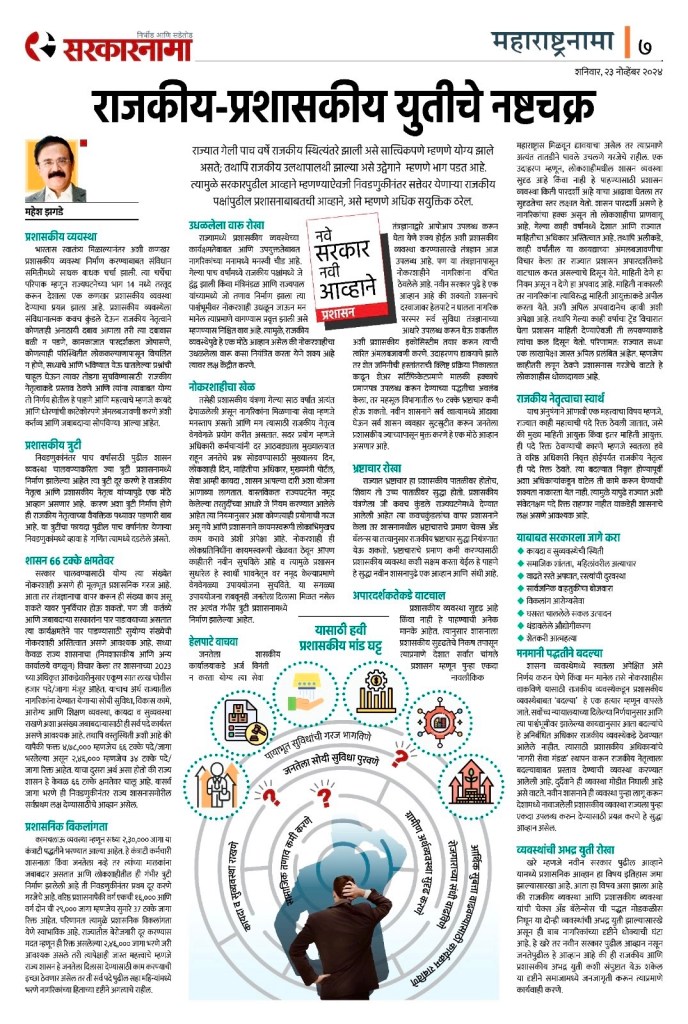
नवीन सरकारा पुढील आव्हाने:प्रशासन

( हा लेख संक्षिप्त स्वरुपात सरकारनामा मध्ये दि २३/११/२०२४ रोजी प्रकाशित झाला.)

राज्यात गेली पाच वर्षे राजकीय स्थित्यंतरे झाली असे सात्विकपणे म्हणणे योग्य झाले असते; तथापि राजकीय उलथा पालथी झाल्या असे उद्वेगाने म्हणणे भाग पडत आहे. आपण 26 जानेवारी 1950 ला प्रजासत्ताक अर्थात लोकशाही शासन व्यवस्थेचा अंगीकार केला, म्हणजेच लोकांची सत्ता असलेली व्यवस्था लागू केली. या लोकांच्या सत्तेचे रूपांतर राजकीय सत्तेत केव्हा झाले ते कळले सुद्धा नाही. त्यामुळे सरकार पुढील आव्हाने म्हणण्याऐवजी निवडणुकीनंतर सत्तेवर येणाऱ्या राजकीय पक्षापुढील प्रशासनाबाबतची आव्हाने असे असे म्हणणे अधिक सयुक्तिक ठरेल.

ही आव्हाने कोणती आहेत हा विषय एका पुस्तकाचा आहे तथापि त्यावर एक संक्षेपाणे दृष्टिक्षेप टाकण्याचा प्रयत्न करूया. लोकशाहीचा प्रथम प्रयोग ग्रीक मधील अथेन्स शहरात 2531 वर्षांपूर्वी झाला आणि सर्व शक्तिमान ‘राजाचे शासन’ या ऐवजी सर्व ‘जनतेचे शासन’ या स्वरूपामध्ये सरकारे स्थापन होऊ  लागली. अर्थात त्यावेळेस अथेन्सची लोकसंख्या कमी असल्यामुळे प्रत्येक नागरिक शासन व्यवस्थेतील सर्व निर्णय घेण्यामध्ये सहभागी होत असे. पण नंतर लोकसंख्या वाढत गेल्याने शासनाच्या प्रत्येक निर्णयात प्रत्येक नागरिकांचा सहभाग होणे हे व्यावहारिक नसल्याने बहुमताने निवडून दिलेल्या लोकप्रतिनिधी कडून ती व्यवस्था चालवण्याची लोकशाही पद्धत रुजली आणि ती प्रातिनिधिक लोकशाही आज सर्वत्र चालू आहे. अर्थात या प्रातिनिधिक लोकशाही व्यवस्थेत सर्वात मोठी त्रुटी ही होती की दर चार-पाच वर्षाने निवडून येणारे लोकप्रतिनिधी राज्यशकट चालवण्यासाठी अनुभवी, प्रगल्भ, सर्वांना समान न्याय देणारे असतीलच असे नाही आणि या त्रुटीमुळे तत्कालीन सॉक्रेटिस, अरिस्टॉटल, प्लेटोइ सारखे तत्ववेत्ते लोकशाही प्रयोगाबाबत साशंक होते. अर्थात ही शासन व्यवस्था राजेशाही किंवा अन्य कोणतेही व्यवस्थेपेक्षा चांगली असल्यामुळे त्यातील त्रुटी दूर करणे गरजेचे होते आणि या विचारातून लोकशाही सुदृढ करण्याकरिता काही व्यवस्था उदयास आल्या. त्यापैकी नोकरशाही किंवा प्रशासन ही एक होय. लोकप्रतिनिधी जरी दर पा चार-पाच वर्षांनी बदलले गेले किंवा ते शासन चालविण्यामध्ये प्रशिक्षित नसले किंवा ते कायदेविषयक बाबीत निष्णात नसले तरी नोकरशाहीच्या माध्यमातून या प्रश्नावर तोडगा काढण्यात आला आणि तो पुढे विकसित होत गेला. लोकशाही सुदृढतेच्या दृष्टीने नोकरशाही ही प्रगल्भ, प्रशिक्षित, अनुभवी, वशिल्याशिवाय त्रयस्त संस्थेकडून निवडली गेलेली, जनतेस जबाबदार असलेली अशी कायम स्वरूपाची व्यवस्था म्हणून निर्माण झाली. भारतास स्वातंत्र्य मिळाल्यानंतर अशी कणखर  प्रशासकीय व्यवस्था निर्माण करण्याबाबत संविधान समितीमध्ये साधक वादक चर्चा झाली. त्या चर्चेचा परिपाक म्हणून संविधानाच्या भाग 14 मध्ये तरतूद करून देशाला एक कणखर प्रशासकीय व्यवस्था देण्याचा प्रयत्न झाला आहे. प्रशासकीय व्यवस्थेला संविधानात्मक कवच कुंडले देऊन राजकीय नेतृत्वाने कोणताही अनाठायी दबाव आणला तरी त्या दबावास बळी न पडणे, कामकाजात पारदर्शकता जोपासणे, कोणत्याही परिस्थितीत लोककल्याणापासून विचलित न होणे, सध्याचे आणि भविष्यात येऊ घातलेल्या प्रश्नांची चाहूल घेऊन त्यावर तोडगा सुचविण्यासाठी राजकीय नेतृत्वाकडे प्रस्ताव ठेवणे आणि त्यांना त्याबाबत सचेतन करून योग्य तो निर्णय होतील हे पाहणे आणि महत्त्वाचे म्हणजे कायदे आणि धोरणांची काटेकोरपणे अंमलबजावणी करणे अशी कर्तव्य आणि जबाबदाऱ्या सोपविण्या आलेल्या आहेत.

एकंदरीतच लोकशाही व्यवस्थेत लोकप्रतिनिधी हे जरी सरकार असतील तरी ते सरकार व्यवस्थित चालवण्याची संविधानिक जबाबदारी चेक्स अँड बॅलेन्सेस या स्वरूपात प्रशासनावर आहे. त्यामुळे देशात आणि राज्यात शासन व्यवस्थे मार्फत जे काही चांगले किंवा वाईट होते त्यात प्रशासनाची मोठी  हिस्सेदारी असते.

महाराष्ट्र राज्य स्थापन झाल्यानंतर गेल्या 64 वर्षात सहा दशकांच्या प्रशासनिक कारकिर्दीचा आढावा घेतला असता एक बाब निश्चितपणे समोर येते ती म्हणजे एकेकाळी महाराष्ट्राचे प्रशासन हे देशांमध्ये सर्वोत्तम प्रशासन म्हणून नावाजलेले होते. अर्थात, ही ख्याती होण्याच्या कारणांपैकी महत्त्वाचे कारण म्हणजे राज्यातील राजकीय व्यवस्था ही लोकाभिमुख, सामाजिक गरजांची जाणीव असलेली आणि प्रशासकीय व्यवस्थेचा राज्यासाठी कसा चांगल्या प्रकारे वापर करता येऊ शकेल असा विचार करणारी होती. आज जर पुन्हा एकदा राज्यातील प्रशासकीय व्यवस्थेचे मूल्यमापन करावयाचे झाले तर देशातील सर्वोत्तम प्रशासन असे म्हणणे आता धाडसाचे ठरेल. त्याला राजकीय व्यवस्थेबरोबरच प्रशासकीय नेतृत्व देखील तितकेच जबाबदार आहे.

निवडणुका नंतर पाच वर्षासाठी पुढील शासन व्यवस्था चालवण्याकरिता ज्या त्रुटी प्रशासनामध्ये निर्माण झालेले आहेत त्या त्रुटी दूर करणे हे राजकीय नेतृत्व आणि प्रशासकीय नेतृत्व यांच्यापुढे एक मोठे आव्हान असणार आहे. अर्थात, यामध्ये ज्या त्रुटी निर्माण झालेल्या आहेत त्या दुरुस्त करण्याची मानसिकता निवडून येणाऱ्या राजकीय व्यवस्थेमध्ये असेलच अशी खात्री देता येणे शक्य नाही कारण अशा त्रुटी निर्माण होणे ही राजकीय नेतृत्वाच्या वैयक्तिक पथ्यावर पडण्यासारख्या बाबी आहेत. या त्रुटींचा फायदा पुढील पाच वर्षानंतर येणाऱ्या निवडणुकांमध्ये व्हावा हे गणित त्यामध्ये दडलेले असते. हे काहीही असले तरी, ज्या प्रशासनिक त्रुटी किंवा विकलांगता निर्माण झालेल्या आहेत त्या कोणत्या आणि त्यावर काय उपाययोजना होऊ शकतात याचा थोडक्यात उहाओह करूया.

सरकार चालवण्यासाठी योग्य त्या संख्येत नोकरशाही असणे ही मूलभूत प्रशासनिक गरज आहे. अर्थात यामध्ये कालपरत्वे बदल होऊ शकतो आणि आता तर तंत्रज्ञानाचा वापर करून ही संख्या काय असू शकते यावर पुनर्विचार होऊ शकतो. पण एक बाब निश्चित आहे की जी कर्तव्ये आणि जबाबदाऱ्या सरकारांना पार पाडावयाच्या असतात त्या कार्यक्षमतेने पार पाडण्यासाठी सुयोग्य संख्येची नोकरशाही राज्यांमध्ये अस्तित्वात असणे आवश्यक आहे. त्यासाठी किती नोकरशाही आवश्यक आहे हे प्रशासनिक नेतृत्वाने राजकीय नेतृत्वाला पटवून देऊन ती संख्या निश्चित करण्याचे प्रक्रिया असते. या प्रक्रियेनुसार सध्या केवळ राज्य शासनाचा(निमशासकीय आणि अन्य कार्यालये वगळून) विचार केला तर शासनाच्या 2023 च्या अधिकृत आकडेवारीनुसार एकूण सात लाख चोवीस हजार पदे मंजूर आहेत. याचाच अर्थ राज्यातील नागरिकांना देण्यात येणाऱ्या सोयी सुविधा, विकास कामे, आरोग्य आणि शिक्षण व्यवस्था, कायदा व सुव्यवस्था राखणे अशा असंख्य जबाबदाऱ्यासाठी ही सर्व पदे कार्यरत असणे आवश्यक आहे. तथापि वस्तुस्थिती अशी आहे की यापैकी फक्त ४,७८,००० म्हणजेच ६६% पदे भरलेली असून २,४६,००० म्हणजेच ३४% पदे रिक्त आहेत. याचा दुसरा अर्थ असा होतो की राज्य शासन हे केवळ ६६% क्षमतेवर चालू आहे. ते जर १००% क्षमतेने चालवावयाचे असेल तर सर्व शंभर टक्के पदे भरणे ही निवडणुकीनंतर राज्य शासनासमोरील सर्वप्रथम लक्ष देण्यासाठीचे आव्हान असेल. अर्थात यामध्ये कामचलाऊ व्यवस्था म्हणून २,३०,००० पदे ही कंत्राटी पद्धतीने भरण्यात आलेली आहेत. हे कंत्राटी कर्मचारी/अधिकारी शासनाला किंवा जनतेला नव्हे तर त्यांच्या मालकांना जबाबदार असतात आणि लोकशाहीतील ही गंभीर त्रुटी निर्माण झालेली आहे ती निवडणुकीनंतर प्रथम दूर करणे गरजेचे आहे. प्रशासन व्यवस्थित चालते किंवा नाही, निर्णय वेळेवर होतात की नाही इत्यादी गोष्टीसाठी वरिष्ठ प्रशासन म्हणजेच पर्यवेक्षकीय प्रशासन गरजेचे असते. वस्तूस्थिती अशी आहे की या वरिष्ठ प्रशासनापैकी वर्ग एकची १६,००० आणि वर्ग दोन ची २९,००० पदे म्हणजेच सुमारे 37% पदे रिक्त आहेत. परिणामतः त्यामुळे प्रशासनिक विकलांगता येणे स्वाभाविक आहे. राज्यातील बेरोजगारी दूर करण्यास मदत म्हणून ही रिक्त असलेले दोन २,४६,००० पदे भरणे जरी आवश्यक असले तरी त्यापेक्षाही जास्त महत्त्वाचे म्हणजे राज्य शासन हे जनतेला दिलासा देण्यासाठी काम करण्याची इच्छा ठेवणार असेल तर ती सर्व पदे पुढील सहा महिन्यांमध्ये भरणे नागरिकांच्या हिताच्या दृष्टीने अगत्याचे राहील.

दुसरे असे की राज्यातील जनतेला सोयी सुविधा पुरवणे, त्यांची आर्थिक सुबत्ता वाढवण्यासाठी योजना आणि कार्यक्रम राबविणे, पायाभूत सुविधांची गरज भागविणे, कायदा व सुव्यवस्था राखणे, सामाजिक तणाव कमी करणे, रोजगाराच्या संधी वाढविणे, ग्रामीण अर्थव्यवस्था सुदृढ करणे,आरोग्य विषयक आणि शैक्षणिक बाबतीत किफायतशीरपणे संधी उपलब्ध करून देणे अशा अगणित बाबतीत प्रशासन अत्यंत संवेदनक्षम राहून त्यांच्या १००% क्षमतेने कसे काम करतील यासाठी प्रशासकीय मांड घट्ट करणे अत्यावश्यक आहे. राज्यामध्ये कोठेही फिरून जर कानोसा घेतला तर प्रशासकीय व्यवस्थेच्या कार्यक्षमतेबाबत आणि उपयुक्ततेबाबत नागरिकांच्या मनामध्ये मनस्वी चीड आहे. प्रशासनामध्ये प्रचंड शैथिल्य आलेले आहे हे सांगण्याची ज्योतिषाची गरज नसावी. ज्यावेळेस राजकीय व्यवस्था क्षीण होते त्यावेळेस प्रशासकीय व्यवस्था त्याचा गैरफायदा घेऊ लागते आणि मन मानेल त्याप्रमाणे वागू लागते. गेल्या पाच वर्षांमध्ये राजकीय पक्षांमध्ये जे द्वंद्व झाली किंवा मंत्रिमंडळ आणि राज्यपाल यांच्यामध्ये जो तणाव निर्माण झाला त्या पार्श्वभूमीवर नोकरशाही उधळून जाऊन मन मानेल त्याप्रमाणे वागण्यास प्रवृत्त झाली असे म्हणण्यास निश्चित वाव आहे. त्यामुळे, राजकीय व्यवस्थेपुढे हे एक मोठे आव्हान असेल की नोकरशाहीचा उधळलेला वारू पुन्हा कसा नियंत्रित करता येणे शक्य आहे त्यावर लक्ष केंद्रीत करणे. अर्थात ही बाब अजिबात कठीण नाही कारण राजकीय नेतृत्वाने ठरविले तर काही आठवड्यातच त्याचे योग्य ते चांगले परिणाम दिसून येऊ लागतील.

तसेही प्रशासकीय यंत्रणा गेल्या साठ वर्षा अत्यंत ढेपाळलेली असून नागरिकांना मिळणाऱ्या सेवा म्हणजे मनस्ताप असतो आणि मग त्यासाठी राजकीय नेतृत्व वेगवेगळे प्रयोग करीत असतात. सदर प्रयोग म्हणजे अधिकारी कर्मचाऱ्यांनी दर आठवड्याला मुख्यालयात राहून जनतेचे प्रश्न सोडवण्यासाठी मुख्यालय दिन, लोकशाही दिन, माहितीचा अधिकार, मुख्यमंत्री पोर्टल, सेवा आम्ही कायदा , शासन आपल्या दारी अशा योजना आणाव्या लागतात. वास्तविकता संविधानात नमूद केलेल्या तरतुदींचे आधारे जे नियम करण्यात आलेले आहेत त्या नियमानुसार अशा कोणत्याही प्रयोगाची गरज असू नये आणि प्रशासनाने कायमस्वरूपी लोकाभिमुखच काम करावे अशी अपेक्षा आहे. नोकरशाही ही लोकप्रतिनिधींना कायमस्वरूपी खेळवत ठेवून आपण काहीतरी नवीन सुचविले आहे व त्यामुळे प्रशासन सुधारेल हे स्वार्थी भावनेतून वर नमूद केल्याप्रमाणे वेगवेगळ्या उपाययोजना सुचविते . या सगळ्या उपाययोजना राबवूनही जनतेला दिलासा मिळत नसेल तर काहीतरी अत्यंत गंभीर त्रुटी प्रशासनामध्ये निर्माण झालेल्या आहेत आणि त्या त्रुटी दूर करण्याचे आव्हान नवीन शासनासमोर असणार आहे,

शासकीय प्रक्रिया पार पाडताना एक तर अशा प्रक्रियांची गरजच भासू नये आणि गरज भासल्यासच तर जनतेला शासकीय कार्यालयाकडे अर्ज विनंती न करता योग्य त्या सेवा तंत्रज्ञानाद्वारे आपोआप उपलब्ध करून घेता येणे शक्य होईल अशी प्रशासकीय व्यवस्था करण्यासारखे तंत्रज्ञान आज उपलब्ध आहे. पण या तंत्रज्ञानापासून नोकरशाहीने नागरिकांना वंचित ठेवलेले आहे. नवीन सरकार पुढे हे एक आव्हान आहे की शक्यतो शासनाचे दरवाजावर हेलपाटे न घालता नागरिक परस्पर सर्व सुविधा तंत्रज्ञानाच्या आधारे उपलब्ध करून घेऊ शकतील अशी प्रशासकीय  इकोसिस्टीम तयार करून त्याची त्वरित अंमलबजावणी करणे. उदाहरणच द्यावयाचे झाले तर शेत जमिनीची हस्तांतरणाची क्लिष्ट प्रक्रिया निकालात काढून शेअर सर्टिफिकेट प्रमाणे मालकी हक्काचे प्रमाणपत्र उपलब्ध करून देण्याच्या पद्धतीचा अवलंब केला तर महसूल विभागातील ९० टक्के भ्रष्टाचार कमी होऊ शकतो. नवीन शासनाने सर्व खात्यामध्ये आढावा घेऊन सर्व शासन व्यवहार सुटसुटीत करून जनतेला प्रशासकीय ज्याच्यापासून मुक्त करणे हे एक मोठे आव्हान असणार आहे.

राज्यात भ्रष्टाचार हा प्रशासकीय पातळीवर होतोच, शिवाय तो उच्च पातळीवर सुद्धा होतो. प्रशासकीय यंत्रणेला जी कवच कुंडले संविधानामध्ये देण्यात आलेली आहेत त्या कवचकुंडलांचा वापर प्रशासनाने केला तर शासनामधील भ्रष्टाचाराचे प्रमाण चेक्स अँड बॅलन्स या तत्त्वानुसार राजकीय भ्रष्टाचार सुद्धा नियंत्रणात येऊ शकतो. त्यामुळे, राज्यात भ्रष्टाचार कमी करावयाचा झाल्यास संविधानात अपेक्षित केल्याप्रमाणे चेक्स अँड बॅलन्स द्वारे भ्रष्टाचाराचे प्रमाण कमी करण्यासाठी तशी प्रशासकीय व्यवस्था कशी सक्षम करता येईल हे पाहणे हे सुद्धा नवीन शासना पुढे एक आव्हान आणि संधी आहे.

प्रशासकीय व्यवस्था सुदृढ आहे किंवा नाही हे पाहण्याचे अनेक मानके आहेत. त्यानुसार शासनाला प्रशासकीय सुदृढतेचे निकष तपासून त्याप्रमाणे देशात सर्वात चांगले प्रशासन म्हणून पुन्हा एकदा नावलौकिक महाराष्ट्रास मिळवून द्यावयाचा असेल तर त्याप्रमाणे अत्यंत तातडीने पाऊल उचलणे गरजेचे राहील. एक उदाहरण म्हणून, लोकशाही मधील शासन व्यवस्था सुदृढ आहे किंवा नाही हे पाहण्यासाठी प्रशासन व्यवस्था किती पारदर्शी आहे याचा आढावा घेतला तर सुदृढतेचा स्तर लक्षात येतो. शासन पारदर्शी असणे हे नागरिकांचा हक्क असून तो लोकशाहीचा प्राणवायू आहे. गेल्या काही वर्षांमध्ये देशात आणि राज्यात  माहितीचा अधिकार अस्तित्वात आहे. तथापि अलीकडे, काही वर्षांतील या कायद्याच्या अंमलबजावणीचा विचार केला तर राज्यात प्रशासन अपारदर्शतेकडे वाटचाल करण्यात येत असल्याची दिसून येते. माहिती देणे हा नियम असून न देणे हा अपवाद आहे. माहिती नाकारली तर नागरिकांना त्याविरुद्ध माहिती आयुक्ताकडे अपील करता येते. अशी अपिल्स अपवादानेच व्हावी अशी अपेक्षा आहे. तथापि गेल्या काही वर्षाचा ट्रेंड विचारात घेता प्रशासन माहिती देण्याऐवजी ती लपवण्याकडे त्यांचा कल दिसून येतो परिणामत: राज्यात सध्या एक लाखापेक्षा जास्त  अपील्स प्रलंबित आहेत. म्हणजेच प्रशासनास काहीतरी लपून ठेवणे गरजेचे वाटते आणि ते लोकशाहीस धोकादायक आहे. हा लोकशाहीचा धोका ओळखून तो कमी करण्याकरिता प्रशासनावर वचक निर्माण करण्याची गरज किंवा आव्हान नवीन शासनापुढे असेल. याच अनुषंगाने आणखी एक महत्त्वाचा विषय म्हणजे, राज्यात काही महत्त्वाची पदे रिक्त ठेवली जातात, जसे की मुख्य माहिती आयुक्त किंवा इतर माहिती आयुक्त. ही पदे रिक्त ठेवण्याची कारणे म्हणजे स्वतःला हवे ते वरिष्ठ अधिकारी निवृत्त होईपर्यंत राजकीय नेतृत्व ही पदे रिक्त ठेवते. त्या बदल्यात निवृत्त होण्यापूर्वी अशा अधिकाऱ्यांकडून वाटेल ती कामे करून घेण्याची शक्यता नाकारता येत नाही. त्यामुळे यापुढे राज्यात अशी संवेदनक्षम पदे रिक्त राहणार नाहीत याकडेही शासनाचे लक्ष असणे आवश्यक आहे. राज्यात कायदा व सुव्यवस्था, सामाजिक व शांतता, स्त्रियांवरील अत्याचार, रस्ते अपघातांचे वाढते प्रमाण, रस्त्यांची दुरावस्था, सार्वजनिक वाहतूक व्यवस्थेचा उडालेला बोजवारा, विकलांग झालेली आरोग्यसेवा, देशातील सकल उत्पादनाबाबत राज्याचा घसरत चाललेला क्रम, थंडावलेले औद्योगीकरण, शेतकरी आत्महत्या आणि त्यांच्या समस्या अशा अगणित प्रश्नाबाबत नवीन शासनाला प्रशासनास सतर्क करून त्यावर अल्पावधीतच समाधान शोधावे लागेल.

शासना व्यवस्थेमध्ये स्वतःला अपेक्षित असे निर्णय करुन घेणे किंवा मन मानेल तसे नोकरशाहीस वाकविणे यासाठी राजकीय व्यवस्थेकडून प्रशासकीय व्यवस्थेबाबत ‘बदल्या’ हे एक हत्यार म्हणून वापरले जाते. सर्वोच्च न्यायालयाच्या दिलेल्या निर्णयानुसार आणि त्या पार्श्वभूमीवर झालेल्या कायद्यानुसार आता बदल्यांचे हे अनिर्बंधित अधिकार राजकीय व्यवस्थेकडे ठेवण्यात आलेले नाहीत. त्यासाठी प्रशासकीय अधिकाऱ्यांचे ‘नागरी सेवा मंडळ’ स्थापन करून राजकीय नेतृत्वाला बदल्याबाबत प्रस्ताव देण्याची व्यवस्था करण्यात आलेली आहे. यामुळे आकसाने किंवा अनाठायी  किंवा अन्य कारणास्तव बदल्या करण्याच्या राजकीय नेतृत्वाच्या अधिकारावर निर्बंध आले असून विनाकारणच बदल्या होऊ नये अशी व्यवस्था तयार झालेली आहे. दुर्दैवाने ही व्यवस्था मोडीत निघाली आहे असे वाटते. नवीन शासनाने ही व्यवस्था पुन्हा लागू करून देशामध्ये आवाजलेली प्रशासकीय व्यवस्था राज्यला पुन्हा एकदा उपलब्ध करुन देण्यासाठी प्रयत्न करणे हे सुद्धा आव्हान असेल.

खरे म्हणजे नवीन सरकार पुढील आव्हाने यामध्ये प्रशासनिक आव्हान हा विषय इतिहास जमा झाल्यासारखा आहे. आता हा विषय असा झाला आहे की राजकीय व्यवस्था आणि प्रशासकीय व्यवस्था यांची चेक्स अँड बॅलेन्सेस ची पद्धत मोडकळीस निघून या दोन्ही व्यवस्थांची अभद्र युती झाल्यासारखे असून ही बाब नागरिकांच्या दृष्टीने धोक्याची घंटा आहे. हे खरे तर नवीन सरकार पुढील आव्हान नसून जनतेपुढील हे आव्हान आहे की ही राजकीय आणि प्रशासकीय अभद्र युती कशी संपुष्टात येऊ शकेल या दृष्टीने समाजामध्ये जनजागृती करून त्याप्रमाणे कार्यवाही करणे.

-महेश झगडे, IAS(नि)

Standard

The Legacy of Jawaharlal Nehru: A Lifetime of Achievement and Vision

In the history of India, few names resonate with the same grandeur, influence, and intellectual prowess as Pandit Jawaharlal Nehru. A polymath whose contributions to India’s intellectual, social, and political fabric are unparalleled, Nehru’s life stands as a testament to the heights one can achieve through dedication to an ideal and a nation. From the early days as a student of natural sciences in Cambridge to his final years as India’s first Prime Minister, Nehru’s achievements spanned realms as diverse as politics, economics, education, and literature. His impact is still felt not only within India’s borders but in academic and intellectual circles worldwide, where his works continue to be studied, his ideas debated, and his influence acknowledged.

 Education and Legal Acumen: The Early Foundations

Jawaharlal Nehru’s path to greatness was laid on solid foundations. Educated at the prestigious Harrow School and Trinity College, Cambridge, where he pursued a Tripos in Natural Sciences, he developed a keen analytical mind well-suited to intellectual pursuits. His education was completed with legal training at the Inner Temple, London, where he was called to the Bar, marking him as a gentleman and scholar in the classical sense. Yet Nehru’s Western education, rather than detaching him from India’s plight, seemed to deepen his empathy and commitment. The rigorous academic training Nehru received abroad was instrumental in cultivating his broad worldview and his deep understanding of Western philosophy, science, and democracy—tools he would later wield as both a visionary leader and a statesman.

A Leader of the Indian Freedom Struggle

Jawaharlal Nehru’s contributions to the Indian freedom struggle are inseparable from his legacy. While he could have pursued a comfortable life in Britain or the Indian legal profession, he instead chose to join the struggle for India’s independence under the guidance of Mahatma Gandhi. Imprisoned multiple times for his participation in the struggle, Nehru exemplified the personal sacrifices that shaped India’s fight against colonial rule. His incarceration, far from weakening his resolve, deepened his ideological convictions and cemented his status as a leader of indomitable spirit. During these periods, Nehru penned some of his most profound thoughts and reflections, later published as insightful works that shed light on India’s political landscape and on humanity at large.

The Visionary First Prime Minister: Laying India’s Foundations

As India’s first Prime Minister, Nehru assumed leadership of a newly independent, culturally diverse, and economically impoverished nation. With remarkable foresight, he set about creating a framework for India’s development that focused on self-sufficiency, scientific advancement, and education. Nehru was instrumental in establishing the Planning Commission, emphasizing the importance of long-term, structured economic development. His Five-Year Plans reflected a commitment to building a robust industrial base and strengthening agriculture, which was essential for a nascent nation’s survival and growth.

Nehru’s contributions to science and technology were pioneering. He envisioned a future where India, self-reliant and progressive, could stand tall in the world. To achieve this, he established premier institutions such as the Indian Institutes of Technology (IITs), which would produce engineers of global repute. His respect for science and rationality led to the formation of the Indian Atomic Energy Commission and the Indian Space Research Organization (ISRO), initiatives that have since positioned India as a leader in scientific innovation. Through these institutions, Nehru laid the intellectual and scientific foundations upon which India continues to build its aspirations as a modern state.

Champion of Social and Educational Reform

Nehru’s dedication to social justice was evident in his policies aimed at reducing inequality and promoting social welfare. He believed that education was the cornerstone of an equitable society and advocated for universal education, with a particular focus on bridging the divide between urban and rural areas. His efforts to eliminate caste discrimination, promote women’s rights, and ensure secular governance were transformative, creating an India that, despite its challenges, upheld principles of equality and human dignity.

Through the establishment of scholarships, schools, and universities, Nehru sought to foster an enlightened citizenry. His belief in education as a fundamental right reflected his conviction that a free India could only thrive if its citizens were literate, informed, and capable of critical thinking. Today, many universities around the world continue to honor Nehru’s legacy with scholarships and chairs named after him, an acknowledgment of his contributions to global thought and education.

A Prolific Writer and Thinker

Nehru’s intellect found expression not only in governance but also in literature. Over his lifetime, he wrote extensively, penning a remarkable 112 books. His works, ranging from “The Discovery of India” to “Glimpses of World History,” offer both a deep historical understanding and a reflection on India’s place in the global narrative. Written with elegance and erudition, these books continue to be studied in over 80 universities worldwide, attesting to Nehru’s lasting impact on intellectual discourse. His writings reveal the heart of a man who, while deeply rooted in Indian culture, held a cosmopolitan outlook and a profound respect for the interconnectedness of humanity.

The fact that so many prestigious institutions around the world have established chairs and scholarships in his name is a testament to the universal relevance of Nehru’s ideas. His thoughts on democracy, peace, and human rights transcend the boundaries of time and geography. They remind us that the pursuit of knowledge and the embrace of empathy are essential qualities for leadership in any age.

A Legacy of Unmatched Achievement

When one considers Nehru’s life and accomplishments, one is struck by the breadth and depth of his contributions. Few lives have been as productive, as varied, or as impactful as Nehru’s. His legacy endures not only in the physical structures and policies he established but also in the values he championed—secularism, social justice, and rational thought. Nehru was a man of his time yet possessed a vision that reached beyond his lifetime. His achievements offer a profound reminder of what one individual, armed with intellect, determination, and a commitment to the greater good, can achieve.

Nehru’s legacy invites each of us to consider the impact we might leave upon the world. In a lifetime dedicated to public service, learning, and the pursuit of a just society, Nehru has shown that a life well-lived is one in service to others, in relentless pursuit of knowledge, and in unyielding dedication to principles. He laid down a path for future generations of Indians to follow and left behind a legacy that speaks not only to the heart of India but to the very soul of humanity.

Standard

Preserving Political Neutrality in Post-Retirement Appointments of Bureaucrats and Judges: A Democratic Imperative

The strength of any democracy lies in its commitment to maintaining fairness, neutrality, and an unwavering adherence to the rule of law. The framework of governance, as defined by the Constitution of India, envisages a state where executive, legislative, and judicial functions operate independently and without fear or favor. In this context, the role of the bureaucracy and judiciary stands paramount. These institutions form the pillars that hold the democratic structure in place, ensuring that decisions are made based on merit, legality, and the broader public interest, untainted by partisan influence. However, the practice of appointing retired senior officials and judges to various statutory bodies, tribunals, commissions, and gubernatorial positions under the Constitution raises questions about the potential erosion of this neutrality.

It is a well-established practice in India to appoint retired bureaucrats, judges, and senior officials to positions of responsibility in various constitutional or statutory bodies. Such appointments serve the dual purpose of tapping into the wealth of experience and wisdom accumulated by these individuals over their careers and providing continued service to the nation after they leave office. These individuals, having dedicated decades to the intricacies of governance and justice, are seen as invaluable assets, whose knowledge can be utilized for the larger public good. The rationale behind these appointments is rooted in the belief that their experience and mature judgment will contribute significantly to the functioning of critical state machinery.

However, in recent years, concerns have emerged about the implications of these post-retirement appointments, particularly in the context of political neutrality. The independence of the bureaucracy and judiciary is fundamental to the success of democracy, and any perception of these institutions being compromised can erode public confidence in their functioning. On this background, let us explore the potential challenges posed by the current system of post-retirement appointments and propose a reform that could ensure greater neutrality and integrity within these systems.

1.The Role of the Bureaucracy and Judiciary in a Democracy

At the heart of any democratic system lies the bureaucracy, which is tasked with implementing the policies and decisions of the elected government. The judiciary, on the other hand, serves as the interpreter of the Constitution and the guardian of legal rights and justice. Both institutions are designed to function independently, without being influenced by the political machinations of the ruling party or opposition. They are tasked with upholding the law, safeguarding public interest, and ensuring that decisions are made in an unbiased and legally sound manner.

Given the immense responsibility they shoulder, it is essential that bureaucrats and judges maintain neutrality during their service and after their retirement. Their decisions, whether related to governance or justice, should reflect the rule of law rather than the will of a particular political party. In India, where political competition is fierce and parties often vie for power using every available means, the neutrality of the bureaucratic and judicial apparatus becomes even more critical.

2.The Post-Retirement Appointment System

Post-retirement appointments, as they currently exist, are aimed at ensuring continuity in governance by tapping into the expertise of those who have held high positions in the administration or judiciary. This practice has long been justified as a way of utilizing the knowledge base and experience of individuals who have a deep understanding of the system, policies, and functioning of government institutions.

Positions such as chairmanships, memberships in statutory tribunals, leadership of commissions, governorships, and other constitutionally created bodies often go to retired bureaucrats or judges. These appointments offer the government access to individuals with substantial experience in governance, policy-making, and the interpretation of law. In many cases, these individuals are also seen as providing a stabilizing influence in these roles, given their mature outlook and years of service in senior capacities.

3.Challenges to Political Neutrality

Despite the benefits of retaining experienced officials in key roles, there is growing concern that the system of post-retirement appointments is increasingly being influenced by political considerations. As political parties intensify their efforts to maintain supremacy, there is a risk that retired officials may feel pressured to align themselves with the government in power. In this context, it is worth reflecting on the dangers posed by the potential for bureaucrats and judges to be swayed by political affiliations during their service, knowing that lucrative post-retirement appointments could await those who demonstrate loyalty to the ruling party.

One of the most significant concerns is the impact this practice may have on decision-making during an official’s career. If a bureaucrat or judge anticipates that their future post-retirement assignment could be contingent on their proximity to political leaders, they may be inclined to make decisions that favor the ruling party, even if these decisions are not entirely in accordance with the Constitution or the law. This erosion of neutrality not only undermines the principle of unbiased governance but also distorts the decision-making process, with detrimental consequences for public trust in institutions.

Moreover, the perception that appointments are made based on political loyalty rather than merit can severely damage the credibility of these institutions. When the public observes that officials close to political leaderships are more likely to be appointed to post-retirement roles, it undermines faith in the fairness and impartiality of these appointments. This, in turn, can dent the credibility of democratic governance as a whole, as citizens begin to question whether decisions made by these officials serve the public interest or the interests of the ruling party.

4.The Role of Political Parties

Political parties, especially those in power, wield considerable influence over these appointments. The close proximity of political leaders to senior bureaucrats and judges often leads to a blurring of the lines between administrative independence and political affiliation. The politicization of appointments is not a new phenomenon; however, in recent years, it appears to have intensified.

This issue is compounded by the fact that political parties today operate in an environment of fierce competition, where no effort is spared in the pursuit of electoral victory. In this “no-holds-barred” environment, where parties vie for dominance, the administrative machinery can become a tool in the hands of the political class. The risk is that officials may be co-opted into this power struggle, compromising their neutrality for the sake of securing a future post-retirement appointment.

While political loyalty should never be the determining factor for appointments, there are instances where officials close to the political leadership are favored for post-retirement positions. This practice, barring rare exceptions, reflects poorly on the robustness of India’s democratic ecosystem, which relies heavily on the impartiality of its institutions.

5.A Need for Reform

In light of the challenges highlighted above, it is evident that the system of post-retirement appointments requires reform. While the expertise of retired officials and judges is invaluable, it is imperative that a mechanism be put in place to ensure that these appointments are made in a politically neutral manner.

One possible solution is to discontinue the current practice of appointing retired officials to such positions. Instead, a healthier practice could be instituted by appointing these individuals during their final years of service, thereby ensuring that their decisions are not influenced by the prospect of post-retirement appointments. This approach would involve creating a system whereby officials can express interest in such roles at an appropriate stage in their careers, perhaps around the age of 55. Once selected, they would exit their regular service and assume the post-retirement role immediately.

Such a system would provide several benefits. First, it would ensure that officials are not influenced by political considerations during their service, as they would already have secured their post-retirement assignment. This would safeguard their neutrality and protect the integrity of the decision-making process. Second, it would allow the government to continue benefiting from the experience and wisdom of these officials, while also preserving the independence of the administrative and judicial apparatus.

Additionally, to facilitate this system, the government could consider increasing the cadre strength for such positions, akin to the Central Deputation reserves. This would ensure that a select percentage of posts are reserved for such appointments, allowing for a smooth transition of officials from active service to post-retirement roles.

 6.Ensuring Neutrality in a Polarized Environment

In today’s politically charged environment, where parties are locked in an intense struggle for supremacy, ensuring the neutrality of the administrative and judicial apparatus is more important than ever. The bureaucratic and judicial systems must be seen as impartial arbiters of the public interest, not as tools of the ruling party. By reforming the system of post-retirement appointments, we can safeguard the independence of these institutions and reinforce the foundations of India’s democracy.

Ultimately, the strength of a democracy lies in the trust its citizens place in its institutions. When officials are seen to act in a neutral and impartial manner, public confidence in the system grows. However, when appointments are made based on political proximity, this trust is eroded, and the entire democratic framework is put at risk. Therefore, it is imperative that reforms be implemented to preserve the sanctity of these appointments and ensure that the bureaucratic and judicial systems remain free from political interference.

In a nutshell, the practice of appointing retired officials from the All India Services, senior State Services, and the judiciary to key post-retirement roles is one that has served India well in many respects. These individuals bring a wealth of knowledge, experience, and wisdom to their roles, and their contributions are invaluable. However, the increasing politicization of these appointments poses a serious threat to the neutrality of India’s democratic institutions. By implementing reforms that allow for the appointment of officials during their final years of service, we can ensure that their decisions remain free from political influence, thereby preserving the integrity of the administrative and judicial apparatus.

The government must act swiftly and decisively to address this issue, for the future of India’s democracy depends on the neutrality and impartiality of its institutions. By reforming the system of post-retirement appointments, we can ensure that these institutions continue to serve the public interest and uphold the rule of law, free from political interference.

-Mahesh Zagade, IAS(rtd)

Standard

Red Lights of VIP Kind!

In the bustling streets of Pune, where the ancient and modern collide in a delightful cacophony, an incident both curious and illuminating recently transpired. An Indian Administrative Service (IAS) trainee, cloaked in the armor of officialdom, sallied forth in her private chariot, festooned with a beacon light—a dazzling triad of red, blue, and white—proclaiming “Government of Maharashtra” to all who would dare notice. Naturally, this spectacle set tongues wagging and media buzzing from the northern hills to the southern shores.

It’s only natural that such a flamboyant display prompts the common folk to ponder: Why all the fuss over a mere lamp on a car? What ancient scriptures or modern codes dictate the dos and don’ts of these vehicular illuminations?

The Luminescence of Law

Let us delve into the annals of the Central Motor Vehicle Rules, 1989. Here lies the holy scripture that ordains the use and misuse of these vehicular illuminations. Non-compliance with these legal decrees invites the wrath of the law. Cast your mind back to days of yore, when the thoroughfares teemed with government cars bedecked with red and yellow lights, and private cars blaring sirens in a symphony of illegality. This phenomenon, dear reader, was christened “VIP culture,” a division as stark as the line between the haves and the have-nots.

The Transport Commissioner’s Quixotic Quest

In the year 2015, I assumed the mantle of Transport Commissioner. It was then that I bore witness to the grotesque visage of this “VIP culture.” Many a dignitary, both official and clandestine, flaunted these forbidden “lights.” When I dared to brandish the sword of regulation, an uproar akin to a tempest ensued. A senior officer, his lamp deemed illicit, unleashed a tirade upon me: “Tum yah jo rahe ho, isake consequences achche nahi honewale.” Ah, such threats were but dulcet whispers to my battle-hardened ears. Undeterred, I pressed on, sowing the seeds of order and reaping the harvest of ire.

In a similar vein, during my tenure as the Collector of Nashik, I faced the wrath of a sadhu during the 2003 Kumbh Mela for denying him the privilege of a lamp on his car. The situation, poised on the edge of a knife, was diffused only by the sagacity of the then Mayor of Nashik, who convinced the sadhu of the inevitability of a stubborn Collector.

A Nation’s Illumination

The predilection for these beacon lights for personal grandeur rather than their intended purpose of law and order, defense emergencies, and firefighting had become a malignancy in the nation’s fabric. Even in states where the rule of law should reign supreme, the mighty Baahubali would flaunt these lights, and the police, those guardians of order, were rendered as bystanders.

But hark! In 2013, the Supreme Court, in its wisdom, decreed that the Central Government must forge new rules to curtail this abuse of luminous power. Thus, in a Cabinet meeting on the 19th of April, 2017, the Central Government resolved to dismantle this VIP culture, and on the 1st of May, 2017, a proclamation was issued. The edict, under the aegis of the Central Motor Vehicle Rules, 1989, mandated that from that day forth, not even the President, Prime Minister, nor any public representative or government official shall adorn their vehicles with such beacon lights.

Exceptions to the Rule

Of course, there are exceptions, as there must be in any tale of regulation. The police, defense departments, paramilitary forces, and vehicles tasked to perform during natural calamities and extinguishing infernos retain the right to these lights, but only during their duties. At all other times, these lights must remain dark, a symbol of their dormancy and a non-VIP culture.

The rules, rigorous and unyielding, also dictate that each state’s Transport Department must annually publish a list of those authorized to use such lights by the police, defense departments, paramilitary forces, etc. Furthermore, a sticker bearing the designation of the authority and a number must be affixed to the vehicle, complete with a printed watermark and hologram to thwart forgery.

The Current Conundrum

Today, any vehicle flaunting these beacon lights unlawfully stands in defiance of the law and must be met with the full force of justice. The vigilance of the Transport Department, the RTO, and the police is paramount to ensure that this VIP culture does not rear its head once more. Alas, it appears the RTOs, engrossed in their “monumental” tasks, have become apathetic, turning a blind eye to the transgressions against central edicts.

Every Indian a VIP

In conclusion, let us recall the poignant words of our esteemed Prime Minister, who, in his clarion call to dismantle this VIP culture, tweeted, “Every Indian is special. Every Indian is a VIP.” It is incumbent upon the authorities to heed this clarion call, to uphold the gravity and significance of these words, and to ensure that every Indian, regardless of their station, is accorded the respect and equality they deserve.

Thus, the saga of the red light, a mere beacon on the surface, illuminates the deeper ethos of our society. Let us extinguish the flames of vanity and bask in the light of equality and justice.

(A shorter version of this Article was published in Times of India on 17/07/2024)

Standard

Mumbai’s Monsoon Malaise – A Call for Accountability and Action

Once again, Mumbai finds itself submerged under the relentless monsoon rains, bringing the city to a standstill and halting proceedings even within the hallowed halls of the Legislature. The narrative, as always, is predictable: the State Government and the Municipal Corporation of Mumbai swiftly point fingers at the usual suspects—Mr. Low Lying Terrain and Mr. Climate Change. This rhetoric is eagerly accepted by citizens and the media alike, who bear the brunt of the deluge, accepting the temporary disruption of life as an unavoidable monsoon phenomenon. Social media, in its characteristic fervor, buzzes with memes and humorous anecdotes, finding fleeting amusement in the city’s perennial plight.

The Political Blame Game

Amidst the chaos, political mudslinging becomes a sideshow, with the party in power and the opposition indulging in blame games. The discourse often centers on the cleaning of stormwater drains and natural watercourses, known locally as Nalas. Tragically, the season also brings with it incidents of landslides, building collapses, and people being sucked into open drains, resulting in loss of lives. The focus of the debate, however, remains squarely on the alleged ineptitude of the ruling party in handling preventive measures and accusations of rampant corruption—money, it is said, going quite literally “down the drain.”

A Perennial Cycle of Forgetfulness

This annual spectacle of flooding and finger-pointing has become a cyclic phenomenon. Each monsoon, the citizens endure the hardships, only to forget them as the season passes, until the next year’s rains bring the same story back to life. The collective amnesia is particularly troubling considering the catastrophic floods of 2005, which claimed nearly a thousand lives. Despite the devastating loss, the underlying issues remain unaddressed, and the city continues to suffer.

The Real Culprits

Having served as the Collector of Nashik and Commissioner of the Pune Municipal Corporation, I have observed firsthand the systemic failures that lead to Mumbai’s annual monsoon misery. The true culprits are not Mr. Low Lying Terrain and Mr. Climate Change but rather Mr. Faulty Planning, Mr. Blockade of Natural Watercourses, Mr. Faulty Execution of Plans, and, most notably, Mr. Thick Skinned Senior Bureaucracy. These issues are not complex or beyond the understanding of the average citizen. They are, in fact, straightforward and glaringly obvious.

Natural Watercourses and Urban Planning

Before the establishment of villages, towns, or cities, rainwater followed natural courses along the contours of the land, draining into rivers or the sea. Human activities—such as building houses, roads, and commercial structures—must be executed in harmony with nature, not in opposition to it. When urban development disrupts these natural watercourses, the harmony is lost, leading to disasters. In Mumbai, rainwater that should naturally drain into the sea is obstructed by human constructions, causing unnatural flooding.

A Human-Made Disaster

The flooding in Mumbai is a human-made disaster, resulting from deliberate disregard for natural watercourses and poor urban planning. Instead of preserving these natural pathways and planning development around them, authorities have allowed them to be blocked or built over. Consequently, rainwater, following its natural contour, gets trapped, leading to the flooding we see today. The prime offenders are Mr. Faulty Planning, Mr. Faulty Execution of Plans, and above all, Mr. Thick Skinned Senior Bureaucracy.

Accountability and Historical Wrongs

The historical wrongs are evident and do not require a Commission of Inquiry—they are as clear as daylight. Successive Municipal Commissioners, under whose leadership faulty plans were prepared, and the Secretaries of the Urban Development Department, who blindly endorsed these plans, bear significant responsibility for the annual flooding and the resultant loss of innocent lives.

Towards a Sustainable Solution

Addressing this deeply entrenched problem requires a multifaceted approach. While a permanent solution through retrofitting measures to correct historical wrongdoings may be complex and difficult, immediate steps can be taken to make life more bearable for Mumbai’s citizens. Acknowledging the mistakes of the past is crucial, as is designing ways and means to minimize future damage. However, given the entrenched mentality of the bureaucracy, expecting them to accept responsibility and offer solutions seems overly optimistic.

A Call for Political Unity

The onus thus falls on the political leadership across the spectrum. It is imperative for political leaders to bury their differences and unite in a concerted effort to make Mumbai a more livable city. Collaboration and shared responsibility are essential to overcoming the bureaucratic inertia and implementing effective solutions.

Designing a permanent solution to rectify the historical missteps of the bureaucracy through retrofitting measures is an exceedingly complex and arduous task. However, the lives of Mumbai’s citizens can be rendered more bearable by identifying these wrongs, acknowledging them, and devising strategies to mitigate the damage. Yet, given the entrenched mindset of the bureaucracy, they are unlikely to accept this reality, let alone offer any glimmer of hope for viable solutions. Therefore, it is imperative that political leaders, across the spectrum, set aside their differences and unite in their efforts to transform Mumbai into a more livable city.

A Call to Action

The annual monsoon floods in Mumbai are not an inevitable natural disaster but a preventable human-made one. The blame lies not with Mr. Low Lying Terrain and Mr. Climate Change but with Mr. Faulty Planning, Mr. Blockade of Natural Watercourses, Mr. Faulty Execution of Plans, and Mr. Thick Skinned Senior Bureaucracy. Addressing this issue requires a holistic approach involving comprehensive planning, technological innovation, community involvement, and political collaboration.

Only through a concerted and sustained effort can Mumbai hope to break the cycle of floods and become a more resilient and livable city. The time for rhetoric and blame games is over; what is needed now is decisive action and accountability to ensure a safer, more sustainable future for all of Mumbai’s residents.

Standard