The Judiciary: A System of Justice, or an Architecture of Injustice?

(Marathi version of this article was originally published in daily Divya Marathi on 23/11/2025)

Democracy, in its purest moral imagination, is founded upon a simple yet solemn promise: that no citizen shall suffer injustice. The architecture of a democratic republic is expected to be so lucid—its Constitution so luminous, its laws so unambiguous, its procedures so fair and frictionless—that private disputes would rarely arise, offenses would seldom occur, and even when they did, justice would descend swiftly, firmly, and finally. In an ideal democracy, the law does not merely punish; it prevents. The system does not merely adjudicate; it dissuades wrongdoing itself.

But this raises a question of uncomfortable candor: Has India, in the seventy-five years of its independent existence, forged such a justice system?
The honest answer, stripped of diplomatic varnish, is a resounding no.

An Ocean of Pending Justice

Today, more than 53 million cases linger unresolved in courts across the nation—from the humblest taluka court to the marble halls of the Supreme Court. At the current pace of disposal, some experts estimate that it would take more than 300 years to clear this judicial mountain—an estimate that does not include quasi-judicial matters or the relentless inflow of fresh cases every single day. If those were added, the figure would ascend into an almost mythological dimension.

The deepening tragedy becomes clearer when one observes that over 180,000 cases in district and high courts have been pending for more than three decades. Entire generations have lived and died within the shadow of a single dispute. Even more troubling is the fact that almost half of all pending cases involve the government—as a litigant, appellant, or respondent. Twenty percent relate to land and property conflicts; among civil matters, nearly two-thirds are land disputes alone. This is not merely inefficiency; it is an indictment of the State’s own administrative architecture.

Over the last four decades, Law Commissions, scholars, and governments have poured out reports, warnings, and suggestions. New court buildings have sprouted; judicial posts have expanded; budgets have swollen. Yet the mountain of pendency grows like a self-replicating organism. The speed of resolution still limps far behind the speed of litigation.

What then is the remedy? And is the nation confronting this foundational crisis with the seriousness it demands?

Justice Delayed, Democracy Denied

The old axiom—justice delayed is justice denied—is not a rhetorical flourish; it is a civilizational truth. For every one of these 53 million cases, there are human beings, families, communities—entangled, exhausted, and often financially ruined. If one considers the numbers statistically, India today has approximately one case for every twenty-six citizens. An entire nation appears litigiously entangled, as though legal conflict were an inescapable part of civic life.

But the gravest danger is not the volume; it is the erosion of trust. When justice becomes a distant horizon reachable only through decades of waiting, democracy itself becomes a brittle edifice. A society that cannot deliver timely justice cannot claim to be just at all.

Piling Courts Will Not Automatically Deliver Justice

While more courts, more judges, and better infrastructure are undeniably necessary, experience shows that they alone cannot slay this many-headed monster. Quantitative expansion without qualitative transformation merely expands the labyrinth. Another century of the same approach will not deliver a different outcome.

For the next twenty-five years, India requires something deeper—a re-engineering of legal processes, a ruthless simplification of procedures, and a systemic commitment to process compression. The British envisioned the “sessions system” where trials were to run continuously until resolved. Today, this principle lies buried beneath the culture of perpetual adjournments. The conveyor-belt of “next dates” has become one of the biggest enemies of justice.

Equally troubling is the quality of decisions in the lower courts. Flawed judgments inevitably travel upwards through appeals, creating avalanches of avoidable litigation. Elevating judicial competence, strengthening legal reasoning, and tightening accountability are, therefore, not luxuries—they are necessities.

The First Principle: Preventing Litigation Itself

The central question is not how to resolve 53 million cases faster.
The deeper, more transformative question is:
How do we ensure that cases do not arise in the first place?

Litigation is not a natural phenomenon; it is a symptom—a symptom of unclear laws, cumbersome processes, bureaucratic indecision, and administrative opacity. When government departments themselves are unable to take firm, timely, lawful decisions, they become compulsive litigants. When land records are confused, when property ownership is opaque, when procedures contradict one another, disputes become inevitable.

For genuine transformation, the State machinery must become competent, accountable, and decisive. Decisions must be taken at the right level, within the right time frame, and in the right spirit.

The Quasi-Judicial Labyrinth

The quasi-judicial universe—especially in revenue administration—creates an endless escalator of appeals. A matter may begin before a Naib-Tahsildar and end up in the Supreme Court, traversing decades and sometimes generations. These structures require deep reconsideration: simplification of procedures, reduction of unnecessary levels, and statutory clarity that prevents interpretational conflicts.

Law reform is thus not a legal exercise alone; it is an administrative and moral imperative.

The Global Lesson: Resolve Before You Litigate

Many nations have shown that mediation, conciliation, community-based resolution, and structured negotiation platforms can resolve nearly 37% of disputes before they ever enter a courtroom. This is not limited to commercial arbitration; it includes social, familial, property, and civic conflicts. A society trained to resolve differences gracefully is a society where the judiciary is not overwhelmed—and where justice is not a privilege of the patient few.

In India, however, dispute resolution often begins with confrontation, distrust, and the expectation of litigation. The social environment must shift towards pre-litigation harmony.

A Vision for the Next 25 Years

The golden goal of democracy is not that justice be accessible; it is that justice be rarely needed. In the ideal polity, laws are clear, procedures are transparent, governance is responsive, records are accurate, and conflicts are pre-empted. Citizens should not have to step into a courtroom unless under truly exceptional circumstances.

And when they do, justice should be swift, final, and impeccable—immune to layers of appeal.

A Hopeful Plea

One hopes that in the next quarter-century, both the Union and State governments will treat this crisis not as a judicial inconvenience, but as a national priority. A democracy cannot thrive when half of its moral machinery is jammed. Justice is not a service; it is the sanctity of the Republic.

The question before us is stark:
Do we possess a justice system, or have we quietly accepted an architecture of injustice?
The answer lies not in lamentation but in reform—deep, urgent, fearless reform.
Standard

लोक म्हणजेच सरकार

(रोटरी क्लब, पुणे आयोजित “शासनात नागरिकांचा सहभाग” या संवाद सत्रावरील माझे मनोगत — ७ ऑक्टोबर २०२५)

सर्वप्रथम शुभ संध्याकाळ — अध्यक्ष, सचिव, सर्व रोटरी सदस्य आणि विशेषतः नितीनजी. तुमच्यासारख्या समाजकार्यात गुंतलेल्या, यशस्वी आणि माणुसकीला समर्पित व्यक्तींसमोर उभं राहणं, ही माझ्यासाठी अभिमानाची आणि थोडीशी भारावून टाकणारी वेळ आहे. तुम्ही केवळ पुण्याची सेवा करत नाही, तर माणुसकीची करता — आणि तीही सीमा ओलांडून, खंड ओलांडून.

तुमच्या संस्थेचे उद्दिष्ट काय आहे हे सांगण्याची गरज नाही — कारण ते तुम्हालाच अधिक ठाऊक आहे. मी इथे बाहेरचा माणूस आहे, पण तुमच्या कार्याचा निःशब्द साक्षीदार आणि प्रशंसक आहे. शासनयंत्रणेत आरोग्य क्षेत्राशी बराच काळ जोडले गेल्याने, तुमच्या कार्याची व्याप्ती आणि प्रामाणिकता मी जवळून पाहिली आहे.

तुम्ही ‘शासनात सहभागी’ नाही — तुम्हीच शासन आहात

आजचा विषय दिला आहे — रोटेरियनसमाजकार्यातूनशासनातकसेसहभागीहोऊशकतात?”
विषय सुंदर आहे — पण मला त्याबाबत थोडं मतभेद आहे.

तुम्ही शासनात “सहभागी” होऊ शकत नाही, कारण तुम्ही शासनच आहात.
तुम्हीच सरकार आहात.

ज्या क्षणी तुम्ही म्हणता की आम्ही शासनात सहभागी व्हायचे आहे, त्या क्षणी तुम्ही नकळत स्वतःला त्या संस्थेपासून दूर ठेवता जी तुमच्याच अस्तित्वावर उभी आहे.

ही विशाल यंत्रणा — जी आपण “शासन” म्हणतो — ती तुमच्या घामावर, तुमच्या कष्टावर, आणि तुमच्या करांवर चालते.
नेते, लोकप्रतिनिधी, अधिकारी — हे सर्व तुमचे कर्मचारी आहेत.
परंतु गेल्या दोन-अडीच हजार वर्षांच्या लोकशाही प्रवासात एक मोठा फेरबदल झाला आहे — लोकशाही पुन्हा एकदा राजेशाहीत परिवर्तित होत आहे.
आता आपल्या सभोवताली “निवडून आलेले सम्राट” आहेत — आणि “जनतेचे सेवक” पुन्हा एकदा “राजे” झाले आहेत.

ही खरी लोकशाही नाही. लोकशाहीचा सारांश असा आहे — अधिकार जनतेकडून निघतो, आणि तो केवळ कार्यान्वयनासाठी प्रतिनिधीकडे सोपवला जातो.
हे प्रतिनिधीत्त्व आहे, सत्तांतर नव्हे.

म्हणून प्रश्न असा नाही की तुम्ही शासनात कसे सहभागी व्हाल;
प्रश्न असा आहे की — तुम्ही शासनाला योग्य मार्गाने कार्य करायला कसे भाग पाडाल?

विसरलेले सार्वभौम नागरिक

जेव्हा मी विद्यार्थ्यांशी बोलतो — मग ती ग्रामीण शाळा असो वा प्रतिष्ठित महाविद्यालय — मी नेहमी सांगतो:
“तुम्ही राजा आहात.”
लोकशाहीत “ते” आणि “आपण” असं द्वंद्व नसतं — तिथं फक्त “आपण” असतो.

पण दुर्दैवाने, आपणच आपल्या आत ‘प्रजा’पण रोवून घेतलं आहे. आपण समजतो की पदावर असलेलेच ‘सत्ता’ आहेत, आणि आपण फक्त विनंती करणारे आहोत.

आजची ही सभा त्या भ्रमाचा भंग करणारी व्हावी ही माझी इच्छा…..
तुम्हीच लोकशाहीचे मालक आहात. शासनाने तुमच्या स्वप्नांमध्ये सहभागी व्हायला हवं,
तुम्ही शासनाच्या संकल्पनांमध्ये नव्हे.

आपण तक्रार करतो — रस्ते खराब आहेत, अर्थव्यवस्था कोसळते आहे, बेरोजगारी वाढते आहे —
पण त्या जबाबदार लोकांना निवडून कोणी आणलं?
आपणच.
मग अपयश फक्त त्यांचं नाही — ते आपलंही आहे.

घरकामासाठी आपण एखादा सहाय्यक ठेवताना शंभर वेळा विचार करतो — तो वेळेवर येईल का, प्रामाणिकपणे काम करेल का?
पण संपूर्ण देश चालवणारे जे लोक आपण “ठेवतो”, त्यांच्याबद्दल आपण किती विचार करतो?

लोकशाहीचा अवनतीकाळ

तुम्ही सर्व सुशिक्षित आणि सजग नागरिक आहात, त्यामुळे जबाबदारी अधिक आहे.
दुसऱ्या महायुद्धानंतर एक विश्वास होता — की एक दिवस संपूर्ण पृथ्वीवर लोकशाही रुजेल.
परंतु आज, गोष्ट उलट चालली आहे.

दरवर्षी जगभरातील लोकशाहीचा निर्देशांक खाली जातो.
इकॉनॉमिस्टइंटेलिजन्सयुनिटसारख्या संस्थांच्या अहवालांनुसार, लोकांचा प्रभाव सतत कमी होत आहे आणि काही मोजक्या गटांचा प्रभाव वाढतो आहे.

नोबेल पारितोषिक विजेते अर्थतज्ज्ञ जोसेफ स्टिग्लिट्झ यांच्या भाषेत सांगायचं झालं तर —
आजची लोकशाही म्हणजे “वन परसेंट लोकांची सत्ता, वन परसेंट लोकांकडून, आणि वन परसेंट लोकांसाठी.”
आणि जगातील केवळ सुमारे 6.8 टक्के लोकसंख्या खरी लोकशाही अनुभवते.

म्हणूनच मी तुम्हाला सांगतो — ज्यांच्याकडे बुद्धी, साधनं आणि संपर्क आहे, त्यांनी आपल्या सुखाच्या कुंपणाबाहेर पाहावं.
कारण तुम्ही ज्या झोपडीची भिंत रंगवताय, त्याच्या आजूबाजूचं जंगल पेटलं आहे.
जंगल जळालं, तर कोणतीही झोपडी वाचणार नाही.

दानधर्माच्या पुढे — बदलाचा प्रवास

तुम्ही अनेक क्षेत्रांत सरकारपेक्षा जास्त साध्य केलं आहे.
जगभर पोलिओ निर्मूलनात रोटरीचं नाव अभिमानाने घेतलं जात.

पण आता काळ दानाचा नाही — बदलाचा आहे.
फक्त उपचार करण्याचा नाही — प्रतिबंध घालण्याचा आहे.

का नाही आपण भ्रष्टाचाराचं निर्मूलन करण्याचा संकल्प करायचा?
का नाही पारदर्शकतेच्या प्रसाराचं यज्ञ करायचा?

हो, शाळेतील शौचालय दुरुस्त करा — पण त्याच वेळी विचारा,
स्वातंत्र्यानंतर पंच्याहत्तर वर्षांनी अजूनही एका शाळेला शौचालयासाठी दान का लागावं लागतं?

शासनयंत्रणेचा गलथानपणा

आज सरकारी खर्चाचा अर्धा भाग ‘लोकसेवकां’च्या पगारावर जातो.
पण या सेवकांपैकी अनेकजण ‘सेवक’ राहिलेले नाहीत — ते ‘अकार्यक्षम भार’ झाले आहेत.
हे मी एका वरिष्ठ अधिकाऱ्याच्या नात्याने नव्हे, तर त्या यंत्रणेतून जगलेल्या माणसाच्या नात्याने सांगतो.

१९९२ मध्ये रिओ डी जानेरो येथे झालेल्या वसुंधरापरिषदेत जाहीर केलं होत —
शासन चार स्तंभांवर उभं असावं:
आंतरराष्ट्रीय संस्था, राष्ट्रीय सरकार, स्थानिक प्रशासन आणि स्वयंसेवी संस्था.

या स्वयंसेवी संस्थांचा हेतू केवळ खड्डे बुजवणं किंवा बाकं देणं नव्हता;
त्यांचं खरं कार्य होतं शासनावर नजर ठेवणं
शासन आणि जागतिक संस्था पारदर्शक आणि जबाबदार आहेत का, हे तपासणं.

तुमचं काम केवळ शासनाची गाडी ढकलणं नाही;
तुम्हाला त्या गाडीचं हातातलं स्टिअरिंग धरायचं आहे —
जेणेकरून चालक झोपू नये किंवा मुद्दाम चुकीचा रस्ता धरू नये.

जबाबदारीचा शून्य

आपल्या राज्याकडे बघा — महाराष्ट्रावर नऊ लाख कोटींचं कर्ज आहे.
प्रश्न विचारा — हे पैसे कुठं गेले?
आणि एवढं कर्ज घेऊनही बेरोजगारी, रस्त्यांची दुर्दशा, पाणीटंचाई — सगळं तसंच का आहे?

उदाहरणार्थ, पुणे घ्या.
१९८७ साली ३४ किलोमीटर लांबीचा ‘हाय-कॅपॅसिटी मास ट्रान्झिट रूट’ आखला गेला.
३७ वर्षे झाली — एक वीटही बसलेली नाही.
बाह्य रिंगरोडचंही तेच झालं.

आणि कुणी विचारलं का?
ना नागरिकांनी, ना स्वयंसेवी संस्थांनी, ना माध्यमांनी.

लोकशाही म्हणजे काय?
ती परवानगी मागण्याचं तंत्र नाही,
ती उत्तरदायित्व मागण्याची संस्कृती आहे.

मी एकदा विचार केला होता — महाराष्ट्रात एक “शॅडो ब्युरोक्रसी” तयार करायची —
एक सावलीप्रशासन — ज्यात खोटं नाही, पण प्रतिबिंब आहे.
शॅडो मुख्य सचिव, शॅडो आयुक्त, शॅडो तहसीलदार —
जे प्रत्यक्ष शासनाचं आरसपानी परीक्षण करतील.

कायदा आहे, पण आत्मा झोपलेला आहे

कायद्यानुसार प्रत्येक शहरी भागात एरियासभा असायला हव्यात —
दोन-तीन मतदान केंद्रांच्या लोकसंख्येवर आधारित नागरिकसभा —
ज्या स्थानिक प्रश्न ओळखतील, उपाय सुचवतील.

हा कायदा २०११ मध्ये झाला.
चौदा वर्षं झाली — पण या सभा आजवर निद्रिस्तच आहेत.

मी महापालिकेत असताना त्या सुरू करण्याचा प्रयत्न केला.
निवडून आलेल्या प्रतिनिधींना ते रुचलं नाही —
कारण त्यात “जनता” आणि “प्रशासन” यांच्यात थेट दुवा निर्माण होत होता,
आणि मध्यस्थांची गरज कमी होत होती.
पण मी आग्रह धरला — कारण शासन हे थेट जनतेचं असलं पाहिजे.

१९९३ च्या ७४व्या घटनादुरुस्तीत नगरपालिकांना आर्थिक विकास आराखडे आणि सामाजिक न्याय योजना तयार करण्याची जबाबदारी देण्यात आली.
पण १९९३ ते २०२५ — एकही आराखडा व्यवस्थित तयार झालेला नाही.

कायद्यानुसार प्रत्येक वर्षी नगरसेवक आयुक्ताने वार्षिक प्रशासकीय अहवाल आणि आर्थिक विवरणपत्र प्रसिद्ध करायचं असतं.
तुमच्यापैकी किती जणांनी ते कधी पाहिलं आहे?

खर्चाचाचा हिशोब कोणी विचारला आहे का ? नाही!

जागृतांसाठी आवाहन

तुम्ही ज्यांच्याकडे बुद्धी, संपत्ती आणि प्रगल्भता आहे, त्यांनी आपलं काम केवळ दयाळूपणापुरतं मर्यादित ठेवू नये.
तुमचं कार्य करुणेचं राहो, पण त्यासोबत सुधारणेचंही बनो.

शासनाने काम केलं नाही तर मागणी करा.
उत्तरदायित्वाची स्फुलिंग पेटवा.

लक्षात ठेवा — तुम्ही मालक आहात, ते सेवक आहेत.
लोकशाहीचा आत्मा तेव्हाच जिवंत राहील,
जेव्हा ही जाणीव पुन्हा जनमानसात जागी होईल.

कदाचित तुम्हाला आज काहीतरी वेगळं ऐकायचं होतं.
पण जर या भाषणानं तुम्हाला थोडंसं अस्वस्थ केलं असेल —
तर तो अस्वस्थपणाच लोकशाही सुधृढ होवू शकेल

-महेश झगडे

Standard

The People Are the Government

(Reflections on a Dialogue with the Rotarians, Pune — On “Citizen Participation in Governance” on 7th October 2025)

Good evening to all of you — the President, the Secretary, all Rotarians, and especially Nitinji. I am truly overwhelmed to stand before such a gathering — a congregation not merely of achievers, but of those who translate their achievements into silent social service. You do not serve merely Pune; you serve humanity, across borders and continents.

I will not recite what your organisation stands for — you know that far better than I. I stand here as an outsider, but an admirer nonetheless. I have seen how Rotarians quietly accomplish what vast bureaucracies often fail to deliver. Having long worked in the health sector, I have observed with respect the magnitude and sincerity of your efforts worldwide.

Now, my friend who introduced me was rather generous. He read a long list of my official designations. Please, ignore that. IAS officers are known to wear many hats, though perhaps not masters of any! We perform because the State requires us to perform, and yes, we are compensated for it — with handsome salaries ..So, there is no charity like you all.

You Are the Government

The subject given to me today is “How Rotarians Can Participate in Governance.” A noble topic — but I must confess, I have a quarrel with the title itself.

You cannot participate in governance, dear Rotarians, because you are the Government who govern!…..Yes, let me repeat, you are the government. The moment you say you wish to “participate,” you unknowingly detach yourself from the very institution that exists because of you.

It is your sweat and toil that sustain this elaborate machine called the State. The political representatives and the bureaucracy — they are your employees, appointed and maintained by your will and your taxes. Over the last two-and-a-half millennia, however, democracy has been quietly metamorphosed into monarchy by another name. We have allowed rulers to re-emerge in democratic robes — emperors with electoral legitimacy — while the people, the true sovereigns, have been reduced to mere recipients.

This is not democracy. The essence of democracy lies in the collective will delegating authority — not surrendering it. Because every citizen cannot sit in the Secretariat or implement every policy, we delegate. But delegation is not abdication. The question, therefore, is not “How can you participate in governance?” The question is “How can you make them govern the way they are meant to?”

The Forgotten Sovereigns

Whenever I address students — whether of a humble village school or an elite college — I remind them: you are the king.In democracy, there is no “them” and “us.” There is only we. Yet, our civic consciousness has been buried beneath a thick crust of submission. We have internalised the idea that those in office are the authority and we are the subjects.

This evening, let us attempt to unearth that buried truth. You must spread this awareness: democracy is not about pleading for participation; it is about asserting ownership. The government’s participation must be sought in your vision of society — not the other way around.

We complain about bad roads, poor economy, failing policies, and unemployment — but who elected the very people responsible for these conditions? We did. So the failure is not theirs alone; it is ours too.

When we hire a domestic help, we think a hundred times — will he arrive on time, perform sincerely, keep confidences? Yet, when we hire our government, we scarcely ask what kind of people we are employing.

The Decline of Democracy

You, as Rotarians, are enlightened citizens, and therefore your responsibility is heavier. Post–World War II, there was an optimistic belief that democracy would one day envelop the entire planet. Today, the story is grimly reversed. Each year, democracy’s index slides lower. Reports by the Economist Intelligence Unit — and others — reveal the same pattern: the power of the people is shrinking, while the power of the few is swelling.

We are now in an age where, to borrow from the Nobel laureate and economist, Joseph Stiglitz, democracy has become government of the one percent, by the one percent, and for the one percent. Only about 6.8 percent of the world’s population now lives under what can still be called a true democracy.

So when I speak to you — who have the means, intellect, and networks to influence society — I urge you to look beyond the comfort of your cottages. Because while you are repainting and polishing them, the forest around you is on fire. And if the forest burns, no cottage shall survive.

Beyond Charity: Towards Change

You have already achieved what many governments could not. The global eradication of polio bears your imprint. But it is time to move from curing to preventing, from repairing to reforming.

Why not attempt the eradication of corruption?
Why not the eradication of opacity in governance?

Why not demand that the government perform the very tasks for which it exists, instead of you substituting for it with noble charity? Yes, repair a school’s toilets if you must — but also question why, after seventy-five years of freedom, a school still needs charity to build one.

The Rot of Bureaucracy

Half the nation’s budgetary expenditure goes into the salaries of bureaucracy — the so-called “public servants.” Yet, many of them have turned into non-performing liabilities, not assets. I can say this after thirty-four years within that system.

In 1992, the Earth Summit at Rio de Janeiro formally recognised that governance must rest on four pillars: international agencies, national governments, sub-national governments, and non-governmental organisations as watchdogs. NGOs were not meant to merely patch potholes or distribute benches. Their true role was to monitor — to ensure that governments and international bodies performed ethically and effectively.

You must not merely push the vehicle of governance with muscle power; you must steer it. You must keep your hands on the wheel, ensuring the driver does not doze off or deliberately take a wrong turn.

The Accountability Vacuum

Let me speak of something closer home. Maharashtra carries a debt of nine lakh crores rupees. Ask: where has that money gone? Why, despite such borrowing, are unemployment, poor roads, and water scarcity still rampant?

Take Pune as an example. In 1987, a 34-kilometre high-capacity mass transit route(HCMTR) was planned. Thirty-seven years later, not a single brick has been laid. The same fate befell the outer ring road project. No citizen, no NGO, no organisation has persistently questioned the authorities — not the Commissioner, not the Mayor, not the Guardian Minister.

The ability to question — that is what democracy demands. Not petitions for permission, but questions for accountability.

I once thought of creating a Shadow Bureaucracy for Maharashtra — a parallel civil structure to mirror the official one, solely to monitor and report: a Shadow Chief Secretary, Shadow Divisional Commissioner, Shadow Tahsildar, and so on — all to remind society what each official is supposed to do and what they actually do not.

The Law Exists, the Spirit Sleeps

Under the law, every urban area must have Area Sabhas — citizens’ assemblies covering the population of one or two polling booths — to identify and address local problems. The law was enacted in 2011. Fourteen years have passed, and these assemblies remain dormant. The machinery of participation has been built — but never switched on.

During my tenure as Municipal Commissioner, I initiated them informally. Corporators resisted, for it diminished their intermediary power between citizens and administration. Yet, I persisted. Governance must belong directly to the governed.

The Constitution’s 74th Amendment of 1993 gave municipal corporations the duty to prepare Economic Development Plans and Social Justice Plans. From 1993 to 2025, not one such plan has been properly prepared. The law mandates that each year, a municipal commissioner must publish an administrative report and statement of accounts. How many of you have ever seen one?

A Call to the Enlightened

You are the torchbearers. Keep doing your humanitarian work — but let your work not be limited to compassion; let it extend to correction. Demand performance. Demand transparency.

Remember always: you are the masters; they are your servants. The democratic spirit will survive only when this equation is restored in public consciousness.

Perhaps you expected a different kind of speech this evening. But if it has disturbed you, even a little — then perhaps that disturbance is the beginning of awakening.

Thank you all….

=Mahesh Zagade

Standard

The 20th Anniversary of Administrative Irresponsibility:

By Mahesh Zagade (Former IAS )

The Day It Rained Death

On July 26, 2005, the heavens tore open over Mumbai, unleashing a torrential fury—944 millimetres of rain in less than 24 hours. The city, known for its resilience, stumbled, choked, collapsed, and ultimately, bled. But let us be clear: the hundreds who perished that day were not victims of rain. They were not martyrs to monsoon. They were not, as the state would lazily term them, “casualties of natural calamity.”

No.
They were victims of unnatural negligence, institutional incompetence, and administrative hubris. They died not because it rained, but because the system refused to plan for what had always been inevitable. This is not nature’s crime. It is man’s sin.

Twenty years have passed since that black day, and what have we learned? Nothing. And that is perhaps the most dangerous lesson of all.

Concrete in the Arteries of the Earth

Rain, by its nature, is not a destroyer. For millennia, it has been the harbinger of life, the rhythm of renewal. It descends from the sky, seeks the path of least resistance, and flows — through rivulets, brooks, and streams — to the rivers, and finally, to the sea. In this grand and harmonious orchestra of nature, man was once merely a quiet spectator.

But not anymore.

In the last two centuries, and with brutal acceleration in the past fifty years, we have choked every vein and artery of the earth with our greed. Natural water channels have been obliterated, streams silenced under roads, nullahs narrowed into cemented coffins, floodplains usurped by parking lots, and hills flattened to build high-rises that scrape the sky and scratch at fate.

And we dared to call this development.

In Mumbai, rivers were reduced to dirty slivers. The Mithi River — once a free-flowing, life-giving artery — was transformed into a gutter of sewage, hemmed in by unregulated construction, mindless reclamation, and plastic-choked drains. The stormwater drainage system, designed for an earlier century with far less rainfall and far fewer people, was neither upgraded nor maintained.

So when the clouds opened their belly on that July afternoon, it wasn’t a calamity. It was a reckoning.

Bureaucracy in Bed with Greed

Who stood between the citizens of Mumbai and the flood? Apathy. That monstrous, many-headed hydra that festers within government offices, thrives in circular files, and hides behind jargon. The municipal and metropolitan authorities, whose duty it was to safeguard the city from foreseeable disasters, had long abdicated that responsibility.

Their silence was bought, borrowed, or bartered.

Rules were bent, exceptions granted, land-use maps redrawn in back rooms. Builders, politicians, and complicit bureaucrats together formed an unholy trinity that prioritised square footage over square integrity. In this moral vacuum, safety was an afterthought, if a thought at all.

The very officers entrusted with enforcement of the law became its most cynical violators. They handed out clearances as if they were alms, not realising—or perhaps not caring—that every illegal slab of concrete was a nail in the city’s coffin.

I say this not from hearsay, but from experience. In my tenure as Municipal Commissioner of Pune and later as Metropolitan Commissioner of PMRDA, I consciously worked to prevent disasters—not merely manage them after they unfolded. I initiated city planning frameworks that respected the terrain, honoured the natural water flow, and integrated monsoon mitigation into urban design. It can be done. But only if administrators shed their indifference and embrace their duty with empathy and intellect.

Unfortunately, Mumbai’s administrators in 2005 did neither.

The Apathy of the Elected

And where were our elected representatives in all this?
Ah, they were there — on hoardings, in convoys, in ribbon-cutting ceremonies — mouthing populist platitudes while doing absolutely nothing of worth. Their brand of politics thrived on short-term visibility, not long-term viability. When questioned on the disaster, they were quick to point fingers at the rain, at climate change, at fate — at anything but themselves.

Let us ask this: What did these men and women do in the monsoon sessions of their legislative assemblies to demand real urban reform? What laws did they draft? What pressure did they exert on the executive arm to prepare the city?

None.
Because genuine reform requires courage. And they had none.

The same political class that supports slum encroachments for vote banks and greenlights dubious infrastructure projects for donations, was now wringing its hands and lamenting the wrath of the skies. It was the performance of a lifetime — crocodile tears for cameras while the waters claimed corpses.

Disaster “Management” – A Euphemism for Failure

There’s a seductive complacency in the phrase “Disaster Management”. It implies that the disaster is a freak event — unpreventable, untameable — and that all one can do is manage it.

Rubbish.

Real leadership lies not in managing disaster but preventing it. Yet, this distinction is lost on most administrators. They stock sandbags after the flood, buy rubber dinghies once the waters rise, and distribute compensation cheques to the bereaved as if that could ever replace a lost child.

In 2005, Mumbai’s disaster “response” was not just late; it was lethargic, ill-coordinated, and wholly inadequate. Hospitals were overwhelmed. Roads became rivers. Communication collapsed. Relief was sporadic. Panic was pervasive.

Contrast this with my experience in Nashik district, where, anticipating heavy rainfall, I ordered controlled release of water from dams well before the monsoon peaked. When the deluge arrived, our reservoirs absorbed the surplus, thereby averting a major calamity. That wasn’t luck. It was planning.

And if a district officer can do it with limited resources, what excuse does a mega-city like Mumbai have?

The Unburied Dead and the Buried Lessons

Twenty years have passed. The graves have aged. The headlines have faded. The files have gathered dust. But the lesson—if one had been learnt—should have remained etched in institutional memory. Instead, we seem poised to repeat the catastrophe.

What has changed in these two decades? The city has grown taller but more fragile. Glass towers stand where mangroves once breathed. Flyovers have risen where floodplains should lie. Policy remains ornamental, execution optional.

And the people? They have grown numb.

Some even romanticise the rains — the poetic despair of a drowning city. But poetry must never be mistaken for governance. Nostalgia is not policy.

This annual monsoon waltz, where citizens prepare for floods as they do for festivals, is a national disgrace. The death of preparedness is the death of civic dignity.

A Call to Action, A Warning to Power

This article is not a eulogy. It is a summons.

Let this 20th anniversary be more than a solemn memory. Let it be a turning point — where administrators remember their purpose, where planners rediscover science, and where elected representatives grow a spine.

Urban India, especially cities like Mumbai, cannot afford the luxury of denial any longer. Climate change will bring more rainfall, more unpredictability. Our margins of error are thinning.

We must build cities not just to impress the investor but to protect the inhabitant. City planning is not the domain of architects alone. It is a covenant — between nature, governance, and humanity.

A Personal Testament

I speak not merely as a former officer, but as a citizen who has held responsibility during monsoon’s fury. I have seen how a timely decision — grounded in science and empathy — can avert destruction. I have witnessed how urban systems respond when operated with discipline and foresight.

But I have also seen the other side — the rot, the callousness, the complicity. And I will not be silent about it.

Because silence is the bureaucrat’s most comfortable sin.

The Final Word

If after two decades, we still treat a 944 mm rainfall as a “shock,” then the real deluge is not outside. It is within — a flood of ignorance, irresponsibility, and institutional decay.

We must dam this internal flood. Or drown in it.

The monsoon will return.
What shall we do this time?
Wait again… to count the dead?

Or rise at last — to save the living?

– Mahesh Zagade
(Former IAS )
A servant of the Constitution. A witness to the storm. A voice for accountability.

Standard

The Croaking Retiree: A Bureaucrat’s Eulogy to Ignorance

In the grand theatre of governance, where wisdom and prudence were once considered the pillars of administrative service, emerges a voice from the abyss—an erstwhile high-ranking bureaucrat, whom we shall, for the sake of brevity, call the Retiree. This distinguished specimen of public service has taken it upon himself to issue a diktat to the nation: Thou shalt not question the omniscience of the IAS officer in power today, for they are the harbingers of all knowledge and governance.

The Retiree, once perched on the tallest branches of administration, now finds himself croaking from the depths of irrelevance. His proclamations reek of a devotion not to public service, but to a brand of ideological servitude that blinds him to reason, morality, and even the faintest echoes of reality. He has found his true calling not in post-retirement reflection but in a self-righteous crusade against intelligence, progress, and above all, the idea that power should ever be questioned.  

The Gospel According to the Retiree

According to this self-anointed oracle of bureaucracy, any discussion about the plight of farmers, the destitute, or the socially disadvantaged is not an exercise in governance but an act of sedition. To even suggest measures that may alleviate their suffering is, in his lexicon, to flirt with the ghost of Karl Marx. Indeed, the mere act of questioning economic disparity or proposing a fairer system he maligns such an individual with the most damning of all titles—A Communist!  

One would imagine that a person who once wielded the pen of policy and the sword of executive power would at least grasp the basic tenets of governance. But no, the Retiree sees the world through a peculiar prism, where stark ignorance is wisdom, mental derailment is intellectual prowess, and logic is but an unfortunate affliction of the weak-minded. His convictions, as unshakable as a weathered bureaucratic file gathering dust in a forgotten ministry, are not merely wrong but stunningly oblivious to their own contradictions.  

Trump, Putin, and the Retiree’s Political Waltz

The Retiree’s ideological compass points resolutely to the extreme right, and his devotion to the gospel of Donald Trump is near religious. Why? Because Trump, like Retiree, thrives on the belief that knowledge is overrated, that institutions exist to be dismantled, and that those who question authority are to be ridiculed rather than heard. But here lies the comedy of it all: while the Retiree worships Trump as the supreme leader of the far-right, he conveniently ignores the rather inconvenient reality that Trump himself now embraces Vladimir Putin, a man who—by any stretch of the Retiree’s fevered imagination—would qualify as an extreme communist.  

But such glaring contradictions do not trouble the fortified walls of the Retiree’s mind, for inside that citadel of circular logic, only one rule exists: I am right, because I say so. The fact that Trump, his ideological messiah, is dancing a diplomatic tango with a leader the Retiree would otherwise despise does not cause him the slightest distress. No, because to acknowledge such paradoxes would require a cognitive flexibility that he has long since abandoned in favor of the simple, comfortable dogma of the far-right echo chamber.  

The Bureaucratic Landmines in India’s Progress

The Retiree’s existence is not merely a minor embarrassment to the IAS fraternity; he is a cautionary tale, a stark reminder of how the corridors of power sometimes breed men who mistake their titles for infallibility. The Indian Administrative Service, for all its imperfections, has been the backbone of governance for nearly eight decades. It has weathered crises, delivered policies, and, at times, served as the last line of defense against political waywardness.  

But then, there are anomalies like the Retiree—bureaucratic landmines, waiting to explode with ignorance, bigotry, and an inexplicable hostility to progress. Such individuals do not merely fail to serve the people during their tenure; they continue their reign of intellectual terror long after retirement, spreading their warped legacy with the enthusiasm of a zealot.  

A Nation’s Imperative: Shun the Croakers

If India is to move forward, it must learn to distinguish between administrators and ideological zealots, between wisdom and dogma, and most importantly, between governance and hollow grandstanding. The Retiree represents the rot that festers when power is mistaken for intelligence, when ideology eclipses logic, and when the civil services, meant to be impartial and rational, become breeding grounds for blind allegiance to extremism.  

We must not merely reject such individuals—we must hold them accountable for the damage they do, both in service and in retirement. The true measure of an administrator is not in the power they wield, but in the integrity with which they wield it. And by that measure, the Retiree, in all his croaking glory, is nothing more than a lamentable footnote in the annals of bureaucracy—a relic best left in the past, as India strides toward a future where governance is dictated not by ideology, but by reason and justice.

Standard

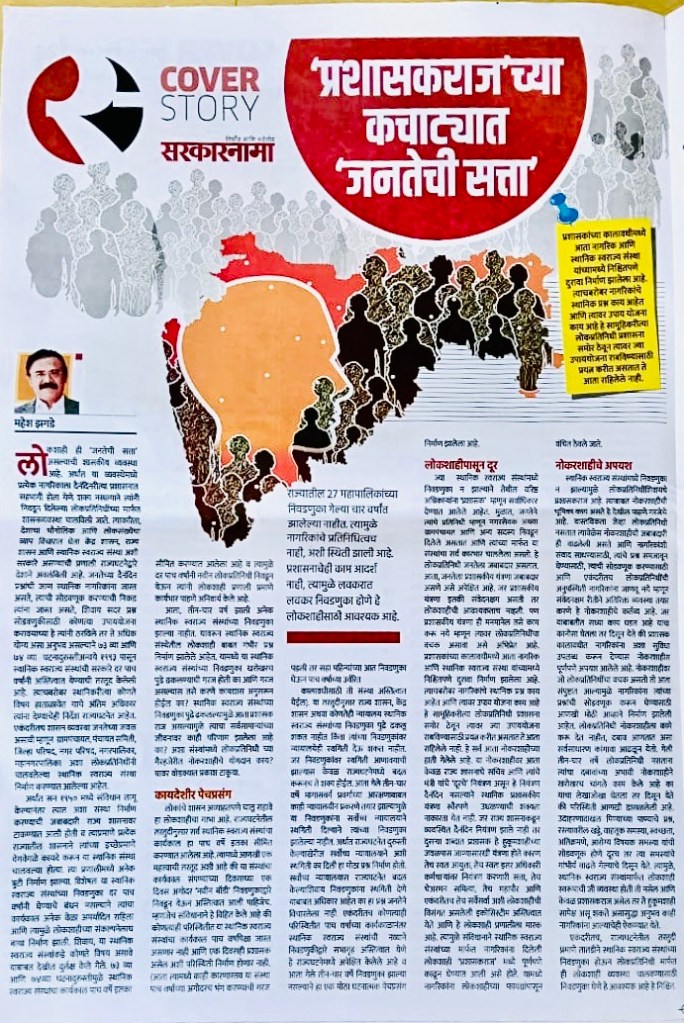
‘प्रशासकराज’ च्या कचाट्यात ‘जनतेची सत्ता’

(सौजन्य: हा लेख सरकारनामा या वृत्तपत्राची COVER STORY म्हणून प्रकाशित झाला होता.)

लोकशाही ही “जनतेची सत्ता” असल्याची शासकीय व्यवस्था आहे. अर्थात या व्यवस्थेमध्ये प्रत्येक नागरिकाला दैनंदिनरीत्या प्रशासनात सहभागी होता येणे शक्य नसल्याने त्यांनी निवडून दिलेल्या लोकप्रतिनिधींच्या मार्फत शासन व्यवस्था चालवली जाते. त्याकरिता, देशाचा भौगोलिक आणि लोकसंख्येचा व्याप विचारात घेता केंद्र शासन, राज्य शासन आणि स्थानिक स्वराज्य संस्था अशी सरकारे असण्याची प्रणाली संविधानाद्वारे देशाने अवलंबिली आहे. जनतेच्या दैनंदिन प्रश्नांची जाण स्थानिक नागरिकांना जास्त असते, त्याची सोडवणूक करण्याची निकड त्यांना जास्त असते, शिवाय सदर प्रश्न सोडवणुकीसाठी कोणत्या उपाययोजना करावयाच्या हे त्यांनी ठरविले तर ते अधिक योग्य असा अनुभव असल्याने ७३ व्या आणि ७४ व्या घटनादुरुस्तीअन्वये १९९३ पासून स्थानिक स्वराज्य संस्थांची सरकारे दर पाच वर्षांनी अस्तित्वात येण्याची तरतूद केलेली आहे. त्याचबरोबर संविधानात त्यांना स्थानिक रित्या कोणते विषय हाताळावेत याचे अंतिम अधिकार देण्याचेही निर्देश आहेत. एकंदरीतच शासन व्यवस्था जनतेच्या जवळ असावी म्हणून ग्रामपंचायत, पंचायत समिती, जिल्हा परिषद, नगर परिषद, नगरपालिका, महानगरपालिका अशा लोकप्रतिनिधींनी चालवलेल्या स्थानिक स्वराज्य संस्था निर्माण करण्यात आलेल्या आहेत.

अर्थात सन १९५० मध्ये संविधान लागू केल्यानंतर त्यात अशा संस्था निर्माण करण्याची जबाबदारी राज्य शासनावर टाकण्यात आली होती व त्याप्रमाणे प्रत्येक राज्यातील शासनाने त्यांच्या इच्छेप्रमाणे वेगवेगळे कायदे करून या स्थानिक संस्था चालवल्या होत्या. त्या प्रणालीमध्ये अनेक त्रुटी निर्माण झाल्या. विशेषतः या स्थानिक स्वराज्य संस्थांच्या निवडणुका दर पाच वर्षांनी घेण्याचे बंधन नसल्याने त्यांचा कार्यकाल अनेक वेळा अमर्यादित राहिला आणि त्यामुळे लोकशाहीच्या संकल्पनेलाच बाधा निर्माण झाली. शिवाय, या स्थानिक स्वराज्य संस्थांकडे कोणते विषय असावे याबाबत देखील दुर्लक्ष केले गेले. ७३ व्या आणि ७४व्या घटनादुरुस्तीमुळे स्थानिक स्वराज्य संस्थांचा कार्यकाल पाच वर्षे इतका सीमित करण्यात आलेला आहे व त्यामुळे दर पाच वर्षांनी नवीन लोकप्रतिनिधी निवडून येऊन त्यांनी लोकशाही प्रणाली प्रमाणे कार्यभार पाहणे अनिवार्य केले आहे.

आता, तीन-चार वर्ष झाली अनेक स्थानिक स्वराज्य संस्थांच्या निवडणुका झाल्या नाहीत. यावरून स्थानिक स्वराज्य संस्थेतील लोकशाही बाबत गंभीर प्रश्न निर्माण झालेले आहेत. यामध्ये या स्थानिक स्वराज्य संस्थांच्या निवडणुका खरोखरच पुढे ढकलण्याची गरज होती का आणि गरज असल्यास तसे करणे कायद्यास अनुसरून होईल का? स्थानिक स्वराज्य संस्थांच्या निवडणुका पुढे ढकलल्यामुळे आता प्रशासक राज असल्यामुळे त्याचा सर्वसामान्यांच्या जीवनावर काही परिणाम झालेला आहे का? अशा संस्थांमध्ये लोकप्रतिनिधी च्या गैरहजेरीत नोकरशाहीचे योगदान काय? यावर थोडक्यात प्रकाश टाकूया.

लोकांचे शासन अव्यहातपणे चालू राहावे हा लोकशाहीचा गाभा आहे. संविधानातील तरतुदीनुसार सर्व स्थानिक स्वराज्य संस्थांचा कार्यकाल हा पाच वर्षे इतका सीमित करण्यात आलेला आहे. त्यामध्ये आणखी एक महत्त्वाची तरतूद अशी आहे की या संस्थांचा कार्यकाल संपण्याच्या दिवसाच्या एक दिवस अगोदर नवीन बॉडी निवडणुकाद्वारे निवडून येऊन अस्तित्वात आली पाहिजेच. म्हणजेच संविधानाने हे विहित केले आहे की कोणत्याही परिस्थितीत या स्थानिक स्वराज्य संस्थांचा कार्यकाल पाच वर्षापेक्षा जास्त असणार नाही आणि एक दिवसही प्रशासक असेल अशी परिस्थिती निर्माण होणार नाही.(आता त्यामध्ये काही कारणास्तव या संस्था पाच वर्षांच्या अगोदरच भंग करण्याची गरज पडली तर सहा महिन्याच्या आत निवडणुका घेऊन पाच वर्षाच्या उर्वरित कालावधीसाठी ती संस्था अस्तित्वात येईल). या तरतुदीनुसार राज्य शासन, केंद्र शासन अथवा कोणतेही न्यायालय स्थानिक स्वराज्य संस्थांच्या निवडणुका पुढे ढकलू शकत नाहीत किंवा त्यांच्या निवडणुकांवर न्यायालयेही स्थगिती देऊ शकत नाहीत. जर निवडणुकावर स्थगिती आणावयाची झाल्यास केवळ संविधानामध्ये बदल करूनच ते शक्य होईल. आता गेले तीन-चार वर्ष मागासवर्ग प्रवर्गाच्या आरक्षणाबाबत काही न्यायालयीन प्रकरणे तयार झाल्यामुळे या निवडणुकांना सर्वोच्च न्यायालयाने स्थगिती दिल्याने त्यांच्या निवडणुका झालेल्या नाहीत. अर्थात संविधानात दुरुस्ती केल्या खेरीज सर्वोच्च न्यायालयाने अशी स्थगिती का दिली हा मोठा प्रश्न निर्माण होतो. सर्वोच्च न्यायालयास संविधानात बदल केल्याशिवाय निवडणुकांना स्थगिती देणे याबाबत अधिकार आहेत का हा प्रश्न जनतेने विचारलेला नाही. एकंदरीतच कोणत्याही परिस्थितीत पाच वर्षाच्या कार्यकाळानंतर स्थानिक स्वराज्य संस्थांची नव्याने निवडणुकाद्वारे बॉडी अस्तित्वात येणे हे संविधानामध्ये अपेक्षित केलेले आहे व आता गेले तीन-चार वर्ष निवडणुका झाल्या नसल्याने हा एक मोठा घटनात्मक पेचप्रसंग निर्माण झालेला आहे.

ज्या स्थानिक स्वराज्य संस्थांमध्ये निवडणुका न झाल्याने तेथील वरिष्ठ अधिकाऱ्यांना “प्रशासक” म्हणून सर्वाधिकार देण्यात आलेले आहेत. मुळात, जनतेने त्यांचे प्रतिनिधी म्हणून नगरसेवक अथवा ग्रामपंचायत आणि अन्य सदस्य निवडून दिलेले असतात आणि त्यांच्या मार्फत या संस्थांचा सर्व कारभार चाललेला असतो. हे लोकप्रतिनिधी जनतेला जबाबदार असतात. आता, जनतेला प्रशासकीय यंत्रणा जबाबदार असणे असे अपेक्षित आहे. जर प्रशासकीय यंत्रणा इतकी संवेदनक्षम असती तर लोकशाहीची आवश्यकताच नव्हती. पण प्रशासकीय यंत्रणा ही मनमानेल तसे काम करू नये म्हणून त्यावर लोकप्रतिनिधींचा वचक असावा असे अभिप्रेत आहे. प्रशासकांच्या कालावधीमध्ये आता नागरिक आणि स्थानिक स्वराज्य संस्था यांच्यामध्ये निश्चितपणे दुरावा निर्माण झालेला आहे. त्याचबरोबर नागरिकांचे स्थानिक प्रश्न काय आहेत आणि त्यावर उपाय योजना काय आहे हे सामूहिकरित्या लोकप्रतिनिधी प्रशासना समोर ठेवून त्यावर ज्या उपाययोजना राबविण्यासाठी प्रयत्न करीत असतात ते आता राहिलेले नाही. हे सर्व आता नोकरशाहीच्या हाती गेलेले आहे. या नोकरशाहीवर आता केवळ राज्य शासनाचे सचिव आणि त्यांचे मंत्री यांचे “दूरचे” नियंत्रण असून हे नियंत्रण दैनंदिन नसल्याने स्थानिक प्रशासकीय यंत्रणा स्वैरपणे  उधळण्याची शक्यता नाकारता येत नाही. जर राज्य शासनाकडून व्यवस्थित दैनंदिन नियंत्रण झाले नाही तर दुसऱ्या शब्दात प्रशासक हे हुकूमशाहीच्या जवळपास जाण्यासारखी यंत्रणा होते कारण तेच स्वतः आयुक्त, तेच स्वतः इतर अधिकारी कर्मचाऱ्यांवर नियंत्रण करणारी सत्ता, तेच चेअरमन समित्या, तेच महापौर आणि एकंदरीतच तेच सर्वेसर्वा अशी लोकशाहीची विसंगत असलेली इकोसिस्टीम अस्तित्वात येते आणि हे लोकशाही प्रणालीला मारक आहे. त्यामुळे संविधानाने स्थानिक स्वराज्य संस्थांच्या मार्फत नागरिकांना दिलेली लोकशाही “प्रशासकराज” मध्ये पूर्णपणे काढून घेण्यात आली असे होते. यामध्ये नागरिकांना लोकशाहीचे फायदे यापासून वंचित ठेवले जाते.

स्थानिक स्वराज्य संस्थांमध्ये निवडणुका न झाल्यामुळे लोकप्रतिनिधीशिवायचे प्रशासकराज आहे. त्याबाबत नोकरशाहीची भूमिका काय असते हे देखील पाहणे गरजेचे आहे. वास्तविकता जेव्हा लोकप्रतिनिधी नसतात त्यावेळेस नोकरशाहीची जबाबदारी ही वाढलेली असते आणि नागरिकांशी संवाद साधण्यासाठी, त्यांचे प्रश्न समजावून घेण्यासाठी, त्याची सोडवणूक करण्यासाठी आणि एकंदरीतच लोकप्रतिनिधींची अनुपस्थिती नागरिकांना जाणू नये म्हणून संवेदनक्षम रीतीने अतिरिक्त व्यवस्था तयार करणे हे नोकरशाहीचे कर्तव्य आहे. जर याबाबतीत सध्या काय घडत आहे याचा कानोसा घेतला तर दिसून येते की प्रशासक कालावधीत नागरिकांना अशा सुविधा उपलब्ध करून देण्यास नोकरशाहीस पूर्णपणे अपयश आलेले आहे. नोकरशाहीवर जो लोकप्रतिनिधींचा वचक असतो तो आता संपुष्टात आल्यामुळे नागरिकांना त्यांच्या प्रश्नांची सोडवणूक करून घेण्यासाठी आणखी मोठी आव्हाने निर्माण झालेली आहेत. लोकप्रतिनिधी नोकरशाहीला कामे करू देत नाहीत, दबाव आणतात असा सर्वसाधारण कांगावा आढळून येतो. गेले तीन-चार वर्ष लोकप्रतिनिधी नसताना त्यांचा दबावांच्या अभावी नोकरशाने खरोखरच चांगले काम केले आहे का ह्याचा लेखाजोखा घेतला तर दिसून येते की परिस्थिती आणखी ढासळलेली आहे. उदाहरणादाखल पिण्याच्या पाण्याचे प्रश्न, रस्त्यावरील खड्डे, वाहतूक समस्या, स्वच्छता, अतिक्रमणे, आरोग्य विषयक समस्या यांची सोडवणूक होणे दुरच तर त्या समस्यांचे गांभीर्य वाढले गेल्याचे दिसून येते. त्यामुळे, स्थानिक स्वराज्य संस्था मार्फत लोकशाही स्वरूपाची जी व्यवस्था होती ती नसेल आणि केवळ प्रशासकराज असेल तर ते हुकूमशाही सापेक्ष असू शकते असा सुद्धा अनुभव काही नागरिकांना आल्याचेही ऐकण्यात येते.

एकंदरीतच, संविधानातील तरतुदी प्रमाणे तातडीने स्थानिक स्वराज्य संस्थांच्या निवडणुका होऊन लोकप्रतिनिधी मार्फत ही लोकशाही व्यवस्था चालवण्यासाठी निवडणुका घेणे हे आवश्यक आहे हे निश्चित.

-महेश झगडे, IAS (नि)

Standard

The Population Paradox: Addressing the Myths and Realities of Decline 

The RSS chief, Shri Mohanji Bhagwat, expressed concern about the declining population of India in a public program in Nagpur on December 1. He further appealed that the current fertility rate in the country has come down to 2.1, which will cause immense harm to the society due to the decrease in population. Considering the social status of Shri Bhagwat in the country, his statement is of immense importance. It is natural to get reactions to the concerns he has expressed, and such reactions have been received.

It will be necessary to understand the reality behind Shri Bhagwat’s statement scientifically. Research has been done all over the world on demography in the last two hundred years and there is a general consensus on one figure, which is that if 2.1 children are born per woman, that is, if the fertility rate is 2.1, the population of that country remains stable without increasing. If the fertility rate is more than 2.1 per woman, the population continues to increase, and if it is less than that, the population decreases over time. Therefore, there is truth in Shri Bhagwat’s statement that if less than 2.1 children are born per woman, the population will start decreasing over time. Of course, this is not just a theory, but its reality is now starting to be seen all over the world. The fertility rate of Macau, South Korea, Hong Kong, Puerto Rico, Taiwan, etc. is less than 1.0. Out of 209 countries for which fertility rate data is available, the fertility rate of 114 countries has decreased to less than 2.1, and the average fertility rate of the entire world is 2.2, i.e., the population has almost reached a plateau. From this, a clear conclusion is drawn that it is an undeniable fact that the fertility rate is definitely decreasing in terms of population growth. Shri Bhagwat’s prediction that India’s current fertility rate of 2.1 will not increase over time is definitely true. But there is another side to it, which is also important. Looking at the future of the country only through the prism of declining fertility rate will not be right. This matter also needs to be discussed and analyzed thoroughly on the basis of scientific and statistical science.

Since the evolution of man about three lakh years ago, when he lived in forests or caves, his number has increased and his global population has reached about one to fifteen lakhs. But when he started farming about ten to twelve thousand years ago, there was a huge upheaval and the number of humans suddenly increased and around the year 1800, the global population reached 100 crores. In other words, it took about three lakh years for the global population of humans to reach 100 crores, however, in the last 220 years alone, it has increased eightfold and now it has reached 805 crores and is still increasing. According to the United Nations, by the year 2086, after this population reaches 10.4 billions, its growth will stop and then the population will start to decline and in the year 2100, it will again come down to 10.3 billions and this process of population decline will continue. There are many opinions about how this population decline will be. Darrell Bricker and John Ibbitson, in their book ‘Empty Planet’, have expressed their doubts in the title of their book whether this planet will become uninhabited. Of course, although different figures are given by different organizations or researchers in this regard, one fact is now clear, which is that the world’s population will definitely start declining by the end of the next century, rather than increasing permanently, and it has actually started in 114 out of the two hundred and nine countries of the world.

There is no consensus on the ideal population of the entire world or each country. But one fact is that the extent to which humans have used the resources of this planet in an uncontrolled and sometimes reckless or unwise manner over the past 250 years has created a man-made threat to this planet by permanently changing the climate. Therefore, the biggest problem facing the world is whether the very existence of humans will be in danger. The root causes of this problem are the excessive and excessive misuse of technology, a wrong economy and a huge population. If we consider this planet, the uncontrolled increase in the number of humans is neither in the interest of the planet nor of humans. Therefore, if the number of humans is decreasing naturally and the balance in nature is being restored, then there should be no objection to considering it as a positive thing. 

If we consider India, the population will continue to grow for the next five decades, reaching 1.7 billion from the current 142 crore, then stabilizing and then decreasing. Therefore, the situation is not the same as the problem of population decline that Shri Bhagwat has expressed, but considering the current fertility rate, another 30 crore people will be added to the population in the next fifty years. Therefore, it is a fact that India will remain the country with the ‘most populous’ population in the world until the year 2100 or even beyond, and we should also consider how appropriate it is to give the title of ‘most populous’ or ‘number one population’ in the world.

In the above context, according to the idea that Shri Bhagwat has put forward that couples should have two to three children, if couples decide to accept his advice, then it is difficult to estimate how much additional population can increase, but it is equally true that the population increase will definitely be more than 30 crore.

It will also be necessary to consider whether this population increase is suitable for India or not. If we look at the global statistics, India’s situation seems contradictory. While we dream of becoming a global superpower, the reality before us is harsh. India’s comparative statistical position in the world is very weak and has always been a challenge to our economic aspirations. 

Let us study the global situation and understand how India stands compared to other rich countries.

Compared to the major countries of the world, India’s position is as follows: 

– Area: Only 2% of the world’s total land area 

– Population: 17.78% of the world’s total population 

– GDP: Only 3.53% of the world’s total GDP 

– Per capita income: Only ₹2.28 lakh (about $2,750) 

In contrast, the figures of a superpower like the United States are: 

– Area: 6.1%

– Population: 4.23% 

– GDP: 26.51% of the world’s total GDP 

– Per capita income: ₹73.17 lakh (about $88,000) 

These figures make it clear that there is a huge gap between India and the United States. Despite India’s population being almost four times that of the United States, its economy is only one-seventh that of the United States. Moreover, the per capita income is very low compared to the United States. To become a global superpower like the US, given its population and per capita income, India would have to grow its current economy of $3.89 trillion to $122 trillion. That is five times the size of the current US economy, and more than the current world GDP ($110 trillion)! While this growth is theoretically possible, it is practically impossible. The most important problem is the unbridled expansion of our population, which is putting a huge strain on our resources. In my opinion, the biggest obstacle in India’s economic math is its huge population! Our economy cannot grow fast enough to keep up with the growth of our population. This results in a very low per capita income. China has largely curbed this problem by implementing strict population control policies. However, in India, population control measures have not been very effective due to political and social reasons. We are seeing the results—crowded cities, crumbling infrastructure, and limited economic growth. This necessitates accepting the reality of the limitations of available resources and land. India is home to 17.78% of the world’s population on 2% of its land area. This disparity is leading to overuse of resources—land degradation, water scarcity, and pressure on arable land. Countries like the United States are blessed with abundant land and natural resources. In contrast, India has to grow within its limited resources. This affects its productivity and limits its ability to create wealth. 

To become a global superpower, India must prioritize population control, efficient use of resources, and growth areas. Political will, social support, and international cooperation will be key factors in this journey. 

We must face the reality that with only 2% of the land area, 17.78% of the population, and 3.53% of the GDP—we must always be aware of these harsh realities. If this math is to change, India can adopt economic restructuring and progressive policies while simultaneously controlling population, or at least supporting population control without interfering with the fertility rate that is currently declining, if it is self-regulating. Only by striving on this path can India take a step forward to become an economic superpower, where wealth and equality are balanced.

-Mahesh Zagade, IAS(rtd)

Standard

The Constitutional Mandate of Local Self-Government Elections: Legal Obligations and Governance Gaps

I. Introduction

India’s Constitution establishes a comprehensive framework for democratic governance at the national, state, and local levels. The 73rd and 74th Constitutional Amendments of 1993 marked a significant milestone by granting constitutional status to local self-governments, thereby ensuring their continuity through regular elections and promoting citizen participation in governance. However, despite these provisions, recent developments have raised serious concerns about the erosion of this democratic framework, particularly when judicial stays or administrative inefficiencies lead to delays in local elections.

A critical issue that often gets overlooked in these delays is that the constitutional requirement for holding local elections within six months of the dissolution of local bodies—or before the expiration of their term—is non-negotiable. This is not merely a legal formality but a fundamental constitutional mandate that can only be altered through a constitutional amendment. Even the highest judicial authority, the Supreme Court, does not have the power to stay or delay these elections unless such an amendment is made. Let’s examine whether such delays constitute a direct violation of the Constitution, threatening the very foundation of democratic governance in India.

II. The Constitutional Framework for Local Self-Government Elections

The Constitution of India, through Articles 243E and 243U, mandates that elections for local self-government institutions must be held every five years. This constitutional stipulation is unequivocal: elections must be conducted before the expiration of the term of the existing body, ensuring that a newly elected body assumes office immediately thereafter. In situations where a local body is dissolved or a new one is created, the Constitution mandates that elections must be held within six months.

This six-month rule is crucial because it ensures that governance at the local level remains democratic and representative. Any failure to adhere to this timeline is not merely an administrative lapse but a constitutional violation. The Constitution does not grant any authority, including the judiciary, the power to extend this six-month window. In other words, even the Supreme Court cannot grant a stay on local elections unless the Constitution is first amended. This makes the timely conduct of local elections an imperative, not just in legal terms but also in the very fabric of democratic governance.

III. Judicial Interventions and the Case of Maharashtra

A prominent example of constitutional non-compliance in local elections can be observed in Maharashtra. Due to legal disputes over political reservations for Other Backward Classes (OBCs), local self-government elections have been delayed in the state. In 2021, the Supreme Court ruled on the procedure for implementing OBC political reservations, directing states to follow a three-step process, including population-based proportional reservation and adherence to the 50% cap on total reservations. Maharashtra struggled to comply with this directive, which led to the postponement of elections in several local bodies.

While the Supreme Court’s intervention was aimed at ensuring fair political representation, it also resulted in delays that contradicted the constitutional mandate. In July 2022, after a report on OBC reservations was submitted, the Court lifted its stay on elections. However, disputes related to ward delimitation and reservation systems have continued to stall the electoral process, leaving local bodies without elected representatives.

These judicial interventions, though intended to rectify legal ambiguities, should not override the Constitution’s explicit directive that elections must be completed within six months, irrespective of other ongoing disputes. As it stands, the Court’s actions in these cases risk undermining the constitutional principle of timely elections, highlighting the need for legislative clarity on handling such disputes without violating the fundamental democratic mandate.

IV. Constitutional Obligations and the Role of State Election Commissions

Article 243K of the Constitution places the responsibility for conducting local elections on State Election Commissions (SECs). These bodies are entrusted with ensuring the timely and fair conduct of elections. Yet, in many cases, SECs have struggled to enforce this schedule, citing reasons such as administrative delays, judicial stays, and political disputes. However, the constitutional mandate remains clear: no authority can delay these elections beyond the six-month window or allow an expired local body to function without a newly elected body. The role of the SECs must be reinforced to ensure that these constitutional obligations are met, irrespective of external pressures.

The case of Maharashtra illustrates how SECs have allowed elections to be postponed under the guise of administrative challenges, such as reservation disputes and delimitation issues. This failure to adhere to the Constitution threatens the very foundation of democratic decentralization. The delays, even when authorized by judicial bodies, cannot stand as they contradict the unequivocal constitutional timeline.

V. Governance in the Absence of Elected Representatives

The failure to conduct timely elections creates a significant governance gap, with local bodies being run by administrators instead of elected representatives. While the Constitution allows for administrators to take charge temporarily, this period cannot exceed six months. Any extension beyond this timeframe is unconstitutional. In practice, however, many local bodies continue to operate without elections, with administrators retaining control well beyond the constitutionally permissible period.

The absence of elected representatives at the local level has far-reaching consequences. It deprives citizens of their democratic right to be governed by individuals they have elected, while also creating an accountability vacuum. Unelected administrators do not have the same level of direct accountability to the public as elected representatives, leading to inefficiencies, mismanagement, and potential abuse of power.

As Lord Acton warned, “Power tends to corrupt, and absolute power corrupts absolutely.” The unchecked power of administrators, in the absence of elected oversight, poses a significant risk to governance at the grassroots level. The Constitution seeks to avoid this situation by mandating regular elections, ensuring that the power rests with elected representatives who are accountable to the people.

VI. Conclusion

The constitutional mandate for regular local elections is non-negotiable. Elections must be conducted before the expiry of the local body’s term, and any dissolution must be followed by elections within six months. This is not merely a procedural requirement—it is a constitutional obligation that cannot be waived or delayed without an amendment to the Constitution itself. Even judicial bodies like the Supreme Court are bound by this mandate and cannot grant stays that contravene this fundamental principle.

Delays in conducting local elections, whether due to judicial stays, administrative inefficiencies, or political disputes, undermine the constitutional framework and erode the very essence of democracy. The State Election Commissions must uphold their constitutional duty to ensure that elections are conducted in a timely manner, irrespective of external challenges. Failure to do so is not only a breach of legal duty but a violation of the democratic rights of citizens.

In a nutshell, timely conduct of local self-government elections is a constitutional imperative that serves as the bedrock of India’s democratic system. Any deviation from this, even by the judiciary, without a constitutional amendment, threatens to erode the foundation of democratic governance and should be rectified with urgency. The Constitution’s directives must be respected and upheld, for without them, the democratic fabric of the nation is at risk of unraveling.

-Mahesh Zagade, IAS(rtd)

Standard

From Law to Life: The Erosion of Accountability in Indian Governance

In the corridors of public discourse, few issues stir the emotions of the masses like that of faith and its sacred rituals. The recent national uproar over the alleged adulteration of Prasad distributed at the sacred Tirupati Balaji Devasthan has evoked a fierce wave of outrage, prompting deep reflections on trust, governance, and accountability. The alleged adulteration, purportedly involving animal fat mixed into the Prasad—a sacred offering to the gods and consumed by millions of devout Hindus—strikes at the heart of faith itself, an affront to the divine bond between worshippers and the deity. The anger is palpable, but this incident shines a light on a larger systemic issue that has long plagued the Indian administrative and political apparatus.

To begin with, it must be acknowledged that the Indian state, through its Parliament, has not left the matter of food safety unattended. On the contrary, the Food Safety and Standards Act of 2006 was instituted to provide a robust legal framework, specifically designed to prevent any form of adulteration in the food supply. The law’s stipulations are internationally compliant and stringent, laying out a nationwide legal framework to protect consumers from the menace of adulterated food products. Yet, the persistence of such violations, particularly in something as sacrosanct as Prasad, raises troubling questions. How could such a grave lapse occur under the watchful eyes of the law?

The answer, tragically, lies not in the weakness of the law itself but in its non-implementation. The Food Safety and Standards Act, 2006, exists not merely as a suggestion but as a binding legislative mandate, fortified by a nationwide bureaucratic apparatus intended to ensure its enforcement. But laws, no matter how well-framed, remain mere words on paper if they are not enforced with vigilance and integrity. The outrage surrounding the Tirupati Balaji Prasad scandal is, therefore, symptomatic of a much deeper problem—an endemic neglect of legal enforcement that has affected this great nation for far too long.

This failure, unfortunately, is not confined to a single incident or sector. The case of adulterated Prasad serves as a stark reminder of a malaise that has pervaded various aspects of governance and law in India. Be it food safety, environmental regulations, or social welfare schemes, regulatory stipulation etc. the gap between the framing of laws and their execution is wide and growing.

At the heart of this issue lies the very structure of India’s democracy. India’s democratic edifice rests upon the shoulders of 5252 people’s representatives, including the President and Vice President, each of whom is conferred with the solemn duty of formulating the nation’s laws and policies. Among these, 4577 individuals are directly elected by the citizens, each representing a territorial constituency. Every Member of Parliament (MP) stands accountable to an average of 25.78 lakh people, while each Member of Legislative Assembly (MLA) is answerable to around 3.47 lakh citizens. This intricate system of representation, designed to give voice to the aspirations and concerns of over 1.4 billion people, is the very backbone of Indian democracy.

But representation does not end with the act of lawmaking. These elected representatives are not merely tasked with drafting legislation; they are also constitutionally bound to ensure the implementation of the laws they pass. It is here that the democratic machinery begins to falter. The crafting of laws may garner public attention and political capital, but the less glamorous work of ensuring that these laws are properly enforced often slips through the cracks. The neglect of this constitutional responsibility is perhaps the most crucial factor undermining the efficacy of the Indian system today.

Let us return to the case of food adulteration, which, while egregious in the context of Prasad, is sadly a widespread issue across the country. Despite the comprehensive provisions of the Food Safety and Standards Act, 2006, adulteration remains rampant in everyday food items consumed by millions of Indians. The question arises—why, in a country with such a robust legal structure, do these transgressions persist?

The answer lies in a combination of factors, all tied to a fundamental failure of governance. Firstly, there is the issue of accountability. While every MP and MLA is elected to serve the people and is constitutionally answerable to their respective constituencies, there is often a disconnect between representatives and the governed. The electoral cycle, with its focus on immediate gains and vote-bank politics, tends to prioritize short-term promises over long-term, sustained governance. As a result, representatives may focus on legislation that can win them political points, while neglecting the hard work of ensuring those laws are enforced on the ground.

Moreover, the bureaucratic apparatus that exists to implement these laws is often plagued by inefficiency, corruption, and unholy political alignment. The regulatory bodies tasked with enforcing food safety standards, for instance, are besieged  with systemic corruption, failure of hierarchical checks and balance, failure of government to punish the non performing and complacent etc. In such a scenario, the enforcement of laws becomes a secondary concern, overshadowed by the more pressing demands of political survival ,electoral expediency and a lax bureaucratic apparatus! 

This is not an isolated problem but a systemic issue that affects multiple areas of governance. From food safety to environmental protection, from healthcare to education, the gap between legislation and implementation undermines the very foundation of democracy. Laws are passed with great fanfare, but the mechanisms required to ensure their success remain woefully underdeveloped or neglected. The consequences are dire: citizens lose faith in the system, and the very purpose of democratic governance—ensuring the welfare of the people—is subverted.

The Tirupati Balaji Prasad incident, therefore, should not be seen in isolation. It is a symptom of a larger malaise, one that reflects the dangerous disconnect between the promises made by elected representatives and the realities on the ground. The outrage that followed this scandal is a reflection of the frustration felt by millions of Indians, who see laws being passed but rarely see them enforced.

To address this issue, a fundamental shift in governance is required. Elected representatives must recognize that their responsibilities do not end with the passage of laws. They must actively engage in ensuring that these laws are implemented in the spirit in which they were intended and they should audit implementation of laws in their constituencies concurrently.  This requires a renewed focus on accountability—both political and bureaucratic. Representatives must be held to account not only by their constituents but by a robust system of checks and balances that ensures that laws are enforced.

Furthermore, the bureaucratic apparatus entrusted with the implementation of laws must be rigorously scrutinized, with those occupying lofty administrative positions at both the national and state levels held to strict account and suitably penalized for any dereliction of duty. In instances of failure, it is the Secretaries who should face the brunt of accountability, rather than the lower-ranking officials in the field. Regulatory bodies must be equipped with the resources and autonomy they need to carry out their duties without fear of political interference. Only then can we hope to close the gap between lawmaking and law enforcement.

All in all, the scandal of adulterated Prasad at Tirupati Balaji is a wake-up call for the Indian democratic system. It is a stark reminder that laws, no matter how well crafted, are meaningless if they are not enforced. The responsibility of ensuring the implementation of these laws rests with the elected representatives, and it is high time they took this duty seriously. For only when laws are enforced can we hope to realize the true potential of democracy, and only then can the faith of the people in their representatives be restored.

-Mahesh Zagade, IAS(rtd)

Standard

स्पर्धा परीक्षेत मुलांच्या आयुष्याशी खेळ थांबवा!

(दै लोकमतमध्ये दि १६/६/२०२४ रोजी सारांशाने प्रकाशित झालेला लेख मूळ स्वरूपात.)

अलिकडेच महाराष्ट्र लोकसेवा आयोगाने राज्यातील स्पर्धा परीक्षा पुढे ढकलल्याचे आणि त्यामुळे उमेदवारांमध्ये नाराजी आणि असंतोष पसरल्याची वृत्ते प्रसिद्ध झाली आहेत. एव्हाना ही वृत्ते नित्याचीच बाब झालेली आहे. शासकीय पदावरील नियुक्त्याबाबत पदे भरली न जाणे, पदे भरण्याच्या जाहिराती विलंबाने येणे, जाहिरातीवर किंवा परीक्षावर शासकीय किंवा न्यायालयीन स्थगिती येणे, परीक्षा पुढे ढकलणे, निकाल लागण्यास कमालीची दिरंगाई होणे, निकाल लागल्यानंतर नियुक्त मिळण्यास कधी कधी वर्षापेक्षाही जास्त कालावधी लागणे आणि हे सर्व होऊ नये म्हणून उमेदवारांचे मोर्चे धरणे, त्यांची अगतिकता या बाबींनी महाराष्ट्र ग्रासलेला आहे. संघ लोकसेवा आयोगाकडून घेतल्या जाणाऱ्या देश पातळीवरील स्पर्धा परीक्षांच्या बाबतीत अशा बाबी ऐकिवात येत नाहीत. हे असे का होत असावे हा प्रश्न सर्वसामान्यांना पडणे स्वाभाविक आहे. या समस्या का उद्भवतात आणि त्यांचे निराकरण शक्य नाही का ते समजून घेण्याचा प्रयत्न करूया.

शासकीय नोकऱ्या या देशातील बेरोजगारी दूर करण्यासाठी पुरेशा आहेत का? अलिकडेच आंतरराष्ट्रीय कामगार संघटनेने भारतातील सुमारे ९० टक्के रोजगार अनौपचारिक क्षेत्रात असून नियमित रोजगार फक्त १० टक्के असल्याचे दर्शविले आहे. त्या १० टक्क्यांमध्ये शासकीय नोकऱ्यांचे प्रमाण अत्यल्प आहे. त्यामुळे शासकीय नोकऱ्या या बेरोजगारीवरील उपाय म्हणून नव्हे तर त्य लोकशाहीतील प्रशासकीय व्यवस्था सुदृढतेने चालविण्याची यंत्रणा असे त्याचे स्वरूप आहे. प्रशासकीय गरजानुसार पदांची संख्या ठरविली जाते. अर्थात त्यामध्ये सामाजिक दुर्बल घटकांना लोकशाहीतील निर्णय प्रक्रियेत सामावून घेणे हा देखील एक विषय आहे. प्रशासकीय व्यवस्था मजबूत ठेवून जनसामान्यांचे जीवनमान सुरळीत ठेवण्यासाठी शासनाअंतर्गत रिक्त पदे राहूच नयेत असे अभिप्रेत आहे.

तथापि, शासकीय नोकरीतील स्थैर्यता, समाजाभिमुख काम करण्याची आस आणि नोकरीची संधी म्हणून तरुण आणि विशेषतः ग्रामीण भागातील तरुण आकर्षित होतात. ते स्पर्धा परीक्षा तयारी, प्रत्यक्ष परीक्षा याकरीता पुण्यासारख्या शहरात येऊन जीवनाची ऐन उमेदीतील ४-५ वर्ष व्यतीत करत असतात. त्यांची कौटुंबिक आर्थिक स्थिती कमकुवत असते. शहरातील वास्तव्यातील दैनंदिन खर्च, क्लासेसचा खर्च इत्यादीमुळे कुटुंबाची आर्थिक स्थिती आणखी खालावते आणि एक मानसिक तणाव निर्माण होतो. परीक्षा विलंबाने झाल्या तर खर्च आणि तणाव त्य प्रमाणात वाढत जातो. यातील अन्य भयानक वास्तव म्हणजे स्पर्धा परीक्षांमध्ये उमेदवारांची आणि पदांची संख्या यामध्ये इतकी तफावत असते की प्रत्यक्षात नोकरी मिळणारांची टक्केवारी अपूर्णाकात यावी. हे सर्व दृष्टचक्र थांबवता येणार नाही का? एकतर, रोजगाराच्या संधीसाठी शासकीय नोकऱ्या हे व्यापक क्षेत्र नसले तरी तेथे भरपूर संधी आहेत. त्यामुळे शासनाने जी पदे निर्माण केलेली आहेत ती रिक्त राहणारच नाहीत हे धोरण काटेकोरपणे पाळले पाहिजे. या धोरणानुसार प्रत्येक वर्षाच्या सप्टेंबर महिन्यात पुढील वर्षी निवृत्ती, पदोन्नती इत्यादीमुळे रिक्त होणाऱ्या या पदांचा आढावा घेऊन त्या संख्येत सर्व निवड प्रक्रिया पार पडून पदोन्नतीने अथवा सरळ सेवेने अधिकारी व कर्मचारी उपलब्ध ठेवून ज्या दिवशी पदे रिक्त होतील त्याच्या दुसऱ्या दिवसापासून भरले गेले जावे. हा आढावा होतो किंवा नाही ते पाहण्याची अंतिम जबाबदारी लोकप्रतिनिधींची नसून प्रशासकीय नेतृत्व म्हणून मुख्य सचिवांची आहे. तसे होते का? उत्तर सोपे आहे; तसे होत नसावे म्हणूनच या सर्व समस्या! वास्तविकत: ही एक सोपी प्रक्रिया आहे. त्यात आणखी सुदृढता आणि पारदर्शकता आणण्यासाठी प्रत्येक तालुक्यातील सर्व शासकीय विभागात किती पदे निर्माण केली गेली आहेत आणि त्यापैकी किती पदे रिक्त आहेत ह्याची आकडेवारी दरवर्षी सप्टेंबरमध्ये जिल्हाधिकारी यांनी स्थानिक आमदारांना उपलब्ध करून दिली, तर ते देखील रिक्त पदे भरण्याबाबत शासनावर दबाव आणू शकतात.

दुसरी महत्त्वाची बाब म्हणजे पदोन्नतीची पदे तर भरली जाण्यास काहीही प्रत्यवाय नसतो. ही पदे भरली गेली तर सरळ सेवेची पदे उपलब्ध होऊन त्याचा फायदा बाह्य उमेदवारांना होतो. पण राज्यातील अशी हजारो पदे केवळ संबंधित खात्याच्या सचिवांच्या नाकर्तेपणामुळे रिक्त राहून बेरोजगार तरुण नोकऱ्यांपासून वंचित राहतात.

तिसरी आणि सर्वात महत्वाची बाब म्हणजे दरवर्षी एक जानेवारीपूर्वी त्या वर्षांची सरळसेवा पदावर नियुक्त होणाऱ्या उमेदवारांची निवडसूची करून त्यांना रिक्त होणाऱ्या पदावर नियुक्तीसाठी याद्या तयार ठेवणे. पूर्वी जेंव्हा संगणक किंवा संगणक प्रणाली नव्हत्या लोकसेवा आयोग आणि अन्य शासकीय यंत्रणाकडून कोणत्याही गोंधळाशिवाय नियमित परीक्षाअत्यंत विनासायास पार पाडल्याजायच्या. आता संगणक आणि संगणक प्रणालीसारखे तंत्रज्ञान प्रगत झाले असताना मोठे गोंधळ निर्माण का होतात, प्रश्नपत्रिका फुटणे,अन्य गैरप्रकार होणे, प्रचंड विलंब होणे, खासगी यंत्रणेवर गैरप्रकाराचे आरोप होणे असे प्रकार घडतात हे प्रशासकीय अपयश होय. या बाबीमुळे उमेदवारांना अतोनात त्रास होतो आणि तो त्रास वर्षानुवर्षे चालू आहे.या सर्व त्रासास केवळ लोकसेवा आयोग, मुख्य सचिव आणि संबंधित खात्यांच्या सचिवांचे पाप किंवा प्रशासकीय दौर्बल्य किंवा निगरगट्टपणा कारणीभूत आहे! जर मुख्यसचिवांनी आणि लोकसेवा आयोगाने ठरविले तर हे प्रश्न अस्तित्वातच राहणार आहे नाहीत. चौथी बाब म्हणजे न्यायालयाचा हस्तक्षेप. हा हस्तक्षेप सेवा प्रवेशातील त्रुटी आणि आरक्षणाबाबत शासनाचे बदलणारे धोरण यामुळे प्रामुख्याने होतो. देशाला स्वातंत्र्य मिळून ७५ वर्ष झाली तरी प्रगल्भ सचिव. बिनचूक सेवा प्रवेश नियम बनवू शकत नसतील तर ते राज्यातील १४ कोटी जनतेचे दुर्दैव होय. निवडणूक प्रक्रिया सुरू झाल्यानंतर त्यामध्ये कोणतेही न्यायालय हस्तक्षेप करणार नाही अशी वैधानिक तरतूद आहे. त्याच धर्तीवर जाहिरात दिल्यानंतर निवड प्रक्रियेत न्यायालय हस्तक्षेप करू शकणार नाहीत असा कायदा करावा असे मी दोन वर्षापूर्वी उपाय म्हणून सुचविला होता पण त्याची दखल घेण्यासाठी वेळ नसावा.

शेवटी, आपण एकविसाव्या शतकात आहोत याचे भान प्रशासनाने ठेवणे आवश्यक आहे. अत्यंत प्रभावी संगणकप्रणाली बाजारात उपलब्ध आहेत. त्याचा वापर करून शासकीय, निमशासकीय कार्यालयातील सर्व म्हणजे वर्ग अ, ब, क आणि ड या सर्व पदांसाठी खाजगीकरांतून नव्हे तर लोकसेवा आयोगामार्फत दरवर्षी फक्त एकच सामायिक परीक्षा घ्यावी. परिक्षेतील आणि मुलाखतीतील गुण पदांची उमेदवारांची प्राधान्यता, शैक्षणिक पात्रता, भौगोलिक गरज इ चा संगणक प्रणालीचा वापर करून संबंधित पदासाठी उमेदवार निवड व्हावी. उमेदवार निवड झाल्याच्या दुसऱ्या दिवशी नियुक्तिपत्रे वितरीत होवू शकतील ह्याची तजवीज ठेवावी. हे शक्य आहे का? अर्थात निश्चितपणे शक्य आहे! केवळ राज्याला लोकाभिमुख आणि प्रगल्भ मुख्य सचिव आणि सचिव असावेत!!

-महेश झगडे xIAS, माजी प्रधान सचिव, महाराष्ट्र शासन.

Standard

The Essence of Electoral Responsibility: A Call to Enlightened Voting

In the heart of the world’s largest democracy, India, lies the pulsating rhythm of electoral fervor. With each stride towards the ballot box, millions of citizens embark on a journey that shapes the destiny of a nation. Yet, amidst the cacophony of political rallies and promises, there exists a fundamental truth often obscured by the dazzle of democratic spectacle: the essence of electoral responsibility transcends the mere act of casting a vote—it is a solemn duty to discern, to evaluate, and to choose wisely for the collective welfare of the nation.

As India gears up for yet another general election to elect its representatives to the esteemed Lok Sabha, it is imperative for the 97 crore eligible voters to grasp a pivotal reality: our Constitutional Representative Democracy is inherently intertwined with the dynamics of Party Democracy. In essence, while we exercise our democratic right to elect individuals to represent us in the hallowed halls of governance, we are, in effect, entrusting the reins of power to the political party or its paramount leader.

In a nation as diverse and dynamic as India, the stakes of electoral decision-making are monumental. Each vote cast reverberates through the corridors of power, shaping policies, charting courses, and influencing the very fabric of society. Hence, the imperative lies not merely in selecting a representative but in discerning the ethos and ideology that underpin the political party or its supreme leader vying for ascendancy.

The hallmark of responsible voting lies in the sagacious evaluation of the suitability or unsuitability of a political party or its leader for the nation’s overarching interests. This entails a holistic assessment of their vision, integrity, track record, and commitment to the cherished ideals enshrined in the Constitution. For the destiny of a nation is not shaped by whimsical choices but by the collective wisdom and foresight of its electorate.

To embark on this discerning journey, it is incumbent upon every citizen to engage in informed discourse, to delve beyond the veneer of populist rhetoric, and to seek enlightenment amidst the cacophony of political discourse. It is not merely a duty confined to the solitary confines of the polling booth but a collective endeavor that necessitates dialogue, debate, and deliberation within the familial, social, and communal spheres.

As custodians of democracy, it is incumbent upon each one of us to internalize the profound impact of our electoral choices. For the trajectory of a nation’s progress hinges upon the collective conscience of its citizens, upon their unwavering commitment to uphold the principles of justice, liberty, equality, and fraternity.

To this end, the onus rests upon every citizen to meticulously elucidate the essence of electoral responsibility to their family, relatives, and acquaintances. It is not merely a call to action but a clarion call to awaken the dormant spirit of civic duty, to ignite the flame of conscientious citizenship, and to forge a collective resolve to steer the ship of the state towards the shores of prosperity and progress.

The ramifications of improper voting reverberate far beyond the confines of the electoral cycle. It engenders a perilous descent into the abyss of mediocrity, inefficacy, and stagnation. It dilutes the sanctity of democratic principles, undermines the edifice of governance, and erodes the very foundations of the nation’s integrity.

Conversely, right voting constitutes the cornerstone of a vibrant, resilient, and progressive democracy. It breathes life into the veins of governance, infuses vigor into the corridors of power, and fosters an environment conducive to the realization of the nation’s highest aspirations.

In conclusion, as India braces itself for the impending electoral exercise, let us heed the clarion call of electoral responsibility. Let us transcend the confines of partisan allegiance and embrace the mantle of conscientious citizenship. For in the crucible of democracy, every ballot cast is not merely an act of pressing a button on EVM but a beacon of hope, a testament to the indomitable spirit of a nation marching towards a brighter tomorrow.

Standard

Corruption:

The Anatomy, Physiology and Remedial measures

(An English Machine translation of an article on corruption originally published in marathi daily Mharashtra Times on 11/2/2024)

The Transparency International, a distinguished NGO headquartered in Berlin, Germany, founded three decades ago and operational globally in the realm of corruption, has recently published the 2023 “Corruption Perception Index” for 180 nations, as is customary each year. This index is meticulously computed to assign zero points to the most corrupt country, with a pinnacle of 100 points reserved for the paragon of probity. Subsequently, the nations are arranged in a descending order from the most scrupulous to the most tainted. In this hierarchical array, Denmark has ascended to the zenith as the most virtuous nation globally, securing an impressive 90 points. Trailing closely behind are Finland, New Zealand, Norway, Singapore, Sweden, and Switzerland. Conversely, Somalia has earned the ignominious distinction of being the foremost purveyor of corruption on a global scale, registering a mere 11 points. Venezuela, Syria, and South Sudan find themselves ensnared in the same web of corruption with a score of 13 points. India, unfortunately, languishes at a lowly 93rd position in the roster of virtuous nations, amassing a modest 39 points. Alas, the data gleaned from this investigation suggests a disconcerting truth – India, having descended eight places from its 2022 standing, is grappling with an unabating surge in corruption.

Corruption, an affliction experienced daily by the citizens of India, assumes a more disquieting dimension when subjected to the scrutiny of an international organization. This is particularly distressing for a country boasting the world’s oldest culture and the grandeur of being the largest democracy. Elucidating the nature of corruption is unnecessary, as readers can draw upon personal experiences or observe the prevailing circumstances. The question that begs consideration is why a nation rooted in ancient principles of truth, honesty, and spirituality finds itself mired in the morass of corruption. Who bears the culpability for this lamentable state of affairs? Even if the eradication of corruption proves elusive, why cannot a culture of integrity akin to that of Denmark, Finland, New Zealand, and Norway be instilled?

Corruption, a multifaceted malady, finds its genesis in the various facets of human morality. Immorality, a pernicious element in human nature, serves as the bedrock of corruption.

While Transparency International’s index encompasses diverse aspects of corruption, its primary focus is on financial malfeasance, particularly within the ambit of government administration. The private sector is not exempt from this blight, but its roots can be traced back to governmental corruption. A discourse on corruption, against the backdrop of this index, warrants attention.

At the global level, the United Nations (UNO) has deemed corruption a “pernicious plague,” recognizing it as an imminent threat to society and democracy. Consequently, member nations are enjoined to formulate policies, enact laws, and establish judicial systems to thwart corruption, punish transgressors, and extirpate this malevolent influence. In the Indian context, the Prevention of Corruption Act of 1988, applicable to all public servants, encompasses government entities, the judiciary, public representatives, statutory public undertakings, co-operative society officers, and government companies. This legislation categorizes the acceptance of illicit remuneration by public servants as corruption, prescribing exhaustive measures for investigating and penalizing the guilty. Each state maintains an Anti-Corruption Bureau(ACB) and at the central government level, the Vigilance Commission, Central Bureau of Investigation (CBI), and special courts have been instituted. Independent bodies like Lokayukta and Lokpal serve as additional bulwarks against corruption. Despite these legal provisions, India’s descent in global rankings is perplexing, a trend corroborated by the 2023 report from the National Crime Records Bureau, revealing a 10.5 percent surge in corruption cases in 2022.

Corruption, an entrenched social malaise, is attributable to myriad factors, including governance, administration, investigative mechanisms, judicial processes, societal apathy, electoral processes, and legal anomalies. The epicenter of corruption lies in the electoral process, where escalating campaign costs engender a symbiotic relationship between politicians and vested interests. Joseph Stiglitz, a Nobel laureate in Economics, posits that contemporary democracy has devolved into a system democracy is no more a system “of the people, by the people and for the people”, but it has become a “system of the one percent, by the one percent and for the one percent”, the one percent being super rich people who have captured democracy as their slave. And , therefore, curtailing spending in elections emerges as a pivotal step toward ameliorating corruption in the country.

Identifying the principal contributor to corruption within the country prompts contemplation on whether it emanates from the administration or the bureaucracy. In a democratic system, periodic elections underscore the impermanence of elected representatives, necessitating a system of checks and balances between them and the bureaucracy. Constitutional safeguards, encapsulated in Part 14, forestall bureaucratic malfeasance and foster a harmonious coexistence with elected officials. The bureaucracy, empowered by its constitutional mandate, bears a solemn responsibility to combat corruption.

Corruption within the administrative echelons operates on two planes: personal corruption and collusion in others’ malfeasance within the government system. The former encompasses illicit financial gains for expediting assigned tasks (speed money), engaging in unlawful activities, or accepting remuneration to overlook ongoing transgressions (bribes). To curb such malpractices, Rules of Conduct, such as the 1968 Rules for All India Services, mandate public servants to discharge their duties with integrity. The bureaucracy, comprising the Indian Administrative Service and the Indian Police Service, is constitutionally obligated to ensure not only their own incorruptibility but also that of the entire system under their purview. Corresponding provisions exist in Maharashtra’s conduct Rules of 1979 for the State Government bureaucracy. Failure to adhere to these rules renders officers and employees liable to punishment. Article 166 of the Constitution stipulates the appointment of secretaries at the helm of each government department, charged with the statutory duty of ensuring a corruption-free environment within their purview.

I have my personal hypothesis regarding corruption as follows. There is an inverse relationship between enforcement and corruption in governance. Rigorous implementation of laws, rules, policies, and schemes correlates with diminished corruption levels, while lax enforcement precipitates heightened corruption. Supervision and reviews by superiors, coupled with periodic reviews of implementation, form integral components of governance. My personal experience in various governmental roles underscores the efficacy of swift disciplinary action in fostering a culture of administrative integrity and diminishing corruption.

Common perception of corruption often pertains to monetary bribes paid to expedite bureaucratic processes. However, this constitutes merely the tip of the iceberg. The more insidious form of corruption involves bestowing substantial financial advantages during policymaking, building permits, tenders, and privatization. This multi-faceted corruption, obscured from public scrutiny, places an onerous burden on the populace. Despite the existence of laws such as the Right to Information and Service Guarantee Act, the 2023 report from the National Crime Records Bureau reveals a disconcerting 10.5 percent uptick in corruption cases in 2022.

Addressing corruption demands an examination of administrative and political collusion. While political leadership is often held accountable, effective intervention necessitates a collective resolve among administrative officers and a robust statutary framework. Succumbing to political pressures and engaging in illicit practices only exacerbates corruption, underscoring the need for bureaucratic autonomy.

Enhancing transparency in administration emerges as a potent antidote to corruption. Provisions such as the Right to Information, while ostensibly effective, are undermined by a culture of denial rather than information dissemination. Public access can be increased to government transactions, facilitated by computerization and network connectivity since it could significantly curtail corruption. However, the inertia of administrative mentality poses a formidable obstacle. A transformative administrative culture, underpinned by effective governance, could manifest tangible change within months, heralding an era where India rivals or surpasses Denmark in integrity. All it requires is the collective will to effect this transformation.

Standard