
(This article was originally published on daily Divya Marathi on 26/4/2026)
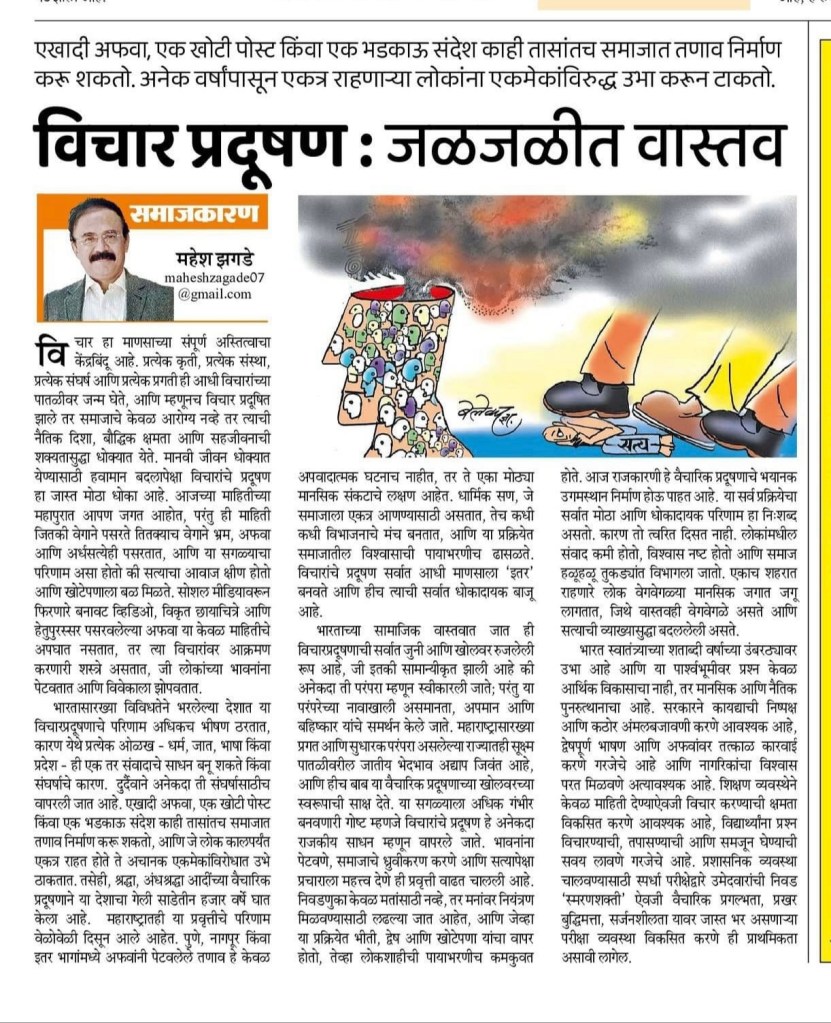
At times, a grey pall of smoke settles over a city’s sky; breathing becomes laborious, the eyes sting, and we rise in immediate protest against the visible tyranny of pollution. Yet beyond these manifest afflictions lies another contamination—subtler, unseen, and far more insidious: the pollution of thought. It creeps quietly, almost imperceptibly, and gnaws away at the very consciousness of society.
Thought is the axis upon which the entirety of human existence turns. Every action, every institution, every conflict, and every advance is first conceived in the realm of ideas. If thought itself is corrupted, then not only the health of society but its moral direction, intellectual vitality, and even the possibility of harmonious coexistence stand imperilled. Polluted air may wound the lungs, contaminated water may afflict the body, but polluted thought strikes at the very faculty of reason. It blurs the boundary between truth and falsehood, until discernment itself falters. In the final reckoning, the danger posed by the corrosion of thought may well exceed that of climate change, for it endangers not merely the environment but the essence of human life.
We inhabit an age of overwhelming information. Yet as swiftly as knowledge travels, so too do illusions, rumours, and half-truths. The consequence is stark: the voice of truth grows faint, while falsehood acquires a disquieting strength. Fabricated videos, distorted images, and deliberately propagated misinformation circulating through social media are not accidental distortions of fact; they are weapons—crafted to assault the mind, inflame emotion, and lull reason into a dangerous slumber.
In a country as richly diverse as India, the consequences of such cognitive pollution are magnified manifold. Here, every identity—religion, caste, language, region—holds the potential either to become a bridge of dialogue or a fault line of conflict. Regrettably, it is too often harnessed for the latter. A rumour, a falsified post, a provocative message—within hours, they can ignite tensions, turning neighbours who once lived in quiet harmony into adversaries. Indeed, the long history of unexamined belief and superstition has, for centuries, burdened the social fabric, leaving deep and enduring scars upon the collective mind.
Even in a state like Maharashtra, with its proud legacy of reform and rational inquiry, these tendencies reveal themselves with troubling frequency. Episodes of tension—whether in Pune, Nagpur, or elsewhere—are not isolated aberrations; they are symptoms of a deeper malaise. Festivals, which ought to serve as occasions of unity, sometimes become stages for division, eroding the very foundation of trust upon which society rests.
The most dangerous aspect of polluted thought is its capacity to transform the fellow human into the “other.” Once this transformation occurs, empathy recedes, and in its place arise suspicion, hostility, and fear. This is not an abrupt metamorphosis; it unfolds gradually—first in narratives, then in rhetoric, and finally in action. By the time it reaches its culmination, violence no longer appears as an aberration but as an inevitability.
Within the Indian social reality, caste remains one of the oldest and most deeply entrenched manifestations of such intellectual contamination. So normalized has it become that it often passes unquestioned as tradition. Yet beneath this veneer of continuity lies a persistent structure of inequality, humiliation, and exclusion. Even in progressive societies, subtle forms of discrimination endure, bearing testimony to the profound and pervasive nature of this ideological affliction.
What renders this phenomenon even more perilous is its frequent deployment as a political instrument. The deliberate stoking of emotion, the polarisation of communities, and the elevation of propaganda above truth have become disturbingly commonplace. Elections are no longer contests merely for votes but struggles for dominion over minds. When fear, hatred, and falsehood are thus weaponised, the very foundations of democracy begin to weaken. Indeed, contemporary political processes risk becoming breeding grounds for the most virulent forms of intellectual pollution.
The gravest consequence of this entire process is its silence. It does not erupt with immediate visibility; rather, it seeps into the interstices of society. Dialogue diminishes, trust evaporates, and the social fabric gradually fragments. People sharing the same city begin to inhabit entirely different mental worlds, where even reality itself diverges, and the meaning of truth becomes mutable.
Air pollution may destroy the body, but the pollution of thought strikes at the soul of society. While technology, law, and policy may purify the air, there exists no mechanical apparatus to cleanse the mind. For that, one requires vigilance, integrity, and the disciplined exercise of reason. More insidiously, the pollution of thought often disguises itself in the language of freedom, rendering its detection and resistance all the more difficult.
As India stands on the threshold of its centenary of independence, the challenge before it is not merely one of economic advancement, but of intellectual and moral renewal. The State must ensure firm and impartial enforcement of law, act decisively against hate speech and misinformation, and restore public trust. The education system must move beyond the mere transmission of information to the cultivation of critical thinking—the ability to question, to examine, and to understand. Even the mechanisms of public recruitment must evolve, privileging intellectual maturity, creativity, and analytical depth over rote memorisation.
Society, too, must rediscover the art of dialogue—embracing dissent, accommodating difference, and seeking unity within diversity. The media and the intelligentsia must shoulder their responsibility with sensitivity, honesty, and accountability. For social reformers, this is a new struggle—not against external adversaries, but against the darkness within.
And so, the question that ultimately confronts us is stark: shall we recognise this invisible contamination before it consumes us? For once thought itself is polluted, even the purest air cannot sustain life in its fullest sense. One may continue to exist, yet cease, in any meaningful way, to live.
-Mahesh Zagade

