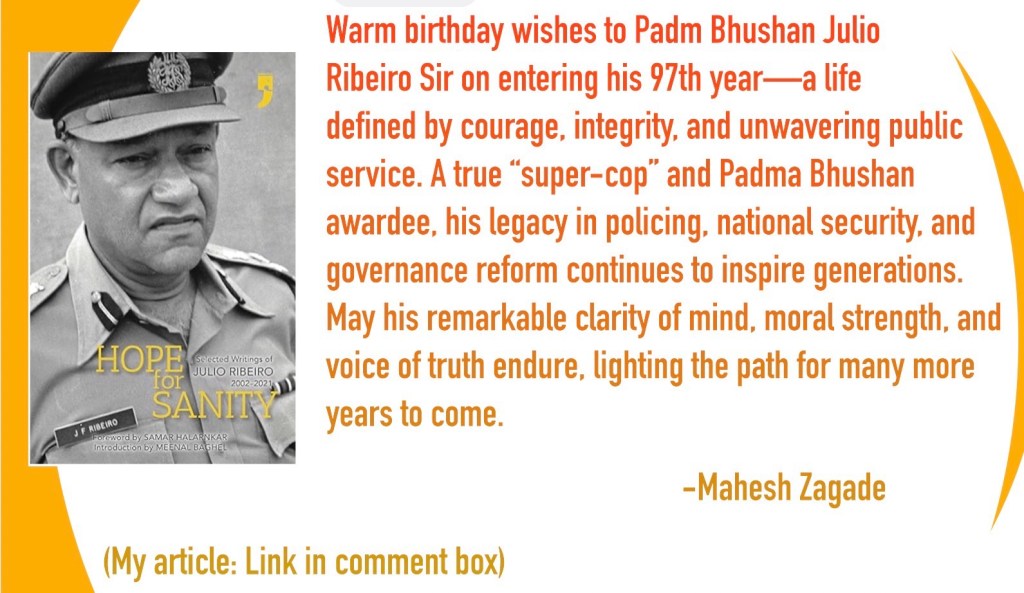
There are lives that pass quietly through the corridors of public service, and then there are lives that illuminate those corridors, leaving behind a steady, incorruptible light by which others may find their way. The life and career of Padma Bhushan Mr Julio Ribeiro belong unmistakably to the latter kind. As he steps into the ninety-seventh year of a long and eventful life, one is compelled not merely to congratulate him, but to reflect upon the rare alloy of courage, discipline, intellect, and moral clarity that he has embodied across decades of national service.
To describe him merely as a distinguished officer of the Indian Police Service would be to understate his stature. He emerged, over time, as a defining figure in the evolution of policing in Maharashtra, setting standards in crime detection, maintenance of law and order, and institutional discipline that have endured long after his formal tenure. His approach was never ornamental; it was precise, unsentimental, and resolutely anchored in the idea that the rule of law must prevail without compromise. In an administrative culture often tempted by expediency, he stood as a reminder that firmness need not exclude fairness, and that authority derives its legitimacy from integrity.
It was, however, during one of the most turbulent chapters in independent India’s history—the rise of militancy associated with the Khalistan movement—that his leadership assumed a national, even international, significance. In the fraught aftermath of Operation Blue Star, when the country grappled with deep internal fissures and a volatile security environment, Mr Ribeiro’s role in restoring a semblance of order and confidence was marked by both strategic acumen and personal courage. These were not merely administrative challenges; they were moral trials, demanding decisions where the costs were immediate and the consequences enduring. His conduct during this period reinforced the idea that the state, when guided by principled leadership, can navigate even the most perilous crises without surrendering its constitutional bearings.
Beyond the domain of policing, his career extended into the sphere of diplomacy, where he represented India abroad with distinction. That transition—from the rigours of internal security to the subtleties of international engagement—speaks to the breadth of his abilities and the trust reposed in him by the nation. It is rare for a single career to traverse such diverse terrains with equal competence, and rarer still to do so while retaining an unblemished reputation.
The conferment of the Padma Bhushan upon him was not merely a recognition of past achievements; it was an acknowledgment of a standard. Indeed, it would not be an exaggeration to say that in the annals of Indian policing and administration, there are few careers that parallel the arc and impact of his own.
Yet, perhaps the most enduring testament to his character lies in what followed his formal retirement. Along with the late B. G. Deshmukh, former Cabinet Secretary to the Government of India, and other like-minded individuals, he established the Public Concern for Governance Trust. The very conception of this institution reflects a deep understanding of the vulnerabilities within governance systems and an unwavering commitment to strengthening them. By offering support to honest officers and advocating for transparency and accountability, the Trust has sought to create an ecosystem where integrity is not an exception but an expectation. That Mr Ribeiro continues to guide it as Chairman Emeritus well into his nineties is, in itself, a lesson in sustained public engagement.
I am one of those who have had the privilege of knowing him personally, the public narrative is only part of the story. From my probationary days in the Home Department at Mantralaya to regular interactions in the Trust’s deliberations these days every month during the PCGT’s monthly meetings, one encounters not merely a decorated officer, but a mind of remarkable vitality. Age, in his case, appears to have sharpened rather than diminished his faculties. His memory remains prodigious, his analytical insights incisive, and his willingness to speak plainly—sometimes uncomfortably so—entirely undiminished. In an era where caution often masquerades as wisdom, his readiness to “call out” what he perceives as wrong stands as a refreshing, if rare, virtue.
His writings in newspapers, engaging with contemporary national and international issues, further reveal a mind that refuses to retreat into the past. They are marked by clarity, conviction, and a certain moral impatience with mediocrity and equivocation. To read them is to engage with a voice that has witnessed history, shaped it in part, and continues to interrogate its present course.
On the occasion of his ninety-seventh year, therefore, the sentiment one offers cannot be confined to routine felicitation. It must carry with it a recognition of what he represents: a continuity of values in a time of flux, a reminder that public service, at its best, is an ethical enterprise. One wishes him not merely longevity, but continued strength—of mind, of voice, and of purpose—so that the torch of integrity he has carried for so long may continue to illuminate the path for those who follow.
In honouring Julio Ribeiro Sir today, we do more than celebrate a life; we reaffirm an ideal.
-Mahesh Zagade