India has completed more than seventy-five years of freedom. That achievement deserves neither casual celebration nor ritual applause, but a moment of serious historical reflection.
In the decades following the Second World War, many nations that emerged from colonial rule saw their democratic experiments collapse. Constitutions were suspended, military regimes seized power, civil wars tore societies apart, and countries disintegrated under the weight of ethnic conflict, authoritarian ambition and institutional fragility. India, despite its immense poverty, linguistic diversity, religious complexity and social inequalities, survived.
Elections were held. Governments were voted out. Power changed hands. A written Constitution continued to govern an extraordinarily diverse civilisation. Courts, legislatures, regulatory bodies, universities, public institutions and local governments expanded. In time, India emerged on the world stage as a significant economic, military, scientific and technological power.
This is no small achievement.
Yet the brilliance of this national success cannot be allowed to conceal the darkness that continues to inhabit the everyday machinery of administration.
It is easy to proclaim that, by the centenary of Independence in 2047, India will become one of the world’s greatest and most radiant democracies. It is easy to speak of a developed India, a digital India, a self-reliant India, an intelligent India and a technologically empowered India.
The ordinary citizen, however, experiences the Republic through a very different vocabulary.
Application.
Certificate.
Affidavit.
Attestation.
Verification.
Objection.
Rejection.
Resubmission.
And waiting.
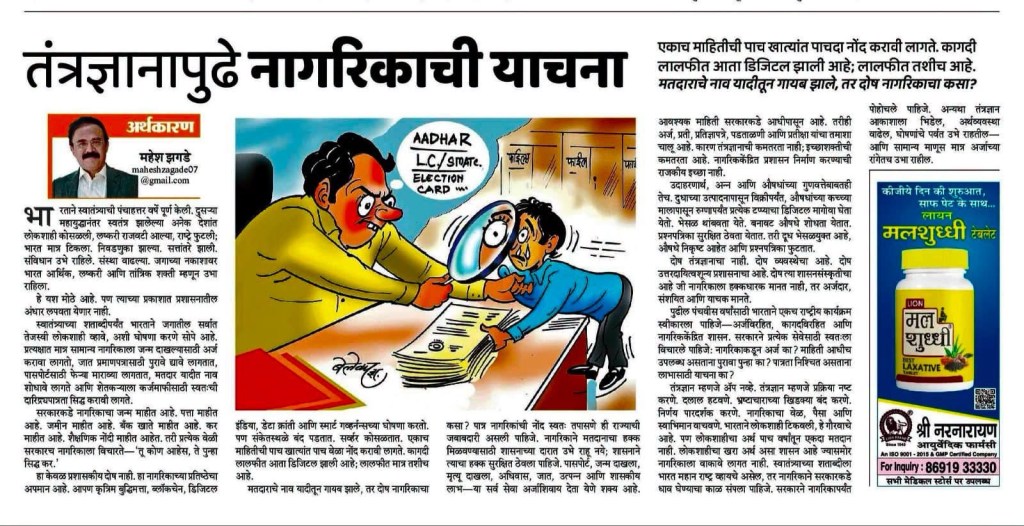
A citizen must apply for a birth certificate, although the birth occurred in a hospital registered with the State. A student must repeatedly produce evidence of caste, residence and income, although the same government has already verified those facts on several previous occasions. A family must run from office to office for a death certificate, even when the death has been recorded by a government hospital or municipal authority. A citizen must struggle to obtain a passport, search for his own name in the electoral roll and, when it disappears without explanation, prove once again that he exists.
A farmer seeking relief must prove that he is distressed.
A poor family seeking assistance must prove that it is poor.
A widow seeking support must prove that her husband is dead.
A senior citizen seeking a pension must prove not merely that he has grown old, but that he is entitled to grow old with dignity.
The State already knows when a citizen was born. It knows where he lives. It knows the land he owns, the taxes he pays, the bank account he operates, the school he attended, the examinations he passed and, increasingly, even the medicines he purchases and the journeys he undertakes.
And yet, at every administrative threshold, the State turns to the citizen and asks:
“Who are you? Prove it again.”
This is not merely an administrative inconvenience. It is not merely a defect in office procedure. It is an assault upon the dignity of citizenship.
A democracy cannot claim to respect its citizens while repeatedly treating them as suspects. It cannot describe people as sovereign and then compel them to appear before every government office as petitioners. It cannot celebrate fundamental rights in constitutional speeches while forcing citizens to plead for services to which they are already legally entitled.
The contradiction becomes even more disturbing when viewed against India’s technological ambitions.
We speak proudly of artificial intelligence, blockchain, facial recognition, digital identity, data analytics, smart cities, digital public infrastructure and algorithmic governance. We announce portals, platforms, dashboards and mobile applications with great ceremony. Each new application is presented as though bureaucracy itself has finally been defeated.
Yet websites remain inaccessible. Servers collapse on the final day for submissions. Portals refuse to recognise information already held by another department. A citizen is required to enter the same name, address, date of birth, bank details and identity numbers five times in five different databases maintained by five branches of the same government.
The colour of the file may have changed.
The file itself may have disappeared from the table.
But the red tape has merely become digital.
The old clerk demanded photocopies. The new portal demands scanned copies.
The old office made the citizen stand in a physical queue. The new system makes him wait before a frozen screen.
The old bureaucracy lost papers. The digital bureaucracy rejects them because the file size exceeds two megabytes.
Technology has modernised the appearance of administration without necessarily transforming its philosophy.
That is the central failure.
The real question is not whether government services are available online. The real question is why citizens must apply for many of them at all.
Consider the electoral roll. Voting is not a concession granted by the State; it is a constitutional expression of citizenship. When the name of an eligible voter mysteriously disappears from the list, why should the burden fall upon the citizen to discover the omission, file an application and wait for correction?
The maintenance of an accurate electoral roll must be an affirmative responsibility of the State.
The citizen should not have to stand at the government’s door to claim the right to vote. The government must stand guard over that right.
Birth certificates, death certificates, domicile records, income certificates, caste certificates, passports, pensions, scholarships and welfare benefits can, in many cases, be generated or initiated without requiring citizens to submit fresh applications. The necessary information is already present within public databases. What is missing is not data but institutional coordination.
What is absent is not technology but political imagination.
What is lacking is the will to build a State that sees the citizen not as an applicant but as the owner of the Republic.
Imagine a different administrative order.
A child is born in a registered hospital. The birth is digitally recorded. A birth certificate is automatically generated and delivered to the parents. The child is added, subject to lawful safeguards, to the relevant civic, health and educational systems.
When the child reaches school-going age, the family receives information about nearby schools and applicable educational entitlements.
When the citizen turns eighteen, the electoral registration process is automatically initiated, with an opportunity to verify or correct the details.
When a person becomes eligible for a pension, scholarship or statutory benefit, the system identifies that eligibility and informs the citizen.
When death is registered, the death certificate is generated automatically, relevant pension and insurance systems are notified, and the family is spared the cruelty of proving bereavement repeatedly before indifferent counters.
None of this belongs to science fiction.
The data exists. The computing capacity exists. The digital identity infrastructure exists. The administrative machinery exists.
What does not yet exist in sufficient measure is a citizen-centred philosophy of governance.
Technology is often mistaken for the creation of an application. But genuine technological reform is not the digitisation of an existing burden. It is the elimination of the burden itself.
Technology should not merely convert a paper form into an electronic form. It should ask whether that form is necessary.
It should not merely create an online queue. It should abolish the queue.
It should not merely transfer discretion from a desk to a dashboard. It should make the decision transparent, traceable and accountable.
It should remove middlemen, close windows of corruption, reduce arbitrary power and protect the citizen’s time, money and self-respect.
The same principle applies to regulatory governance.
India continues to confront adulterated food, substandard medicines, counterfeit drugs, examination paper leaks and failures in the delivery of essential services. Each crisis is followed by outrage, raids, arrests, inquiries, press conferences and promises of stringent action. Yet the underlying systems remain unchanged.
From the production of milk to its processing, transportation and sale, every critical stage can be digitally traced. Deviations in temperature, volume, chemical composition and movement can be flagged. Patterns of adulteration can be detected before contaminated products reach consumers.
In the pharmaceutical sector, the journey of a medicine—from raw material and manufacturing batch to distributor, pharmacy and patient—can be made traceable. Counterfeit products can be identified. Recalls can be executed swiftly. Supply-chain manipulation can be detected through data rather than discovered after patients have suffered.
Question papers can be encrypted, access can be restricted, digital trails can reveal unauthorised entry, and responsibility can be fixed with precision.
Yet adulterated milk continues to be sold. Substandard medicines reach patients. Examination papers leak. Fraudulent certificates are issued. Public records disappear.
The failure is not technological.
It is administrative.
It arises from fragmented databases, institutional rivalries, outdated procedures, absence of accountability and, above all, a governance culture that has not fully accepted that public power exists for the citizen.
Technology cannot redeem an administration that does not wish to be accountable.
Artificial intelligence cannot compensate for artificial responsibility.
Blockchain cannot cure broken institutions.
A mobile application cannot replace administrative morality.
A dashboard cannot substitute for duty.
Unless the philosophy of governance changes, every technological innovation risks becoming another ornamental layer placed over an unreformed system.
India therefore needs, for the next twenty-five years, a national mission of extraordinary clarity:
Application-free, paperless and citizen-centred governance.
Every ministry, department, municipality, district administration, regulatory authority and local body must be compelled to ask three fundamental questions.
Why is the citizen being required to apply?
Why is the citizen being asked to provide information that the government already possesses?
Why must an eligible person plead for a benefit that the law has already granted?
These questions must not be treated as matters of administrative convenience. They concern the constitutional relationship between the State and the individual.
Under the present system, citizens are expected to understand departmental boundaries, even though those boundaries are creations of government. They are asked to carry information from one public office to another because government departments often refuse to communicate with one another.
To the citizen, however, there is only one government.
He should not suffer because the Revenue Department cannot communicate with the Registration Department, because a municipality cannot access hospital records, because a welfare department cannot verify income data or because an electoral authority cannot coordinate with civil registration systems.
The architecture of the State must be invisible to the citizen.
The burden of coordination must rest upon government, not upon the governed.
Such integration must, of course, be accompanied by rigorous protection of privacy, informed consent, cybersecurity, legal safeguards and strict limitations on the use of personal data. A citizen-centred State cannot become a surveillance State. Data collected for public welfare must not be converted into an instrument of political control, commercial exploitation or administrative intimidation.
The objective is not to make the citizen transparent before the government while leaving the government opaque before the citizen.
The objective is precisely the opposite: to make public decisions transparent, government actions auditable and citizens’ rights effortless to exercise.
Technology must strengthen liberty, not weaken it.
It must reduce State intrusion, not expand it.
It must empower the citizen, not merely make him more easily measurable.
India deserves credit for preserving electoral democracy through turbulent decades. But democracy cannot be reduced to the act of voting once every five years. Elections are the doorway to democracy; they are not the entire house.
The true measure of democracy is found in the daily encounter between the individual and the State.
Does the citizen receive a service without humiliation?
Is a lawful application decided within a defined period?
Is rejection accompanied by reasons?
Can the official responsible for delay be identified?
Can an appeal be made without influence or bribery?
Does the system presume honesty, or does it begin with suspicion?
Does the State protect rights automatically, or does it wait for citizens to beg?
A nation may possess magnificent highways, advanced weapons, digital payment systems, space missions and artificial intelligence laboratories, yet remain administratively primitive if its citizens are forced to plead for elementary documents and lawful entitlements.
A country does not become modern merely because its government uses computers.
It becomes modern when power is reorganised around human dignity.
The coming decades will determine whether India’s technological revolution liberates the citizen or merely digitises his helplessness.
By the centenary of Independence, the citizen’s journey to government offices should have largely ended. Rights should not depend upon personal connections. Certificates should not require repeated supplication. Welfare should not arrive as political charity. Public services should not be presented as favours granted by rulers to grateful subjects.
The government must cease asking the citizen to come to it.
The government must reach the citizen.
It must identify eligibility, deliver services, prevent exclusion and correct its own errors before those errors destroy livelihoods.
Otherwise, technology may rise to the heavens. The economy may expand. Artificial intelligence may astonish the world. Towers of declarations may be erected, one upon another.
And beneath those glittering towers, the ordinary citizen will still be standing in the same old queue—
holding an application,
carrying a bundle of proofs,
and waiting for the Republic to recognise him.
—Mahesh Zagade