The Croaking Retiree: A Bureaucrat’s Eulogy to Ignorance

In the grand theatre of governance, where wisdom and prudence were once considered the pillars of administrative service, emerges a voice from the abyss—an erstwhile high-ranking bureaucrat, whom we shall, for the sake of brevity, call the Retiree. This distinguished specimen of public service has taken it upon himself to issue a diktat to the nation: Thou shalt not question the omniscience of the IAS officer in power today, for they are the harbingers of all knowledge and governance.

The Retiree, once perched on the tallest branches of administration, now finds himself croaking from the depths of irrelevance. His proclamations reek of a devotion not to public service, but to a brand of ideological servitude that blinds him to reason, morality, and even the faintest echoes of reality. He has found his true calling not in post-retirement reflection but in a self-righteous crusade against intelligence, progress, and above all, the idea that power should ever be questioned.  

The Gospel According to the Retiree

According to this self-anointed oracle of bureaucracy, any discussion about the plight of farmers, the destitute, or the socially disadvantaged is not an exercise in governance but an act of sedition. To even suggest measures that may alleviate their suffering is, in his lexicon, to flirt with the ghost of Karl Marx. Indeed, the mere act of questioning economic disparity or proposing a fairer system he maligns such an individual with the most damning of all titles—A Communist!  

One would imagine that a person who once wielded the pen of policy and the sword of executive power would at least grasp the basic tenets of governance. But no, the Retiree sees the world through a peculiar prism, where stark ignorance is wisdom, mental derailment is intellectual prowess, and logic is but an unfortunate affliction of the weak-minded. His convictions, as unshakable as a weathered bureaucratic file gathering dust in a forgotten ministry, are not merely wrong but stunningly oblivious to their own contradictions.  

Trump, Putin, and the Retiree’s Political Waltz

The Retiree’s ideological compass points resolutely to the extreme right, and his devotion to the gospel of Donald Trump is near religious. Why? Because Trump, like Retiree, thrives on the belief that knowledge is overrated, that institutions exist to be dismantled, and that those who question authority are to be ridiculed rather than heard. But here lies the comedy of it all: while the Retiree worships Trump as the supreme leader of the far-right, he conveniently ignores the rather inconvenient reality that Trump himself now embraces Vladimir Putin, a man who—by any stretch of the Retiree’s fevered imagination—would qualify as an extreme communist.  

But such glaring contradictions do not trouble the fortified walls of the Retiree’s mind, for inside that citadel of circular logic, only one rule exists: I am right, because I say so. The fact that Trump, his ideological messiah, is dancing a diplomatic tango with a leader the Retiree would otherwise despise does not cause him the slightest distress. No, because to acknowledge such paradoxes would require a cognitive flexibility that he has long since abandoned in favor of the simple, comfortable dogma of the far-right echo chamber.  

The Bureaucratic Landmines in India’s Progress

The Retiree’s existence is not merely a minor embarrassment to the IAS fraternity; he is a cautionary tale, a stark reminder of how the corridors of power sometimes breed men who mistake their titles for infallibility. The Indian Administrative Service, for all its imperfections, has been the backbone of governance for nearly eight decades. It has weathered crises, delivered policies, and, at times, served as the last line of defense against political waywardness.  

But then, there are anomalies like the Retiree—bureaucratic landmines, waiting to explode with ignorance, bigotry, and an inexplicable hostility to progress. Such individuals do not merely fail to serve the people during their tenure; they continue their reign of intellectual terror long after retirement, spreading their warped legacy with the enthusiasm of a zealot.  

A Nation’s Imperative: Shun the Croakers

If India is to move forward, it must learn to distinguish between administrators and ideological zealots, between wisdom and dogma, and most importantly, between governance and hollow grandstanding. The Retiree represents the rot that festers when power is mistaken for intelligence, when ideology eclipses logic, and when the civil services, meant to be impartial and rational, become breeding grounds for blind allegiance to extremism.  

We must not merely reject such individuals—we must hold them accountable for the damage they do, both in service and in retirement. The true measure of an administrator is not in the power they wield, but in the integrity with which they wield it. And by that measure, the Retiree, in all his croaking glory, is nothing more than a lamentable footnote in the annals of bureaucracy—a relic best left in the past, as India strides toward a future where governance is dictated not by ideology, but by reason and justice.
Standard

The Population Paradox: Addressing the Myths and Realities of Decline 

The RSS chief, Shri Mohanji Bhagwat, expressed concern about the declining population of India in a public program in Nagpur on December 1. He further appealed that the current fertility rate in the country has come down to 2.1, which will cause immense harm to the society due to the decrease in population. Considering the social status of Shri Bhagwat in the country, his statement is of immense importance. It is natural to get reactions to the concerns he has expressed, and such reactions have been received.

It will be necessary to understand the reality behind Shri Bhagwat’s statement scientifically. Research has been done all over the world on demography in the last two hundred years and there is a general consensus on one figure, which is that if 2.1 children are born per woman, that is, if the fertility rate is 2.1, the population of that country remains stable without increasing. If the fertility rate is more than 2.1 per woman, the population continues to increase, and if it is less than that, the population decreases over time. Therefore, there is truth in Shri Bhagwat’s statement that if less than 2.1 children are born per woman, the population will start decreasing over time. Of course, this is not just a theory, but its reality is now starting to be seen all over the world. The fertility rate of Macau, South Korea, Hong Kong, Puerto Rico, Taiwan, etc. is less than 1.0. Out of 209 countries for which fertility rate data is available, the fertility rate of 114 countries has decreased to less than 2.1, and the average fertility rate of the entire world is 2.2, i.e., the population has almost reached a plateau. From this, a clear conclusion is drawn that it is an undeniable fact that the fertility rate is definitely decreasing in terms of population growth. Shri Bhagwat’s prediction that India’s current fertility rate of 2.1 will not increase over time is definitely true. But there is another side to it, which is also important. Looking at the future of the country only through the prism of declining fertility rate will not be right. This matter also needs to be discussed and analyzed thoroughly on the basis of scientific and statistical science.

Since the evolution of man about three lakh years ago, when he lived in forests or caves, his number has increased and his global population has reached about one to fifteen lakhs. But when he started farming about ten to twelve thousand years ago, there was a huge upheaval and the number of humans suddenly increased and around the year 1800, the global population reached 100 crores. In other words, it took about three lakh years for the global population of humans to reach 100 crores, however, in the last 220 years alone, it has increased eightfold and now it has reached 805 crores and is still increasing. According to the United Nations, by the year 2086, after this population reaches 10.4 billions, its growth will stop and then the population will start to decline and in the year 2100, it will again come down to 10.3 billions and this process of population decline will continue. There are many opinions about how this population decline will be. Darrell Bricker and John Ibbitson, in their book ‘Empty Planet’, have expressed their doubts in the title of their book whether this planet will become uninhabited. Of course, although different figures are given by different organizations or researchers in this regard, one fact is now clear, which is that the world’s population will definitely start declining by the end of the next century, rather than increasing permanently, and it has actually started in 114 out of the two hundred and nine countries of the world.

There is no consensus on the ideal population of the entire world or each country. But one fact is that the extent to which humans have used the resources of this planet in an uncontrolled and sometimes reckless or unwise manner over the past 250 years has created a man-made threat to this planet by permanently changing the climate. Therefore, the biggest problem facing the world is whether the very existence of humans will be in danger. The root causes of this problem are the excessive and excessive misuse of technology, a wrong economy and a huge population. If we consider this planet, the uncontrolled increase in the number of humans is neither in the interest of the planet nor of humans. Therefore, if the number of humans is decreasing naturally and the balance in nature is being restored, then there should be no objection to considering it as a positive thing. 

If we consider India, the population will continue to grow for the next five decades, reaching 1.7 billion from the current 142 crore, then stabilizing and then decreasing. Therefore, the situation is not the same as the problem of population decline that Shri Bhagwat has expressed, but considering the current fertility rate, another 30 crore people will be added to the population in the next fifty years. Therefore, it is a fact that India will remain the country with the ‘most populous’ population in the world until the year 2100 or even beyond, and we should also consider how appropriate it is to give the title of ‘most populous’ or ‘number one population’ in the world.

In the above context, according to the idea that Shri Bhagwat has put forward that couples should have two to three children, if couples decide to accept his advice, then it is difficult to estimate how much additional population can increase, but it is equally true that the population increase will definitely be more than 30 crore.

It will also be necessary to consider whether this population increase is suitable for India or not. If we look at the global statistics, India’s situation seems contradictory. While we dream of becoming a global superpower, the reality before us is harsh. India’s comparative statistical position in the world is very weak and has always been a challenge to our economic aspirations. 

Let us study the global situation and understand how India stands compared to other rich countries.

Compared to the major countries of the world, India’s position is as follows: 

– Area: Only 2% of the world’s total land area 

– Population: 17.78% of the world’s total population 

– GDP: Only 3.53% of the world’s total GDP 

– Per capita income: Only ₹2.28 lakh (about $2,750) 

In contrast, the figures of a superpower like the United States are: 

– Area: 6.1%

– Population: 4.23% 

– GDP: 26.51% of the world’s total GDP 

– Per capita income: ₹73.17 lakh (about $88,000) 

These figures make it clear that there is a huge gap between India and the United States. Despite India’s population being almost four times that of the United States, its economy is only one-seventh that of the United States. Moreover, the per capita income is very low compared to the United States. To become a global superpower like the US, given its population and per capita income, India would have to grow its current economy of $3.89 trillion to $122 trillion. That is five times the size of the current US economy, and more than the current world GDP ($110 trillion)! While this growth is theoretically possible, it is practically impossible. The most important problem is the unbridled expansion of our population, which is putting a huge strain on our resources. In my opinion, the biggest obstacle in India’s economic math is its huge population! Our economy cannot grow fast enough to keep up with the growth of our population. This results in a very low per capita income. China has largely curbed this problem by implementing strict population control policies. However, in India, population control measures have not been very effective due to political and social reasons. We are seeing the results—crowded cities, crumbling infrastructure, and limited economic growth. This necessitates accepting the reality of the limitations of available resources and land. India is home to 17.78% of the world’s population on 2% of its land area. This disparity is leading to overuse of resources—land degradation, water scarcity, and pressure on arable land. Countries like the United States are blessed with abundant land and natural resources. In contrast, India has to grow within its limited resources. This affects its productivity and limits its ability to create wealth. 

To become a global superpower, India must prioritize population control, efficient use of resources, and growth areas. Political will, social support, and international cooperation will be key factors in this journey. 

We must face the reality that with only 2% of the land area, 17.78% of the population, and 3.53% of the GDP—we must always be aware of these harsh realities. If this math is to change, India can adopt economic restructuring and progressive policies while simultaneously controlling population, or at least supporting population control without interfering with the fertility rate that is currently declining, if it is self-regulating. Only by striving on this path can India take a step forward to become an economic superpower, where wealth and equality are balanced.

-Mahesh Zagade, IAS(rtd)

Standard

Selling Your Soul: The Perils of Trading with the Devil, a Lesson for Democracy

Introduction

The concept of selling one’s soul to the devil has intrigued and frightened humanity for centuries, often serving as a cautionary tale against compromising one’s values for personal gain. This metaphorical idea has transcended literature and folklore, finding its place in contemporary discussions about politics, ethics, and governance. When considering the intersection of this notion with democracy, a thought-provoking analogy emerges: the notion that the purchaser, akin to the devil in the folklore, may not always be what it seems. Let’s delve into the intriguing correlation between selling one’s soul and democratic compromise, shedding light on the potential dangers when ideals are sacrificed in the pursuit of power.

The Temptation of Selling One’s Soul

The idea of selling one’s soul is symbolic of making a Faustian bargain, exchanging long-held principles and beliefs for short-term gains. This metaphor transcends cultural and historical boundaries, appearing in various forms in literature, art, and religious texts. The archetype of the devil represents the allure of power and material success, often tempting individuals with promises of wealth, fame, or influence. The consequences of such a pact, however, tend to be dire, leaving the individual spiritually impoverished and morally compromised.

In a broader context, the temptation to compromise one’s values is not confined to personal stories but extends to societal and political realms. Democracy, a system that is built upon the principles of representation, accountability, and the will of the people, can also fall prey to compromise when its actors prioritize power over principles.

The Devil in Democracy

Democracy, despite its ideals, is not immune to the seductive allure of compromise. Elected officials, in the quest for power and influence, may sometimes abandon their original convictions and the needs of their constituents. The “purchaser” in this context could be seen as special interest groups, lobbyists, foreign powers, or even sectarian ideologies seeking to influence the democratic process. The promise of financial support, endorsements, or campaign assistance may lead politicians to make choices that deviate from the greater good.

Moreover, the devilish aspect of democracy becomes even more evident when examining the rise of populism and demagoguery. Leaders who exploit fear, prejudice, and misinformation to gain power may offer simple solutions to complex problems, capitalizing or diverting attention to inconsequential emotional tools, on the frustrations of the electorate. This compromises the very essence of democracy, as it substitutes informed decision-making with emotional manipulation.

The Erosion of Democratic Values

Just as the individual who sells his soul experiences a gradual erosion of his identity and moral compass, democracy too can suffer a degradation of its core values. When elected representatives prioritize their personal ambitions or working for a cause that could be detrimental to the masses, over the well-being of the populace, public trust in democratic institutions diminishes. Citizens become disillusioned, feeling disconnected from a system that appears to serve the interests of the powerful rather than the common good.

An erosion of democratic values can lead to a concentration of power in the hands of a few, undermining the checks and balances that are essential to maintaining a healthy democracy. When leaders are willing to compromise ethics for personal or political gain, corruption can become rampant, weakening the very foundation of democratic governance.

The Road to Redemption

Just as the devilish contract can lead to regret and a yearning for redemption in folklore, democracies too have the potential to self-correct. Acknowledging the dangers of compromising principles for power is the first step towards preventing the erosion of democratic values. Citizens, informed and engaged, can demand accountability from their elected representatives, thereby ensuring that the pursuit of power does not come at the expense of ethical governance and secured future.

Transparency and accountability mechanisms are crucial tools in preventing the devilish influence of compromise from taking root. Strengthening campaign finance regulations, promoting independent media, and encouraging civic education are strategies that can help citizens make informed choices and hold their representatives accountable.

In conclusion, the metaphorical notion of selling one’s soul to the devil offers a cautionary tale that resonates across cultures and time periods. When juxtaposed with democracy, this metaphor provides insight into the dangers of compromising principles for power. Just as the devil in folklore tempts with promises of success and fulfillment, the allure of power and influence can lead individuals and even entire democratic systems astray.

However, it is also emphasised that the redeeming power of awareness and action has its own significance. By recognizing the perils of compromise and prioritizing ethical governance, citizens can guide their democracies away from the path of erosion and towards a more principled and accountable future. Ultimately, the lesson to be learned is that while the temptation to sell one’s soul may persist, it is within our collective power to resist the allure of compromise and protect the integrity of democratic ideals.

Standard

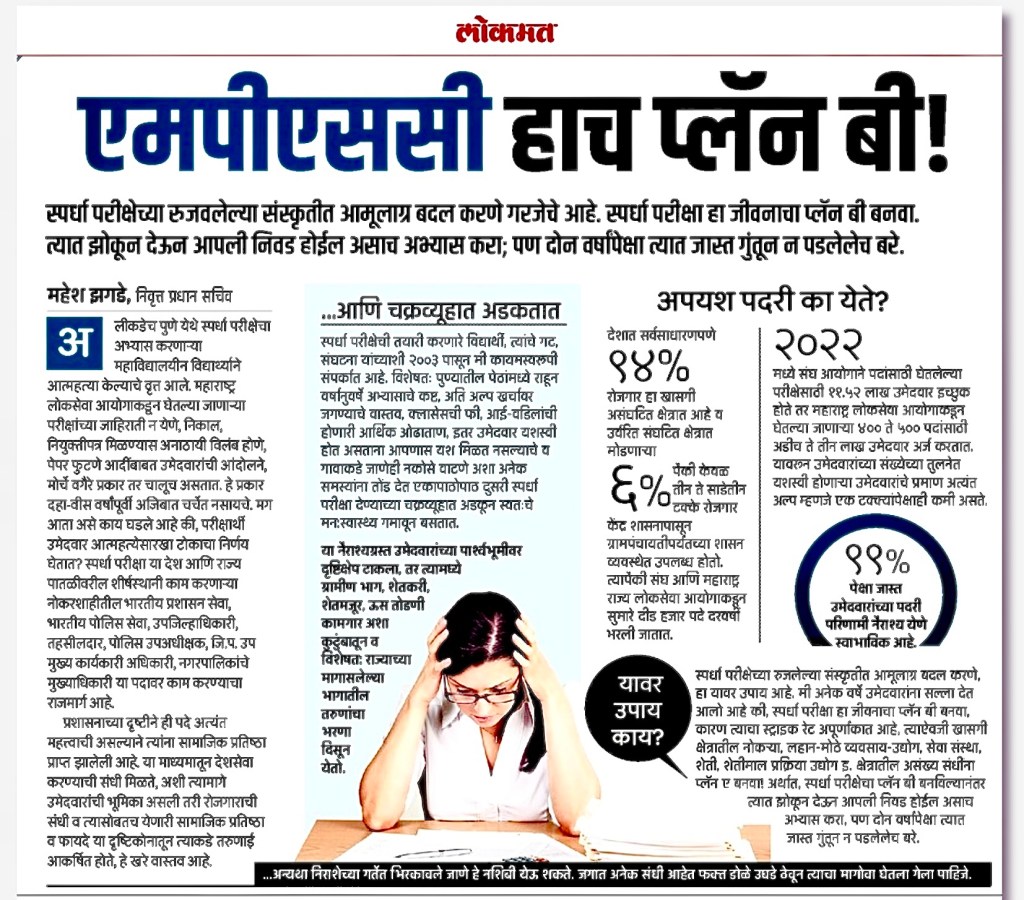
एमपीएससी हाच प्लॅन-बी बनवा!

अलीकडेच पुणे येथील स्पर्धा परीक्षेचा अभ्यास करणाऱ्या महाविद्यालयीन विद्यार्थ्याने आत्महत्या केल्याचे वृत्त आले. महाराष्ट्र लोकसेवा आयोगाकडून घेतल्या जाणाऱ्या परीक्षांच्या जाहिराती न येणे, परीक्षा, निकालास, नियुक्तीपत्र मिळण्यास अनाठायी विलंब होणे, परीक्षा पेपर फुटणे इ सारख्या अनेक बाबतीत उमेदवारांची आंदोलने मोर्चे वगैरे प्रकार तर चालूच असतात.

हे प्रकार दहा वीस वर्षांपूर्वी अजिबात चर्चेत नसायचे. मग आता असे काय घडले आहे की जेणेकरून परीक्षार्थी उमेदवार आत्महत्या सारख्या टोकाचा निर्णय घेतात हा प्रश्न पडतो. स्पर्धा परीक्षा या देश आणि राज्य पातळीवरील शीर्षस्थानी काम बजावणाऱ्या नोकरशाहीतील भारतीय प्रशासन सेवा, भारतीय पोलीस सेवा, उपजिल्हाधिकारी, तहसीलदार, पोलीस उपअधीक्षक, जि.प. उप मुख्य कार्यकारी अधिकारी, नगरपालिकांचे मुख्याधिकारी वगैरे मुख्य सेवांचा समावेश होतो. प्रशासनाच्या दृष्टीने ही पदे अत्यंत महत्त्वाची असल्याने अशा पदांना सामाजिक प्रतिष्ठा निर्माण झालेली आहे. या माध्यमातून देश सेवा करण्याची संधी मिळते अशी त्यामागे उमेदवारांची भूमिका असली तरी रोजगाराची संधी व त्यासोबतच येणारी सामाजिक प्रतिष्ठा व फायदे या दृष्टिकोनातून त्याकडे तरुणाई आकर्षित होते हे खरे वास्तव.

शासन नोकरशाहीच्या स्वरूपात रोजगाराच्या संधी उपलब्ध करून देणारा देशातील सर्वात मोठ्या आस्थापनांपैकी एक आस्थापना आहे. राज्यशकट चालवण्यासाठी तटस्थ पद्धतीने निवडलेली प्रगल्भ बुद्धिमत्तेचे उमेदवार लोकसेवा आयोगाकडून स्पर्धा परीक्षेच्या माध्यमातून निवडले जातात. वरिष्ठ नोकरशाहीत रोजगारांच्या संधी ह्याचे वास्तव काय आहे हे समजून घेणे आवश्यक झाले आहे कारण लाखो उमेदवार व विशेषतः ग्रामीण महाराष्ट्रातील तरुण-तरुणी पदवीनंतरची सात आठ वर्ष उमेदीची वर्षे स्पर्धा परीक्षा देण्यामध्ये व्यतीत करतात. हे प्रकरण आता पुढे गेले आहे. स्पर्धा परीक्षामधून निवड झाल्यानंतर यशस्वी उमेदवारांचा जाहीर सत्कार मिरवणुका, जाहिराती, प्रसार माध्यमाद्वारे त्यास मिळालेली प्रसिद्धी या सर्वांच्या परिपाकामुळे स्पर्धा परीक्षा भोवती एक अत्यंत विलोभनीय वलय निर्माण झालेले आहे. त्यातच स्पर्धा परीक्षांचा व्यापार करून भुलभुलैय्या वातावरणाद्वारे उमेदवार आणि त्यांच्या कुटुंबाची आर्थिक लूट करणारे ‘हमखास यशाची हमी’ देणाऱ्या स्पर्धा परीक्षा क्लासेसचे फुटलेले पेव! उमेदवारांना या परीक्षांच्या जंजाळात वर्षानुवर्षी अडकवून ठेवून भरमसाठ नफा मिळवणे हाच या क्लासेसचा मुख्य उद्देश असतो पण उमेदवारांकरता ती अपरिहार्यता होत जाते. याशिवाय हे क्लासेस नोकरशाहीतील काही अधिकारी आपल्या व्याख्याना द्वारे ‘प्रशासकीय नोकरी करणे म्हणजे जीवनात त्यास अन्य तोड नाही’ अशा स्वरूपाचा त्यास तेजोमय मुलामा देऊन स्वतःच्या कर्तृत्वाचा डांगोरा पिटवत तरुणाईस भुरळ पाडीत असतात.

स्पर्धा परीक्षेची तयारी करणारे विद्यार्थी, त्यांचे गट, संघटना यांच्याशी २००३ पासून मी कायमस्वरूपी संपर्कात आहे. विशेषतः पुण्यातील पेठांमध्ये राहून वर्षानुवर्षे अभ्यासाचे कष्ट, अति अल्प खर्चावर जगण्याचे वास्तव, क्लासेसची फी, आई-वडिलांची होणारी आर्थिक ओढाताण, इतर उमेदवारा यशस्वी होत असताना आपणास यश मिळत नसल्याचे गावाकडे जाणेही नकोसे वाटणे अशा अनेक समस्यांना तोंड देत एका पाठोपाठ दुसरी स्पर्धा परीक्षा देण्याच्या चक्रव्युव्हात अडकून स्वतःचे मन:स्वास्थ्य गमावून बसतात. या नैराश्यकग्रस्त उमेदवारांच्या पार्श्वभूमीवर दृष्टीकोण टाकला तर त्यामध्ये ग्रामीण भाग, शेतकरी, शेतमजूर, ऊस तोडणी कामगार अशा कुटुंबातून व विशेषत: राज्याच्या मागासलेल्या भागातील तरुणांचा भरणा दिसून येतो. अलीकडेच या उमेदवारांच्या विदारक परिस्थितीवर भाष्य करणाऱ्या ‘यथावकाश’ हा उमेदवारांनीच निर्माण केलेल्या चित्रपटाच्या प्रीमियरला पुण्यात उपस्थित राहिलो त्यामध्ये प्रकर्षाने प्रकर्ष. परिस्थितीचे त्यांनी जे वास्तव कथानकाद्वारे रेखाटले आहे ते पाहून मन विदारक होते.

याबाबत नेमकी वस्तूस्थिती काय आहे ते सर्व इच्छुक उमेदवार,त्यांचे कुटुंबीय, माध्यमे, शैक्षणिक संस्था, सामाजिक कार्यकर्ते इ नी समजून घेतले पाहिजे. गेल्या तीन दशकांमध्ये देशात शिक्षणाचा प्रसार मोठ्या प्रमाणात झाल्याने गावागावात, कुटुंबात पदवीधारक निर्माण होत आहेत व या सर्वांचा बहुतांश ओढा नोकऱ्या आणि त्या देखील शासकीय नोकऱ्या आणि विशेषत: वरिष्ठ पदावरील नोकऱ्या याकडे असतो. देशात सर्व साधारणपणे 94% रोजगार हा खाजगी असंघटित क्षेत्रात आहे व उर्वरित संघटित क्षेत्रात मोडणाऱ्या 6% पैकी केवळ तीन ते साडेतीन टक्के रोजगार केंद्र शासनापासून ग्रामपंचायतीपर्यंतच्या शासन व्यवस्थेत उपलब्ध होतो. त्यापैकी संघ आणि महाराष्ट्र राज्य लोकसेवा आयोगाकडून सुमारे दीड हजार पदे दरवर्षी भरली जातात. संघ आयोगाने पदांसाठी 2022 मध्ये घेतलेल्या परीक्षेसाठी ११.५२ लाख उमेदवारी इच्छुक होते तर महाराष्ट्र लोकसेवा आयोगाकडून घेतल्या जाणाऱ्या 400 ते 500 पदांसाठी अडीच ते तीन लाख उमेदवारा अर्ज करतात. यावरून उमेदवारांच्या संख्येच्या तुलनेत यशस्वी होणाऱ्या उमेदवारांचे प्रमाण अत्यंत अल्प म्हणजे एक टक्यापेक्षाही कमी असते.

परिणामतः ९९% पेक्षा जास्त उमेदवारांच्या पदरी नैराश्य येणे स्वाभाविक आहे.

यावर उपाय म्हणजे हि वस्तुस्थिती उमेदवार आणि त्यांच्या कुटुंबियांवर रुजविणे. तसेच बेगडी मार्गदर्शन करून उमेदवारांना भरकटविणाऱ्या अधिकाऱ्यावर चाप आणला गेला पाहिजे. क्लासेसने त्यांच्या जाहिरातीमध्ये वास्तस्थिती देण्याचे बंधन घालणे गरजेचे आहे. अर्थात हे झाले वरवरचे उपाय.

खरा उपाय म्हणजे सध्याची जी स्पर्धा परीक्षा संस्कृती रुजवली गेली आहे त्यात अमुलाग्र बदल करणे.

मी अनेक वर्ष या उमेदवारांना सल्ला देत आलो आहे की स्पर्धा परीक्षा या जीवनाचा प्लॅन-बी बनवा, कारण ज्याचा स्ट्राईक रेट अपूर्णांकात आहे त्या ऐवजी खाजगी क्षेत्रातील नोकऱ्या, लहान मोठे व्यवसाय-उद्योग, सेवा संस्था, शेती, शेतीमाल प्रक्रिया उद्योग इ क्षेत्रातील असंख्य संधींना प्लॅन-ए बनवा! अर्थात स्पर्धा परीक्षेचा प्लॅन-बी बनवल्यानंतर त्यात झोकून देऊन आपली निवड होईल असाच अभ्यास करा, पण दोन वर्षापेक्षा जास्त त्यात गुंतून न पडलेलेच बरे. अन्यथा निराशेच्या गर्तेत भिरकावले जाणे हे नशिबी येऊ शकते. जगात अनेक संधी आहेत फक्त डोळे उघडे ठेवून त्याचा मागवा घेतला गेला पाहिजे.

Standard

Perceptions of Justice:The Dichotomy between Ideal and Realised Justice.

Introduction:

The concept of justice holds a significant place in human societies, embodying the fundamental principles of fairness, equality, and moral rightness. However, the perception and experience of justice often differ between the idealistic notion and the practical realisation. The intriguing dichotomy that justice is not solely defined by its inherent qualities but rather by the outcomes individuals actually receive within a given societal context. Justice, as a fundamental principle, is often associated with notions of fairness, equality, and the rule of law. While subjectivity has been acknowledged as an inherent element in the interpretation and application of justice, the proposition that striving for objectivity in justice can enhance its integrity and alleviate potential biases should not be ignored. By exploring the factors influencing the interpretation of justice and examining the implications of this distinction, we gain valuable insights into the complex dynamics that shape our understanding of justice.

Justice, as an abstract and multifaceted concept, is subject to diverse interpretations and contextual influences. It represents an ideal state of affairs, characterised by equitable treatment, impartiality, and adherence to ethical principles. However, the reality of justice is far from a universal experience, as it is contingent upon numerous socio-cultural, economic, and political factors. Let’s try to shed light on the intricate interplay between the ideal and realised dimensions of justice, emphasising the significance of outcome-based perceptions in evaluating the fairness of a given system.

Ideal Justice:

Ideal justice embodies the vision of a perfect and morally upright society, where every individual is treated fairly, rights are protected, and the rule of law prevails. Rooted in philosophical and ethical frameworks, this conception of justice serves as a benchmark against which societies measure the quality of the human existence. It encompasses theories such as distributive justice, retributive justice, and procedural justice, all seeking to establish a framework that ensures fairness and equality.

Realised Justice: Contextual Factors and Disparities:

The realisation of justice is contingent upon various contextual factors, including socio-economic disparities, cultural norms, historical legacies, and the functioning of legal and political institutions. The application of justice in practice often faces challenges such as bias, corruption, unequal access to legal recourse, and systemic inequalities. These factors contribute to the divergence between the idealised vision of justice and the outcomes experienced by individuals within a given society.

The Role of Perception:

Perceptions of justice are subjective and influenced by personal experiences, social conditioning, and cultural values. The gap between ideal justice and realised justice can lead to disillusionment, frustration, and a loss of trust in the system. Individuals’ perceptions of justice are shaped not only by their direct encounters with the legal system but also by societal narratives, media representation, and collective experiences. Moreover, the unequal distribution of justice can perpetuate social divisions, engendering feelings of marginalisation and injustice.

Perceptions and Subjectivity:

Individual perceptions of justice are subjective and can vary based on personal experiences, cultural background, and societal norms. The outcomes people receive directly impact their perception of justice, as they evaluate the fairness of the system based on the tangible results they observe or experience. Recognising the subjective nature of justice can lead to a deeper understanding of the diverse ways in which individuals engage with and assess justice in their lives.

Implications for Justice Systems:

Embracing an outcome-based perspective on justice has significant implications for the design and functioning of justice systems. It highlights the importance of creating mechanisms that ensure equitable outcomes, rather than solely focusing on the procedural aspects of justice. This necessitates addressing systemic biases, disparities in access to legal resources, and empowering marginalised communities to ensure fairness in outcomes.

Promoting a Just Society:

Acknowledging the connection between justice and outcomes encourages a proactive approach to fostering a just society. This requires continuous evaluation, reform, and the pursuit of policies that aim to improve outcomes for all individuals. Efforts should be directed towards reducing disparities, addressing systemic injustices, and ensuring that the justice system operates in a manner that promotes fairness and equality.

The Societal Ecosystem: Elements and Interactions:

The societal ecosystem comprises various interconnected elements, including cultural values, norms, power structures, economic systems, and legal frameworks. These elements interact and influence one another, creating a dynamic environment that shapes the understanding and implementation of justice. Cultural beliefs and traditions, for instance, inform notions of right and wrong, while economic disparities can impact access to legal resources and representation.

Norms and Power Structures:

Norms, both explicit and implicit, play a crucial role in shaping societal expectations and behaviour. They contribute to the establishment of standards for justice, dictating what is considered fair and acceptable within a given society. Power structures within the societal ecosystem, such as political systems and social hierarchies, can influence the distribution of justice, often resulting in inequalities and differential treatment.

Legal and Political Systems:

The legal and political systems within a society serve as key mechanisms for delivering justice. These systems are designed to interpret and enforce laws, resolve disputes, and safeguard individual rights. However, the functioning of legal and political institutions is influenced by the broader societal ecosystem. Factors such as corruption, bias, and systemic inequalities can undermine the impartiality and effectiveness of these systems, impacting the realisation of justice.

Inequalities and Marginalisation:

The existing societal ecosystem can perpetuate inequalities and marginalisation, leading to a skewed distribution of justice. Discrimination based on factors such as race, gender, socioeconomic status, or caste can create systemic barriers, limiting access to justice for marginalised communities. The interplay between societal power dynamics and justice can further entrench social divisions and contribute to the perpetuation of injustice.

Justice cannot be viewed in isolation from the societal ecosystem in which it operates. The existing social, cultural, economic, and political dynamics significantly shape the understanding, application, and realisation of justice. By recognising and addressing the complexities and challenges within the societal ecosystem, societies can work towards creating a more just and equitable system. Achieving justice requires a holistic approach that encompasses legal reforms, cultural shifts, and a commitment to dismantling systemic barriers.

Implications and Moving Forward:

Recognising the gap between ideal and realised justice is crucial for fostering a more just society. Efforts should be directed toward minimising disparities and ensuring that legal frameworks and institutions are designed to deliver equitable outcomes. Strengthening transparency, accountability, and inclusivity within the justice system is paramount. Additionally, promoting legal literacy and empowering marginalised communities can help bridge the divide between ideal justice and its realisation. In a nutshell, the understanding of justice goes beyond its conceptual definition. It encompasses the tangible outcomes individuals experience within the socio-cultural, economic, and political contexts in which they live. By acknowledging and addressing the disparities between ideal and realised justice, societies can strive towards a more inclusive and equitable system. Achieving justice requires continuous reflection, reform, and collective action to bridge the divide and ensure that justice is not just an abstract ideal, but a tangible reality for all.

Keywords: #justice, #ideal_justice, #realised_justice, #fairness, #equality, #perception, #socio-cultural_factors, #legal_system, #disparities, #social_divisions, #inclusivity.

Standard