Selling Your Soul: The Perils of Trading with the Devil, a Lesson for Democracy

Introduction

The concept of selling one’s soul to the devil has intrigued and frightened humanity for centuries, often serving as a cautionary tale against compromising one’s values for personal gain. This metaphorical idea has transcended literature and folklore, finding its place in contemporary discussions about politics, ethics, and governance. When considering the intersection of this notion with democracy, a thought-provoking analogy emerges: the notion that the purchaser, akin to the devil in the folklore, may not always be what it seems. Let’s delve into the intriguing correlation between selling one’s soul and democratic compromise, shedding light on the potential dangers when ideals are sacrificed in the pursuit of power.

The Temptation of Selling One’s Soul

The idea of selling one’s soul is symbolic of making a Faustian bargain, exchanging long-held principles and beliefs for short-term gains. This metaphor transcends cultural and historical boundaries, appearing in various forms in literature, art, and religious texts. The archetype of the devil represents the allure of power and material success, often tempting individuals with promises of wealth, fame, or influence. The consequences of such a pact, however, tend to be dire, leaving the individual spiritually impoverished and morally compromised.

In a broader context, the temptation to compromise one’s values is not confined to personal stories but extends to societal and political realms. Democracy, a system that is built upon the principles of representation, accountability, and the will of the people, can also fall prey to compromise when its actors prioritize power over principles.

The Devil in Democracy

Democracy, despite its ideals, is not immune to the seductive allure of compromise. Elected officials, in the quest for power and influence, may sometimes abandon their original convictions and the needs of their constituents. The “purchaser” in this context could be seen as special interest groups, lobbyists, foreign powers, or even sectarian ideologies seeking to influence the democratic process. The promise of financial support, endorsements, or campaign assistance may lead politicians to make choices that deviate from the greater good.

Moreover, the devilish aspect of democracy becomes even more evident when examining the rise of populism and demagoguery. Leaders who exploit fear, prejudice, and misinformation to gain power may offer simple solutions to complex problems, capitalizing or diverting attention to inconsequential emotional tools, on the frustrations of the electorate. This compromises the very essence of democracy, as it substitutes informed decision-making with emotional manipulation.

The Erosion of Democratic Values

Just as the individual who sells his soul experiences a gradual erosion of his identity and moral compass, democracy too can suffer a degradation of its core values. When elected representatives prioritize their personal ambitions or working for a cause that could be detrimental to the masses, over the well-being of the populace, public trust in democratic institutions diminishes. Citizens become disillusioned, feeling disconnected from a system that appears to serve the interests of the powerful rather than the common good.

An erosion of democratic values can lead to a concentration of power in the hands of a few, undermining the checks and balances that are essential to maintaining a healthy democracy. When leaders are willing to compromise ethics for personal or political gain, corruption can become rampant, weakening the very foundation of democratic governance.

The Road to Redemption

Just as the devilish contract can lead to regret and a yearning for redemption in folklore, democracies too have the potential to self-correct. Acknowledging the dangers of compromising principles for power is the first step towards preventing the erosion of democratic values. Citizens, informed and engaged, can demand accountability from their elected representatives, thereby ensuring that the pursuit of power does not come at the expense of ethical governance and secured future.

Transparency and accountability mechanisms are crucial tools in preventing the devilish influence of compromise from taking root. Strengthening campaign finance regulations, promoting independent media, and encouraging civic education are strategies that can help citizens make informed choices and hold their representatives accountable.

In conclusion, the metaphorical notion of selling one’s soul to the devil offers a cautionary tale that resonates across cultures and time periods. When juxtaposed with democracy, this metaphor provides insight into the dangers of compromising principles for power. Just as the devil in folklore tempts with promises of success and fulfillment, the allure of power and influence can lead individuals and even entire democratic systems astray.

However, it is also emphasised that the redeeming power of awareness and action has its own significance. By recognizing the perils of compromise and prioritizing ethical governance, citizens can guide their democracies away from the path of erosion and towards a more principled and accountable future. Ultimately, the lesson to be learned is that while the temptation to sell one’s soul may persist, it is within our collective power to resist the allure of compromise and protect the integrity of democratic ideals.

Standard

The Paradox of Human Evolution: Constricting the Mind

Human beings, the most evolved and intelligent species on Earth, possess an unparalleled capacity for progress and advancement. However, amidst our supposed journey towards greater understanding and intelligence, we often find ourselves confined by artificial divisions. The limitations imposed by religion, caste, financial strata, geographical boundaries, and even our concepts of gods hinder our collective growth. This raises a crucial question: Are we truly progressing or inadvertently regressing in terms of our evolution? Let’s delves into the tragic paradox created by human minds and explores the implications of these artificial divides on our collective development.

1. The Potential for Progress:

As a species, humans have demonstrated remarkable intellectual capabilities, enabling us to achieve unprecedented scientific and technological advancements. From unraveling the mysteries of the cosmos to harnessing the power of the atom, we have continuously pushed the boundaries of knowledge and reshaped our world. This inherent potential for progress suggests that we are indeed evolving in terms of understanding and intelligence.

2. Artificial Divides:

Despite our inherent capacity for progress, the human mind often erects barriers that hinder our development. These artificial divides manifest in various forms such as religion, caste, financial strata, geographical boundaries, and concepts of gods. While these constructs have historical, cultural, and social roots, they tend to constrict our cerebral resources and limit our collective potential.

a) Religion: Throughout history, religion has played a significant role in shaping human societies and providing a sense of meaning and purpose. However, when rigid beliefs and dogmas replace open-minded inquiry, they can impede the pursuit of knowledge and stifle intellectual growth. Interfaith conflicts and religious fundamentalism exemplify the regressive tendencies that can emerge when religion becomes a barrier to progress.

b) Caste and Financial Strata: Social stratification based on caste or economic status creates artificial divisions within societies. Discrimination and unequal access to opportunities prevent the full utilization of human potential, hindering progress and perpetuating societal imbalances. The confinement of intellectual resources within specific social groups obstructs the collective advancement of humanity.

c) Geographical Boundaries: Nationalism and geopolitical divisions often reinforce artificial boundaries that limit the exchange of ideas and impede collaboration. The focus on protecting national interests can overshadow collective global challenges, hindering scientific cooperation and slowing down progress. In an interconnected world, these boundaries can be counterproductive to our evolution as a species.

d) Concepts of Gods: While concepts of gods and spirituality can provide solace and guidance, rigid adherence to specific doctrines can hinder critical thinking and the exploration of alternative ideas. When dogmatic beliefs dominate intellectual discourse, it restricts the growth of knowledge and undermines the spirit of scientific inquiry.

3. Regressive Tendencies:

The persistence of these artificial divides suggests that, despite our potential for progress, we are not evolving as rapidly as we could be. The tragedy lies in the fact that the very constructs we create to find meaning and security often become barriers to our collective growth. By focusing on narrow identities and limiting our perspectives, we fail to tap into the full range of human intelligence and imagination.

4. Way forward:

To overcome this tragic paradox, it is crucial to recognize the limitations of these artificial divides and embrace a more inclusive and open-minded approach to our collective evolution. By fostering a spirit of cooperation, encouraging intellectual diversity, and promoting dialogue across boundaries, we can begin to transcend the constraints that hamper our progress. Education and awareness play a crucial role in dismantling these divisions, nurturing a society that values knowledge, empathy, and collaboration.

In a nutshell, while human beings possess remarkable intellectual capabilities, our progress is often hindered by the artificial divides we create. Religion, caste, financial strata, geographical boundaries, and concepts of gods restrict our collective growth and impede our evolution as a species. To truly realize our potential, we must transcend these barriers and foster an inclusive, open-minded approach that values knowledge, empathy, and cooperation. Only then can we break free from the tragedy created by our own minds and embark on a path of true enlightenment and progress.

Standard

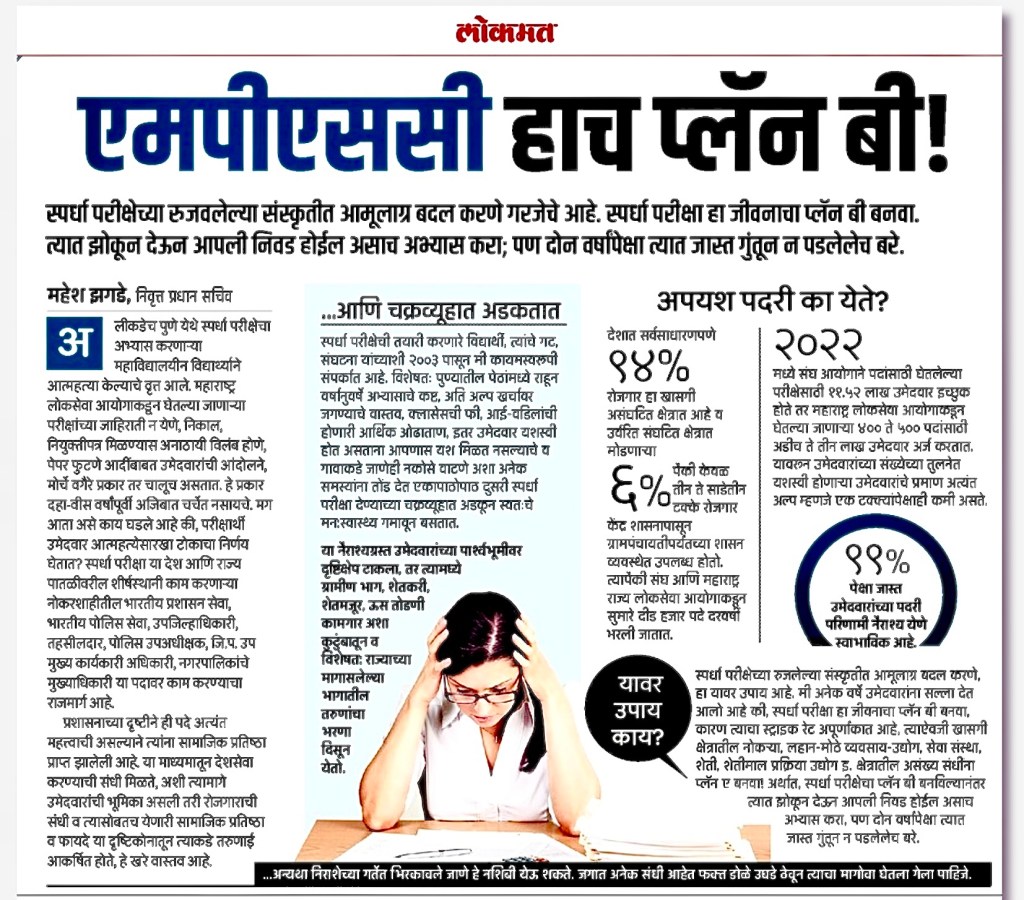
एमपीएससी हाच प्लॅन-बी बनवा!

अलीकडेच पुणे येथील स्पर्धा परीक्षेचा अभ्यास करणाऱ्या महाविद्यालयीन विद्यार्थ्याने आत्महत्या केल्याचे वृत्त आले. महाराष्ट्र लोकसेवा आयोगाकडून घेतल्या जाणाऱ्या परीक्षांच्या जाहिराती न येणे, परीक्षा, निकालास, नियुक्तीपत्र मिळण्यास अनाठायी विलंब होणे, परीक्षा पेपर फुटणे इ सारख्या अनेक बाबतीत उमेदवारांची आंदोलने मोर्चे वगैरे प्रकार तर चालूच असतात.

हे प्रकार दहा वीस वर्षांपूर्वी अजिबात चर्चेत नसायचे. मग आता असे काय घडले आहे की जेणेकरून परीक्षार्थी उमेदवार आत्महत्या सारख्या टोकाचा निर्णय घेतात हा प्रश्न पडतो. स्पर्धा परीक्षा या देश आणि राज्य पातळीवरील शीर्षस्थानी काम बजावणाऱ्या नोकरशाहीतील भारतीय प्रशासन सेवा, भारतीय पोलीस सेवा, उपजिल्हाधिकारी, तहसीलदार, पोलीस उपअधीक्षक, जि.प. उप मुख्य कार्यकारी अधिकारी, नगरपालिकांचे मुख्याधिकारी वगैरे मुख्य सेवांचा समावेश होतो. प्रशासनाच्या दृष्टीने ही पदे अत्यंत महत्त्वाची असल्याने अशा पदांना सामाजिक प्रतिष्ठा निर्माण झालेली आहे. या माध्यमातून देश सेवा करण्याची संधी मिळते अशी त्यामागे उमेदवारांची भूमिका असली तरी रोजगाराची संधी व त्यासोबतच येणारी सामाजिक प्रतिष्ठा व फायदे या दृष्टिकोनातून त्याकडे तरुणाई आकर्षित होते हे खरे वास्तव.

शासन नोकरशाहीच्या स्वरूपात रोजगाराच्या संधी उपलब्ध करून देणारा देशातील सर्वात मोठ्या आस्थापनांपैकी एक आस्थापना आहे. राज्यशकट चालवण्यासाठी तटस्थ पद्धतीने निवडलेली प्रगल्भ बुद्धिमत्तेचे उमेदवार लोकसेवा आयोगाकडून स्पर्धा परीक्षेच्या माध्यमातून निवडले जातात. वरिष्ठ नोकरशाहीत रोजगारांच्या संधी ह्याचे वास्तव काय आहे हे समजून घेणे आवश्यक झाले आहे कारण लाखो उमेदवार व विशेषतः ग्रामीण महाराष्ट्रातील तरुण-तरुणी पदवीनंतरची सात आठ वर्ष उमेदीची वर्षे स्पर्धा परीक्षा देण्यामध्ये व्यतीत करतात. हे प्रकरण आता पुढे गेले आहे. स्पर्धा परीक्षामधून निवड झाल्यानंतर यशस्वी उमेदवारांचा जाहीर सत्कार मिरवणुका, जाहिराती, प्रसार माध्यमाद्वारे त्यास मिळालेली प्रसिद्धी या सर्वांच्या परिपाकामुळे स्पर्धा परीक्षा भोवती एक अत्यंत विलोभनीय वलय निर्माण झालेले आहे. त्यातच स्पर्धा परीक्षांचा व्यापार करून भुलभुलैय्या वातावरणाद्वारे उमेदवार आणि त्यांच्या कुटुंबाची आर्थिक लूट करणारे ‘हमखास यशाची हमी’ देणाऱ्या स्पर्धा परीक्षा क्लासेसचे फुटलेले पेव! उमेदवारांना या परीक्षांच्या जंजाळात वर्षानुवर्षी अडकवून ठेवून भरमसाठ नफा मिळवणे हाच या क्लासेसचा मुख्य उद्देश असतो पण उमेदवारांकरता ती अपरिहार्यता होत जाते. याशिवाय हे क्लासेस नोकरशाहीतील काही अधिकारी आपल्या व्याख्याना द्वारे ‘प्रशासकीय नोकरी करणे म्हणजे जीवनात त्यास अन्य तोड नाही’ अशा स्वरूपाचा त्यास तेजोमय मुलामा देऊन स्वतःच्या कर्तृत्वाचा डांगोरा पिटवत तरुणाईस भुरळ पाडीत असतात.

स्पर्धा परीक्षेची तयारी करणारे विद्यार्थी, त्यांचे गट, संघटना यांच्याशी २००३ पासून मी कायमस्वरूपी संपर्कात आहे. विशेषतः पुण्यातील पेठांमध्ये राहून वर्षानुवर्षे अभ्यासाचे कष्ट, अति अल्प खर्चावर जगण्याचे वास्तव, क्लासेसची फी, आई-वडिलांची होणारी आर्थिक ओढाताण, इतर उमेदवारा यशस्वी होत असताना आपणास यश मिळत नसल्याचे गावाकडे जाणेही नकोसे वाटणे अशा अनेक समस्यांना तोंड देत एका पाठोपाठ दुसरी स्पर्धा परीक्षा देण्याच्या चक्रव्युव्हात अडकून स्वतःचे मन:स्वास्थ्य गमावून बसतात. या नैराश्यकग्रस्त उमेदवारांच्या पार्श्वभूमीवर दृष्टीकोण टाकला तर त्यामध्ये ग्रामीण भाग, शेतकरी, शेतमजूर, ऊस तोडणी कामगार अशा कुटुंबातून व विशेषत: राज्याच्या मागासलेल्या भागातील तरुणांचा भरणा दिसून येतो. अलीकडेच या उमेदवारांच्या विदारक परिस्थितीवर भाष्य करणाऱ्या ‘यथावकाश’ हा उमेदवारांनीच निर्माण केलेल्या चित्रपटाच्या प्रीमियरला पुण्यात उपस्थित राहिलो त्यामध्ये प्रकर्षाने प्रकर्ष. परिस्थितीचे त्यांनी जे वास्तव कथानकाद्वारे रेखाटले आहे ते पाहून मन विदारक होते.

याबाबत नेमकी वस्तूस्थिती काय आहे ते सर्व इच्छुक उमेदवार,त्यांचे कुटुंबीय, माध्यमे, शैक्षणिक संस्था, सामाजिक कार्यकर्ते इ नी समजून घेतले पाहिजे. गेल्या तीन दशकांमध्ये देशात शिक्षणाचा प्रसार मोठ्या प्रमाणात झाल्याने गावागावात, कुटुंबात पदवीधारक निर्माण होत आहेत व या सर्वांचा बहुतांश ओढा नोकऱ्या आणि त्या देखील शासकीय नोकऱ्या आणि विशेषत: वरिष्ठ पदावरील नोकऱ्या याकडे असतो. देशात सर्व साधारणपणे 94% रोजगार हा खाजगी असंघटित क्षेत्रात आहे व उर्वरित संघटित क्षेत्रात मोडणाऱ्या 6% पैकी केवळ तीन ते साडेतीन टक्के रोजगार केंद्र शासनापासून ग्रामपंचायतीपर्यंतच्या शासन व्यवस्थेत उपलब्ध होतो. त्यापैकी संघ आणि महाराष्ट्र राज्य लोकसेवा आयोगाकडून सुमारे दीड हजार पदे दरवर्षी भरली जातात. संघ आयोगाने पदांसाठी 2022 मध्ये घेतलेल्या परीक्षेसाठी ११.५२ लाख उमेदवारी इच्छुक होते तर महाराष्ट्र लोकसेवा आयोगाकडून घेतल्या जाणाऱ्या 400 ते 500 पदांसाठी अडीच ते तीन लाख उमेदवारा अर्ज करतात. यावरून उमेदवारांच्या संख्येच्या तुलनेत यशस्वी होणाऱ्या उमेदवारांचे प्रमाण अत्यंत अल्प म्हणजे एक टक्यापेक्षाही कमी असते.

परिणामतः ९९% पेक्षा जास्त उमेदवारांच्या पदरी नैराश्य येणे स्वाभाविक आहे.

यावर उपाय म्हणजे हि वस्तुस्थिती उमेदवार आणि त्यांच्या कुटुंबियांवर रुजविणे. तसेच बेगडी मार्गदर्शन करून उमेदवारांना भरकटविणाऱ्या अधिकाऱ्यावर चाप आणला गेला पाहिजे. क्लासेसने त्यांच्या जाहिरातीमध्ये वास्तस्थिती देण्याचे बंधन घालणे गरजेचे आहे. अर्थात हे झाले वरवरचे उपाय.

खरा उपाय म्हणजे सध्याची जी स्पर्धा परीक्षा संस्कृती रुजवली गेली आहे त्यात अमुलाग्र बदल करणे.

मी अनेक वर्ष या उमेदवारांना सल्ला देत आलो आहे की स्पर्धा परीक्षा या जीवनाचा प्लॅन-बी बनवा, कारण ज्याचा स्ट्राईक रेट अपूर्णांकात आहे त्या ऐवजी खाजगी क्षेत्रातील नोकऱ्या, लहान मोठे व्यवसाय-उद्योग, सेवा संस्था, शेती, शेतीमाल प्रक्रिया उद्योग इ क्षेत्रातील असंख्य संधींना प्लॅन-ए बनवा! अर्थात स्पर्धा परीक्षेचा प्लॅन-बी बनवल्यानंतर त्यात झोकून देऊन आपली निवड होईल असाच अभ्यास करा, पण दोन वर्षापेक्षा जास्त त्यात गुंतून न पडलेलेच बरे. अन्यथा निराशेच्या गर्तेत भिरकावले जाणे हे नशिबी येऊ शकते. जगात अनेक संधी आहेत फक्त डोळे उघडे ठेवून त्याचा मागवा घेतला गेला पाहिजे.

Standard

Perceptions of Justice:The Dichotomy between Ideal and Realised Justice.

Introduction:

The concept of justice holds a significant place in human societies, embodying the fundamental principles of fairness, equality, and moral rightness. However, the perception and experience of justice often differ between the idealistic notion and the practical realisation. The intriguing dichotomy that justice is not solely defined by its inherent qualities but rather by the outcomes individuals actually receive within a given societal context. Justice, as a fundamental principle, is often associated with notions of fairness, equality, and the rule of law. While subjectivity has been acknowledged as an inherent element in the interpretation and application of justice, the proposition that striving for objectivity in justice can enhance its integrity and alleviate potential biases should not be ignored. By exploring the factors influencing the interpretation of justice and examining the implications of this distinction, we gain valuable insights into the complex dynamics that shape our understanding of justice.

Justice, as an abstract and multifaceted concept, is subject to diverse interpretations and contextual influences. It represents an ideal state of affairs, characterised by equitable treatment, impartiality, and adherence to ethical principles. However, the reality of justice is far from a universal experience, as it is contingent upon numerous socio-cultural, economic, and political factors. Let’s try to shed light on the intricate interplay between the ideal and realised dimensions of justice, emphasising the significance of outcome-based perceptions in evaluating the fairness of a given system.

Ideal Justice:

Ideal justice embodies the vision of a perfect and morally upright society, where every individual is treated fairly, rights are protected, and the rule of law prevails. Rooted in philosophical and ethical frameworks, this conception of justice serves as a benchmark against which societies measure the quality of the human existence. It encompasses theories such as distributive justice, retributive justice, and procedural justice, all seeking to establish a framework that ensures fairness and equality.

Realised Justice: Contextual Factors and Disparities:

The realisation of justice is contingent upon various contextual factors, including socio-economic disparities, cultural norms, historical legacies, and the functioning of legal and political institutions. The application of justice in practice often faces challenges such as bias, corruption, unequal access to legal recourse, and systemic inequalities. These factors contribute to the divergence between the idealised vision of justice and the outcomes experienced by individuals within a given society.

The Role of Perception:

Perceptions of justice are subjective and influenced by personal experiences, social conditioning, and cultural values. The gap between ideal justice and realised justice can lead to disillusionment, frustration, and a loss of trust in the system. Individuals’ perceptions of justice are shaped not only by their direct encounters with the legal system but also by societal narratives, media representation, and collective experiences. Moreover, the unequal distribution of justice can perpetuate social divisions, engendering feelings of marginalisation and injustice.

Perceptions and Subjectivity:

Individual perceptions of justice are subjective and can vary based on personal experiences, cultural background, and societal norms. The outcomes people receive directly impact their perception of justice, as they evaluate the fairness of the system based on the tangible results they observe or experience. Recognising the subjective nature of justice can lead to a deeper understanding of the diverse ways in which individuals engage with and assess justice in their lives.

Implications for Justice Systems:

Embracing an outcome-based perspective on justice has significant implications for the design and functioning of justice systems. It highlights the importance of creating mechanisms that ensure equitable outcomes, rather than solely focusing on the procedural aspects of justice. This necessitates addressing systemic biases, disparities in access to legal resources, and empowering marginalised communities to ensure fairness in outcomes.

Promoting a Just Society:

Acknowledging the connection between justice and outcomes encourages a proactive approach to fostering a just society. This requires continuous evaluation, reform, and the pursuit of policies that aim to improve outcomes for all individuals. Efforts should be directed towards reducing disparities, addressing systemic injustices, and ensuring that the justice system operates in a manner that promotes fairness and equality.

The Societal Ecosystem: Elements and Interactions:

The societal ecosystem comprises various interconnected elements, including cultural values, norms, power structures, economic systems, and legal frameworks. These elements interact and influence one another, creating a dynamic environment that shapes the understanding and implementation of justice. Cultural beliefs and traditions, for instance, inform notions of right and wrong, while economic disparities can impact access to legal resources and representation.

Norms and Power Structures:

Norms, both explicit and implicit, play a crucial role in shaping societal expectations and behaviour. They contribute to the establishment of standards for justice, dictating what is considered fair and acceptable within a given society. Power structures within the societal ecosystem, such as political systems and social hierarchies, can influence the distribution of justice, often resulting in inequalities and differential treatment.

Legal and Political Systems:

The legal and political systems within a society serve as key mechanisms for delivering justice. These systems are designed to interpret and enforce laws, resolve disputes, and safeguard individual rights. However, the functioning of legal and political institutions is influenced by the broader societal ecosystem. Factors such as corruption, bias, and systemic inequalities can undermine the impartiality and effectiveness of these systems, impacting the realisation of justice.

Inequalities and Marginalisation:

The existing societal ecosystem can perpetuate inequalities and marginalisation, leading to a skewed distribution of justice. Discrimination based on factors such as race, gender, socioeconomic status, or caste can create systemic barriers, limiting access to justice for marginalised communities. The interplay between societal power dynamics and justice can further entrench social divisions and contribute to the perpetuation of injustice.

Justice cannot be viewed in isolation from the societal ecosystem in which it operates. The existing social, cultural, economic, and political dynamics significantly shape the understanding, application, and realisation of justice. By recognising and addressing the complexities and challenges within the societal ecosystem, societies can work towards creating a more just and equitable system. Achieving justice requires a holistic approach that encompasses legal reforms, cultural shifts, and a commitment to dismantling systemic barriers.

Implications and Moving Forward:

Recognising the gap between ideal and realised justice is crucial for fostering a more just society. Efforts should be directed toward minimising disparities and ensuring that legal frameworks and institutions are designed to deliver equitable outcomes. Strengthening transparency, accountability, and inclusivity within the justice system is paramount. Additionally, promoting legal literacy and empowering marginalised communities can help bridge the divide between ideal justice and its realisation. In a nutshell, the understanding of justice goes beyond its conceptual definition. It encompasses the tangible outcomes individuals experience within the socio-cultural, economic, and political contexts in which they live. By acknowledging and addressing the disparities between ideal and realised justice, societies can strive towards a more inclusive and equitable system. Achieving justice requires continuous reflection, reform, and collective action to bridge the divide and ensure that justice is not just an abstract ideal, but a tangible reality for all.

Keywords: #justice, #ideal_justice, #realised_justice, #fairness, #equality, #perception, #socio-cultural_factors, #legal_system, #disparities, #social_divisions, #inclusivity.

Standard