Post-Truth and Artificial Intelligence: Navigating the Challenges of an Evolving Information Landscape.

The advent of the digital age has brought about significant advancements in technology, particularly in the field of artificial intelligence (AI). Concurrently, society has witnessed the emergence of the post-truth era, characterized by the manipulation of information and the disregard for objective facts. The Oxford dictionary had selected the word ‘Post-truth’ as the word of the year in 2016 and, since then, the world has become increasingly sensitized by the threats posed by dominance of post-truth in the society. The intersection of post-truth and artificial intelligence poses unique challenges, as AI technologies have the potential to both exacerbate and mitigate the spread of misinformation. Let’s explore the complex relationship between post-truth and AI, examining the challenges it presents and the opportunities for responsible AI deployment in combating the erosion of truth.

The Threat of Amplified Disinformation

Artificial intelligence, with its capacity for automated data analysis, has the power to amplify the spread of disinformation in the post-truth era. AI algorithms can be trained to identify patterns and trends in vast amounts of data, making them vulnerable to manipulation by malicious actors seeking to exploit the vulnerabilities of the information ecosystem. With the ability to generate and disseminate content at an unprecedented scale, AI-powered systems can create sophisticated deepfake videos, generate convincing misinformation, and deploy social bots to artificially inflate the visibility of false narratives. This amplification of disinformation poses a grave threat to public discourse, social cohesion, and democratic processes.

Algorithmic Bias and Truth Perception

Another significant challenge lies in the potential for algorithmic bias within AI systems, which can inadvertently contribute to the perpetuation of post-truth narratives. AI algorithms learn from existing data, and if that data is biased or tainted with misinformation, it can perpetuate and amplify such biases. This can lead to a distortion of truth perception, as AI systems reinforce pre-existing beliefs and perspectives, further entrenching individuals in their ideological echo chambers. The reinforcement of confirmation bias can hinder the open-mindedness and critical thinking necessary to challenge false information and engage in constructive dialogue.

Opportunities for Responsible AI Deployment

While AI poses challenges in the post-truth era, it also offers opportunities for combating the erosion of truth when deployed responsibly. AI-powered fact-checking systems, for instance, can aid in the identification and debunking of false information. By leveraging natural language processing and machine learning techniques, these systems can analyze large volumes of text and compare them against trusted sources to determine the veracity of claims. Such tools can empower individuals to make informed judgments, enhancing media literacy and promoting a more discerning consumption of information.

Furthermore, AI can assist in detecting patterns of disinformation and identifying fake accounts and bot networks on social media platforms. By analyzing user behavior and content interactions, AI algorithms can identify suspicious activities indicative of automated propaganda campaigns or coordinated disinformation efforts. This enables platforms to take appropriate action to mitigate the influence of malicious actors and maintain the integrity of public discourse.

Promoting Ethical AI and Digital Literacy

To harness the potential of AI in combating the challenges of post-truth, it is crucial to prioritize ethical AI development and digital literacy initiatives. Ethical guidelines and regulations must be established to govern AI usage and address the risks associated with the spread of disinformation. Transparency and accountability in AI algorithms should be prioritized, ensuring that decision-making processes are explainable, auditable, and free from bias.

Simultaneously, comprehensive digital literacy programs must be implemented to equip individuals with the necessary skills to navigate the evolving information landscape. Education should focus on critical thinking, media literacy, and information verification, enabling individuals to evaluate the credibility and reliability of sources in an AI-driven era. By fostering a society that is adept at discerning truth from falsehoods, we can fortify ourselves against the threats posed by post-truth narratives.

In conclusion, let’s accept the fact that the convergence of post-truth and artificial intelligence poses complex challenges to society’s pursuit of truth and the integrity of public discourse. While AI has the potential to amplify disinformation and perpetuate biases, it also offers opportunities for combating the erosion of truth through responsible deployment. By prioritizing ethical AI development, promoting transparency and accountability, and enhancing digital literacy, we can navigate the evolving information landscape more effectively. To ensure the preservation of truth in the face of post-truth, we must harness the power of AI as a force for veracity, empowering individuals and strengthening the foundations of a well-informed society.

Standard

The Sign of a Very Ill Society: Nurturing Conscience Illiteracy.

Society serves as the foundation upon which individuals grow, interact, and flourish. It is meant to foster values, ethics, and a collective conscience that guides individuals towards empathy, compassion, and justice. However, when a society fails to cultivate these qualities and instead nurtures what can be called “conscience illiteracy,” it is a clear sign of deep-seated social problems. Let’s explore the detrimental effects of conscience illiteracy on society and emphasizes the importance of fostering a moral compass for the betterment of our collective well-being.

Understanding Conscience Illiteracy:

Conscience illiteracy refers to a state in which individuals lack the ability to recognize and distinguish right from wrong, and lack the moral understanding necessary for making ethical choices. It is a condition where individuals prioritize self-interest, disregarding the impact of their actions on others and society as a whole. Conscience illiteracy often leads to a society plagued by injustice, indifference, and a lack of empathy.

Effects of Conscience Illiteracy on Society:

1. Erosion of Trust: When conscience illiteracy becomes pervasive in a society, trust between individuals and institutions deteriorates. People become skeptical, suspicious, and hesitant to rely on others, hindering the development of a strong social fabric.

2. Increased Inequality: Conscience illiteracy fosters a culture that prioritizes personal gain over the welfare of others. This mindset perpetuates social and economic inequalities, as those with power and privilege exploit the vulnerabilities of others for their own benefit.

3. Lack of Social Cohesion: A society that neglects to nurture ethical awareness and responsibility experiences a decline in social cohesion. The absence of a shared moral framework leads to division, polarization, and conflicts based on self-interest rather than the common good.

4. Injustice and Exploitation: Conscience illiteracy enables a climate where injustice and exploitation thrive. Individuals disregard the rights and well-being of others, leading to systemic discrimination, human rights abuses, and the perpetuation of social injustices.

Addressing Conscience Illiteracy:

1. Education and Awareness: One of the fundamental ways to combat conscience illiteracy is through education. Educational institutions should prioritize teaching values, ethics, and empathy alongside academic subjects, instilling a sense of moral responsibility in individuals from a young age.

2. Role Models and Leadership: Society needs strong role models and ethical leaders who exemplify and promote values such as compassion, integrity, and justice. By celebrating and supporting those who demonstrate ethical behavior, we can inspire others to follow suit.

3. Promoting Empathy and Inclusivity: Encouraging empathy and inclusivity is crucial in developing a society that values the well-being and dignity of all its members. Promoting dialogue, fostering understanding, and dismantling biases are essential steps toward creating a compassionate and empathetic society.

4. Accountability and Consequence: Conscience illiteracy can only be curbed through accountability and consequence. Establishing strong legal frameworks, ensuring fair justice systems, and holding individuals accountable for their actions are vital in discouraging unethical behavior and promoting a culture of responsibility.

In conclusion, let’s accept that a society that nurtures conscience illiteracy is in a state of profound illness, where the well-being and dignity of individuals are compromised. Recognizing the detrimental effects of conscience illiteracy is the first step towards fostering positive change. By prioritizing education, promoting empathy, and holding individuals accountable for their actions, we can work towards creating a society that upholds ethical values, justice, and compassion. It is our collective responsibility to cultivate a moral compass that guides us towards a more just, inclusive, and empathetic future.

Standard

Unveiling the Hidden Gems: Serendipity and Lessons Learned in the Technological Era.

Introduction:

The age of technology has brought forth a multitude of advantages and disadvantages, but what if I were to tell you that sometimes the disadvantages can harbor their own set of advantages? In a recent solo journey that I took across Maharashtra, covering approximately 900 kilometers for two social functions, the intricacies of this complex relationship between technology and human experience became abundantly clear. One of the functions was a training workshop for Corporators in Sindhudurg district organised by a digital channel. While Google Maps played the role of an expert guide, it also took me on unexpected detours, revealing both threats and opportunities along the way.

The Vibrant Guide:

Google Maps, a stalwart in the realm of navigation, undoubtedly excels in its role as a guide. It assists millions of travelers daily, offering reliable directions and real-time updates. Its efficiency and accuracy have revolutionized the way we explore unfamiliar territories, making it an indispensable tool for modern-day adventurers.

The Jungle Enigma:

However, even the most reliable guide can sometimes lead us astray. While self-driving from Kudal to Pune, Google Maps perplexingly directed me towards the heart of a jungle in search of the nearest road. Initially, the forest road seemed like an ordinary paved route, but gradually, it transformed into a dirt path, winding deeper into the lush wilderness. As I ventured further, Google unexpectedly disconnected, leaving me without contact with the outside world. I found myself driving through the dense forest, without a trail to follow and with no alternative but to embrace the journey through nature’s untamed domain.

The Unforeseen Opportunity:

Though this unexpected turn of events initially felt like a disaster, it later revealed itself as a rare opportunity. The sheer magnificence of the dense forest, with its nature-made tunnels formed by a sprawling canopy of trees, provided a sense of otherworldly delight. Alone in the car, I marveled at the serenity and majesty of this unexplored wilderness. Surprisingly, aside from a quiet gathering of a rather large herd of plump Hanuman langurs , no other wildlife could be seen on the way. It was rather strange.The absence of human intervention allowed me to immerse myself in the eerie beauty of the untamed natural surroundings.

The Guiding Encounter:

After traveling for 40-50 kilometers through this enchanting forest, a gravel road finally emerged, offering a sense of relief. Soon after, I stumbled upon a cyclist, his face weathered, who stared at me with wide-eyed astonishment. I seized the opportunity to interact with a fellow human being, eager to inquire about the road to Kolhapur. In an intimate manner, he unveiled two potential routes, passionately elucidating the details of each path. His fervent explanation, borne out of a desire to engage with another person, instilled in me a sense of trust and connection that surpassed the reliability of Google Maps. It was a refreshing reminder that human knowledge and local guidance hold immense value even in the age of technology.

The Surprise:

With renewed confidence, I continued my journey, and as the network connectivity returned, Google Maps once again resumed its role. It was then that I realised that I had traversed through the renowned Dajipur Sanctuary, a UNESCO World Heritage site of global significance. This unexpected opportunity to experience such a remarkable natural treasure in Maharashtra will forever be etched in my memory. It served as a poignant reminder that blind reliance on technology may lead us astray, but it also presented me with a valuable life-lesson.

The Lessons Learned:

My adventure through this journey served as a vivid illustration of the complex relationship between technology and human experience. While Google Maps remains an invaluable tool, it is essential to exercise caution and not solely rely on its guidance. The detours and unexpected opportunities that arise in the midst of technological mishaps can open doors to hidden wonders and enrich our understanding of the world around us. Balancing the benefits of technology with the wisdom of human connection and local knowledge offers a holistic approach to exploration.

Conclusion:

In the realm of technology, the advantages and disadvantages often intertwine, revealing unanticipated layers of experience. This unforgettable journey, guided by Google Maps yet veering into unexpected territories, showcased the dual nature of technological reliance. As we navigate the world, let us remember to embrace the unexpected, trust in the wisdom of our fellow humans, and appreciate the lessons learned along the way. Technology is a remarkable tool, but it is our responsibility to strike a harmonious balance between the digital realm and the richness of the world that lies beyond our screens.

Standard

The Paradox of Human Evolution: Constricting the Mind

Human beings, the most evolved and intelligent species on Earth, possess an unparalleled capacity for progress and advancement. However, amidst our supposed journey towards greater understanding and intelligence, we often find ourselves confined by artificial divisions. The limitations imposed by religion, caste, financial strata, geographical boundaries, and even our concepts of gods hinder our collective growth. This raises a crucial question: Are we truly progressing or inadvertently regressing in terms of our evolution? Let’s delves into the tragic paradox created by human minds and explores the implications of these artificial divides on our collective development.

1. The Potential for Progress:

As a species, humans have demonstrated remarkable intellectual capabilities, enabling us to achieve unprecedented scientific and technological advancements. From unraveling the mysteries of the cosmos to harnessing the power of the atom, we have continuously pushed the boundaries of knowledge and reshaped our world. This inherent potential for progress suggests that we are indeed evolving in terms of understanding and intelligence.

2. Artificial Divides:

Despite our inherent capacity for progress, the human mind often erects barriers that hinder our development. These artificial divides manifest in various forms such as religion, caste, financial strata, geographical boundaries, and concepts of gods. While these constructs have historical, cultural, and social roots, they tend to constrict our cerebral resources and limit our collective potential.

a) Religion: Throughout history, religion has played a significant role in shaping human societies and providing a sense of meaning and purpose. However, when rigid beliefs and dogmas replace open-minded inquiry, they can impede the pursuit of knowledge and stifle intellectual growth. Interfaith conflicts and religious fundamentalism exemplify the regressive tendencies that can emerge when religion becomes a barrier to progress.

b) Caste and Financial Strata: Social stratification based on caste or economic status creates artificial divisions within societies. Discrimination and unequal access to opportunities prevent the full utilization of human potential, hindering progress and perpetuating societal imbalances. The confinement of intellectual resources within specific social groups obstructs the collective advancement of humanity.

c) Geographical Boundaries: Nationalism and geopolitical divisions often reinforce artificial boundaries that limit the exchange of ideas and impede collaboration. The focus on protecting national interests can overshadow collective global challenges, hindering scientific cooperation and slowing down progress. In an interconnected world, these boundaries can be counterproductive to our evolution as a species.

d) Concepts of Gods: While concepts of gods and spirituality can provide solace and guidance, rigid adherence to specific doctrines can hinder critical thinking and the exploration of alternative ideas. When dogmatic beliefs dominate intellectual discourse, it restricts the growth of knowledge and undermines the spirit of scientific inquiry.

3. Regressive Tendencies:

The persistence of these artificial divides suggests that, despite our potential for progress, we are not evolving as rapidly as we could be. The tragedy lies in the fact that the very constructs we create to find meaning and security often become barriers to our collective growth. By focusing on narrow identities and limiting our perspectives, we fail to tap into the full range of human intelligence and imagination.

4. Way forward:

To overcome this tragic paradox, it is crucial to recognize the limitations of these artificial divides and embrace a more inclusive and open-minded approach to our collective evolution. By fostering a spirit of cooperation, encouraging intellectual diversity, and promoting dialogue across boundaries, we can begin to transcend the constraints that hamper our progress. Education and awareness play a crucial role in dismantling these divisions, nurturing a society that values knowledge, empathy, and collaboration.

In a nutshell, while human beings possess remarkable intellectual capabilities, our progress is often hindered by the artificial divides we create. Religion, caste, financial strata, geographical boundaries, and concepts of gods restrict our collective growth and impede our evolution as a species. To truly realize our potential, we must transcend these barriers and foster an inclusive, open-minded approach that values knowledge, empathy, and cooperation. Only then can we break free from the tragedy created by our own minds and embark on a path of true enlightenment and progress.

Standard

Only education is not enough….

The Importance of Creating a Relevant Education and Opportunities-to- Earn Ecosystem: A Government Responsibility

Education has always been recognised as a vital aspect of human development, empowering individuals with knowledge, skills, and opportunities. However, in today’s rapidly changing world, the significance of education has taken on an even greater importance. It is no longer enough to simply provide access to education; it is equally crucial to establish an ecosystem wherein education remains relevant and aligns with the needs of society. This responsibility primarily lies with the government, as it plays a pivotal role in shaping policies and frameworks that enable individuals to thrive and secure their livelihoods.

In the absence of a comprehensive approach to education, the consequences can be dire. The trajectory of society could take a distressing turn, posing a severe threat to the very existence of humanity. Therefore, it becomes imperative for governments to recognise the crucial link between education, livelihood, and the overall well-being of their citizens.

Creating a relevant education ecosystem encompasses several key elements. Firstly, it involves ensuring that education is accessible to all, irrespective of social, economic, or geographical barriers. This entails implementing policies that promote inclusivity and provide equal opportunities for individuals from diverse backgrounds. By removing obstacles such as financial constraints, discrimination, and limited resources, governments can pave the way for a more equitable society where education becomes a vehicle for social mobility.

However, accessibility alone is not sufficient. The education system must be dynamic and adaptable to the evolving needs of the job market and society at large. Governments should foster collaboration between educational institutions, industry leaders, and policymakers to identify emerging trends, skills, and knowledge areas that are in demand. This collaborative approach enables educational curricula to be revised and updated regularly, ensuring that graduates possess the skills and competencies necessary to excel in the current job market.

Moreover, it is crucial to foster an environment of innovation and critical thinking within educational institutions. By encouraging creativity, problem-solving, and entrepreneurial spirit, governments can empower students to become active contributors to society. This entails investing in research and development, promoting interdisciplinary approaches, and integrating technology into the learning process. By doing so, educational institutions can equip individuals with the ability to adapt to new challenges and seize opportunities in an increasingly dynamic world.

In addition to cultivating relevant skills and knowledge, governments should also focus on fostering values and ethics within the education system. Education should not solely revolve around academic achievements and professional success but should also aim to nurture responsible, empathetic, and ethical citizens. By emphasising the importance of integrity, compassion, and sustainability, governments can shape a society that is not only economically prosperous but also socially cohesive and environmentally conscious.

The responsibility of creating a relevant education ecosystem cannot be shouldered by educational institutions alone. Governments must play a pivotal role in formulating policies that support and enhance education at every level. Adequate investment in education, both in terms of financial resources and human capital, is essential to build a strong foundation for a prosperous future.

Furthermore, governments should engage in partnerships with private enterprises, non-profit organisations, and civil society to leverage their expertise, resources, and networks. Collaboration with these stakeholders can help bridge the gap between education and employment, ensuring that individuals are equipped with the skills demanded by the job market.

Standard

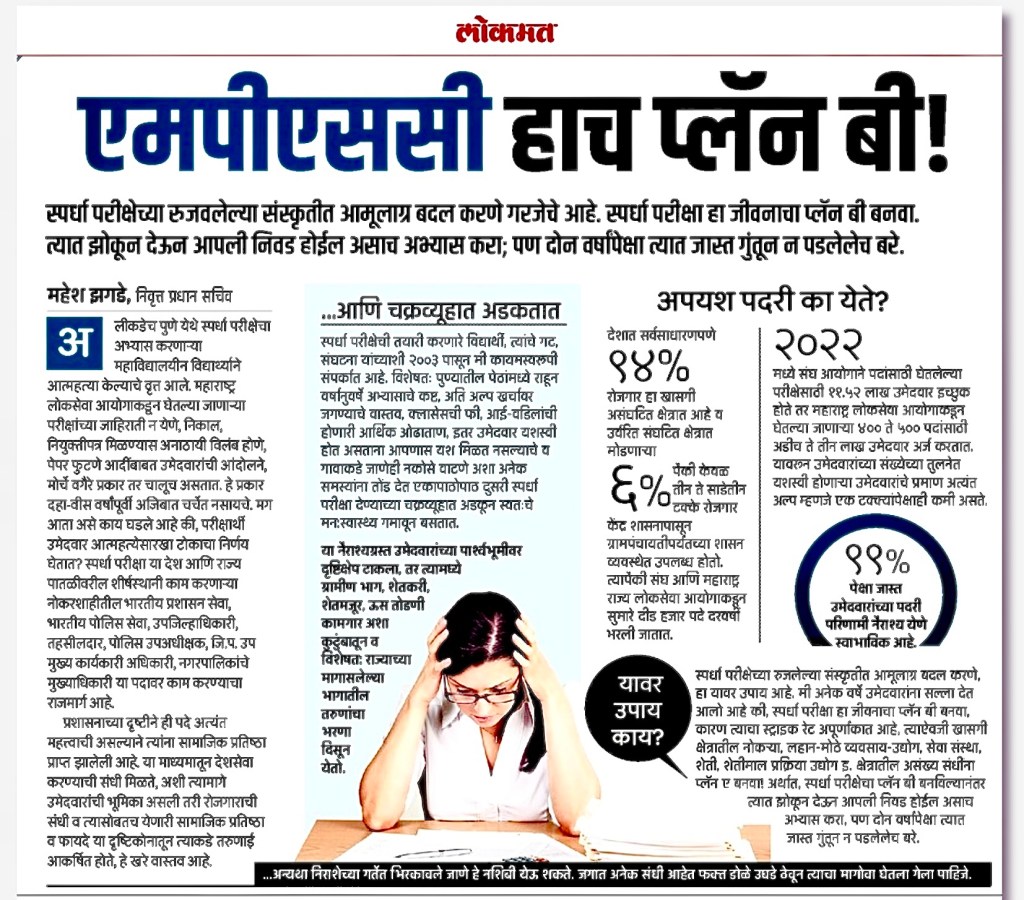
एमपीएससी हाच प्लॅन-बी बनवा!

अलीकडेच पुणे येथील स्पर्धा परीक्षेचा अभ्यास करणाऱ्या महाविद्यालयीन विद्यार्थ्याने आत्महत्या केल्याचे वृत्त आले. महाराष्ट्र लोकसेवा आयोगाकडून घेतल्या जाणाऱ्या परीक्षांच्या जाहिराती न येणे, परीक्षा, निकालास, नियुक्तीपत्र मिळण्यास अनाठायी विलंब होणे, परीक्षा पेपर फुटणे इ सारख्या अनेक बाबतीत उमेदवारांची आंदोलने मोर्चे वगैरे प्रकार तर चालूच असतात.

हे प्रकार दहा वीस वर्षांपूर्वी अजिबात चर्चेत नसायचे. मग आता असे काय घडले आहे की जेणेकरून परीक्षार्थी उमेदवार आत्महत्या सारख्या टोकाचा निर्णय घेतात हा प्रश्न पडतो. स्पर्धा परीक्षा या देश आणि राज्य पातळीवरील शीर्षस्थानी काम बजावणाऱ्या नोकरशाहीतील भारतीय प्रशासन सेवा, भारतीय पोलीस सेवा, उपजिल्हाधिकारी, तहसीलदार, पोलीस उपअधीक्षक, जि.प. उप मुख्य कार्यकारी अधिकारी, नगरपालिकांचे मुख्याधिकारी वगैरे मुख्य सेवांचा समावेश होतो. प्रशासनाच्या दृष्टीने ही पदे अत्यंत महत्त्वाची असल्याने अशा पदांना सामाजिक प्रतिष्ठा निर्माण झालेली आहे. या माध्यमातून देश सेवा करण्याची संधी मिळते अशी त्यामागे उमेदवारांची भूमिका असली तरी रोजगाराची संधी व त्यासोबतच येणारी सामाजिक प्रतिष्ठा व फायदे या दृष्टिकोनातून त्याकडे तरुणाई आकर्षित होते हे खरे वास्तव.

शासन नोकरशाहीच्या स्वरूपात रोजगाराच्या संधी उपलब्ध करून देणारा देशातील सर्वात मोठ्या आस्थापनांपैकी एक आस्थापना आहे. राज्यशकट चालवण्यासाठी तटस्थ पद्धतीने निवडलेली प्रगल्भ बुद्धिमत्तेचे उमेदवार लोकसेवा आयोगाकडून स्पर्धा परीक्षेच्या माध्यमातून निवडले जातात. वरिष्ठ नोकरशाहीत रोजगारांच्या संधी ह्याचे वास्तव काय आहे हे समजून घेणे आवश्यक झाले आहे कारण लाखो उमेदवार व विशेषतः ग्रामीण महाराष्ट्रातील तरुण-तरुणी पदवीनंतरची सात आठ वर्ष उमेदीची वर्षे स्पर्धा परीक्षा देण्यामध्ये व्यतीत करतात. हे प्रकरण आता पुढे गेले आहे. स्पर्धा परीक्षामधून निवड झाल्यानंतर यशस्वी उमेदवारांचा जाहीर सत्कार मिरवणुका, जाहिराती, प्रसार माध्यमाद्वारे त्यास मिळालेली प्रसिद्धी या सर्वांच्या परिपाकामुळे स्पर्धा परीक्षा भोवती एक अत्यंत विलोभनीय वलय निर्माण झालेले आहे. त्यातच स्पर्धा परीक्षांचा व्यापार करून भुलभुलैय्या वातावरणाद्वारे उमेदवार आणि त्यांच्या कुटुंबाची आर्थिक लूट करणारे ‘हमखास यशाची हमी’ देणाऱ्या स्पर्धा परीक्षा क्लासेसचे फुटलेले पेव! उमेदवारांना या परीक्षांच्या जंजाळात वर्षानुवर्षी अडकवून ठेवून भरमसाठ नफा मिळवणे हाच या क्लासेसचा मुख्य उद्देश असतो पण उमेदवारांकरता ती अपरिहार्यता होत जाते. याशिवाय हे क्लासेस नोकरशाहीतील काही अधिकारी आपल्या व्याख्याना द्वारे ‘प्रशासकीय नोकरी करणे म्हणजे जीवनात त्यास अन्य तोड नाही’ अशा स्वरूपाचा त्यास तेजोमय मुलामा देऊन स्वतःच्या कर्तृत्वाचा डांगोरा पिटवत तरुणाईस भुरळ पाडीत असतात.

स्पर्धा परीक्षेची तयारी करणारे विद्यार्थी, त्यांचे गट, संघटना यांच्याशी २००३ पासून मी कायमस्वरूपी संपर्कात आहे. विशेषतः पुण्यातील पेठांमध्ये राहून वर्षानुवर्षे अभ्यासाचे कष्ट, अति अल्प खर्चावर जगण्याचे वास्तव, क्लासेसची फी, आई-वडिलांची होणारी आर्थिक ओढाताण, इतर उमेदवारा यशस्वी होत असताना आपणास यश मिळत नसल्याचे गावाकडे जाणेही नकोसे वाटणे अशा अनेक समस्यांना तोंड देत एका पाठोपाठ दुसरी स्पर्धा परीक्षा देण्याच्या चक्रव्युव्हात अडकून स्वतःचे मन:स्वास्थ्य गमावून बसतात. या नैराश्यकग्रस्त उमेदवारांच्या पार्श्वभूमीवर दृष्टीकोण टाकला तर त्यामध्ये ग्रामीण भाग, शेतकरी, शेतमजूर, ऊस तोडणी कामगार अशा कुटुंबातून व विशेषत: राज्याच्या मागासलेल्या भागातील तरुणांचा भरणा दिसून येतो. अलीकडेच या उमेदवारांच्या विदारक परिस्थितीवर भाष्य करणाऱ्या ‘यथावकाश’ हा उमेदवारांनीच निर्माण केलेल्या चित्रपटाच्या प्रीमियरला पुण्यात उपस्थित राहिलो त्यामध्ये प्रकर्षाने प्रकर्ष. परिस्थितीचे त्यांनी जे वास्तव कथानकाद्वारे रेखाटले आहे ते पाहून मन विदारक होते.

याबाबत नेमकी वस्तूस्थिती काय आहे ते सर्व इच्छुक उमेदवार,त्यांचे कुटुंबीय, माध्यमे, शैक्षणिक संस्था, सामाजिक कार्यकर्ते इ नी समजून घेतले पाहिजे. गेल्या तीन दशकांमध्ये देशात शिक्षणाचा प्रसार मोठ्या प्रमाणात झाल्याने गावागावात, कुटुंबात पदवीधारक निर्माण होत आहेत व या सर्वांचा बहुतांश ओढा नोकऱ्या आणि त्या देखील शासकीय नोकऱ्या आणि विशेषत: वरिष्ठ पदावरील नोकऱ्या याकडे असतो. देशात सर्व साधारणपणे 94% रोजगार हा खाजगी असंघटित क्षेत्रात आहे व उर्वरित संघटित क्षेत्रात मोडणाऱ्या 6% पैकी केवळ तीन ते साडेतीन टक्के रोजगार केंद्र शासनापासून ग्रामपंचायतीपर्यंतच्या शासन व्यवस्थेत उपलब्ध होतो. त्यापैकी संघ आणि महाराष्ट्र राज्य लोकसेवा आयोगाकडून सुमारे दीड हजार पदे दरवर्षी भरली जातात. संघ आयोगाने पदांसाठी 2022 मध्ये घेतलेल्या परीक्षेसाठी ११.५२ लाख उमेदवारी इच्छुक होते तर महाराष्ट्र लोकसेवा आयोगाकडून घेतल्या जाणाऱ्या 400 ते 500 पदांसाठी अडीच ते तीन लाख उमेदवारा अर्ज करतात. यावरून उमेदवारांच्या संख्येच्या तुलनेत यशस्वी होणाऱ्या उमेदवारांचे प्रमाण अत्यंत अल्प म्हणजे एक टक्यापेक्षाही कमी असते.

परिणामतः ९९% पेक्षा जास्त उमेदवारांच्या पदरी नैराश्य येणे स्वाभाविक आहे.

यावर उपाय म्हणजे हि वस्तुस्थिती उमेदवार आणि त्यांच्या कुटुंबियांवर रुजविणे. तसेच बेगडी मार्गदर्शन करून उमेदवारांना भरकटविणाऱ्या अधिकाऱ्यावर चाप आणला गेला पाहिजे. क्लासेसने त्यांच्या जाहिरातीमध्ये वास्तस्थिती देण्याचे बंधन घालणे गरजेचे आहे. अर्थात हे झाले वरवरचे उपाय.

खरा उपाय म्हणजे सध्याची जी स्पर्धा परीक्षा संस्कृती रुजवली गेली आहे त्यात अमुलाग्र बदल करणे.

मी अनेक वर्ष या उमेदवारांना सल्ला देत आलो आहे की स्पर्धा परीक्षा या जीवनाचा प्लॅन-बी बनवा, कारण ज्याचा स्ट्राईक रेट अपूर्णांकात आहे त्या ऐवजी खाजगी क्षेत्रातील नोकऱ्या, लहान मोठे व्यवसाय-उद्योग, सेवा संस्था, शेती, शेतीमाल प्रक्रिया उद्योग इ क्षेत्रातील असंख्य संधींना प्लॅन-ए बनवा! अर्थात स्पर्धा परीक्षेचा प्लॅन-बी बनवल्यानंतर त्यात झोकून देऊन आपली निवड होईल असाच अभ्यास करा, पण दोन वर्षापेक्षा जास्त त्यात गुंतून न पडलेलेच बरे. अन्यथा निराशेच्या गर्तेत भिरकावले जाणे हे नशिबी येऊ शकते. जगात अनेक संधी आहेत फक्त डोळे उघडे ठेवून त्याचा मागवा घेतला गेला पाहिजे.

Standard

Choosing Ethics and Integrity for True Success(Beware, it may sound outlandish!)

In today’s fast-paced world, the pursuit of success often takes centre stage. We are constantly bombarded with stories of individuals and organisations achieving remarkable feats, amassing wealth, and attaining positions of power. However, it is crucial to examine the means through which success is attained. Are all paths to success equally valid? Let’s try understand the importance of ethics and integrity in the quest for true success.

Success at What Cost?

Success achieved through evil means is a bitter pill to swallow. While it may seem tempting to compromise our values and engage in unethical practices, we must remember that such achievements come at a high cost. By sacrificing the well-being and happiness of others, we tarnish our own integrity and contribute to a society plagued by injustice and suffering.

The Impact on Others:

When we prioritise personal gains over the welfare of others, we create a world filled with inequality and misery. True success should not be measured solely by our own accomplishments but also by the positive impact we have on the lives of others. It is through acts of kindness, empathy, and ethical conduct that we can uplift communities and contribute to the betterment of society as a whole.

Choosing Ethics and Integrity:

The path to true success lies in making conscious choices that uphold ethics and integrity. We must resist the allure of shortcuts and quick wins that come at the expense of others. Instead, let us adopt a mindset that values honesty, fairness, and compassion. By doing so, we can build a foundation of trust, foster meaningful relationships, and create a sustainable environment for growth a

Ethics and integrity are not limited to personal actions but also extend to the realm of business, entrepreneurship, governments, politics, institutions and society as whole. It is essential to prioritize ethical practices, treat others with respect, and consider the impact of their actions on the larger society. By choosing ethics over unethical shortcuts, society can establish long-term success built on trust and goodwill.

It is of paramount importance to understand and remember that while we navigate our paths to success, it is not just the destination that matters but the journey we undertake. Ravana was successful in the abduction of Sitmai, Kauravas were successful in snatching the entire kingdom; but then these were not the examples of success but that of misery for themselves and others! Success achieved through evil means may bring temporary satisfaction, but it ultimately erodes our own sense of self-worth and damages the world around us. Let us rise above the temptation to compromise our values and instead embrace ethics and integrity as guiding principles. By choosing ethics and integrity, we can redefine success and contribute to a world where the well-being and happiness of all are valued.

#ChooseEthics #SuccessWithIntegrity

Standard

Perceptions of Justice:The Dichotomy between Ideal and Realised Justice.

Introduction:

The concept of justice holds a significant place in human societies, embodying the fundamental principles of fairness, equality, and moral rightness. However, the perception and experience of justice often differ between the idealistic notion and the practical realisation. The intriguing dichotomy that justice is not solely defined by its inherent qualities but rather by the outcomes individuals actually receive within a given societal context. Justice, as a fundamental principle, is often associated with notions of fairness, equality, and the rule of law. While subjectivity has been acknowledged as an inherent element in the interpretation and application of justice, the proposition that striving for objectivity in justice can enhance its integrity and alleviate potential biases should not be ignored. By exploring the factors influencing the interpretation of justice and examining the implications of this distinction, we gain valuable insights into the complex dynamics that shape our understanding of justice.

Justice, as an abstract and multifaceted concept, is subject to diverse interpretations and contextual influences. It represents an ideal state of affairs, characterised by equitable treatment, impartiality, and adherence to ethical principles. However, the reality of justice is far from a universal experience, as it is contingent upon numerous socio-cultural, economic, and political factors. Let’s try to shed light on the intricate interplay between the ideal and realised dimensions of justice, emphasising the significance of outcome-based perceptions in evaluating the fairness of a given system.

Ideal Justice:

Ideal justice embodies the vision of a perfect and morally upright society, where every individual is treated fairly, rights are protected, and the rule of law prevails. Rooted in philosophical and ethical frameworks, this conception of justice serves as a benchmark against which societies measure the quality of the human existence. It encompasses theories such as distributive justice, retributive justice, and procedural justice, all seeking to establish a framework that ensures fairness and equality.

Realised Justice: Contextual Factors and Disparities:

The realisation of justice is contingent upon various contextual factors, including socio-economic disparities, cultural norms, historical legacies, and the functioning of legal and political institutions. The application of justice in practice often faces challenges such as bias, corruption, unequal access to legal recourse, and systemic inequalities. These factors contribute to the divergence between the idealised vision of justice and the outcomes experienced by individuals within a given society.

The Role of Perception:

Perceptions of justice are subjective and influenced by personal experiences, social conditioning, and cultural values. The gap between ideal justice and realised justice can lead to disillusionment, frustration, and a loss of trust in the system. Individuals’ perceptions of justice are shaped not only by their direct encounters with the legal system but also by societal narratives, media representation, and collective experiences. Moreover, the unequal distribution of justice can perpetuate social divisions, engendering feelings of marginalisation and injustice.

Perceptions and Subjectivity:

Individual perceptions of justice are subjective and can vary based on personal experiences, cultural background, and societal norms. The outcomes people receive directly impact their perception of justice, as they evaluate the fairness of the system based on the tangible results they observe or experience. Recognising the subjective nature of justice can lead to a deeper understanding of the diverse ways in which individuals engage with and assess justice in their lives.

Implications for Justice Systems:

Embracing an outcome-based perspective on justice has significant implications for the design and functioning of justice systems. It highlights the importance of creating mechanisms that ensure equitable outcomes, rather than solely focusing on the procedural aspects of justice. This necessitates addressing systemic biases, disparities in access to legal resources, and empowering marginalised communities to ensure fairness in outcomes.

Promoting a Just Society:

Acknowledging the connection between justice and outcomes encourages a proactive approach to fostering a just society. This requires continuous evaluation, reform, and the pursuit of policies that aim to improve outcomes for all individuals. Efforts should be directed towards reducing disparities, addressing systemic injustices, and ensuring that the justice system operates in a manner that promotes fairness and equality.

The Societal Ecosystem: Elements and Interactions:

The societal ecosystem comprises various interconnected elements, including cultural values, norms, power structures, economic systems, and legal frameworks. These elements interact and influence one another, creating a dynamic environment that shapes the understanding and implementation of justice. Cultural beliefs and traditions, for instance, inform notions of right and wrong, while economic disparities can impact access to legal resources and representation.

Norms and Power Structures:

Norms, both explicit and implicit, play a crucial role in shaping societal expectations and behaviour. They contribute to the establishment of standards for justice, dictating what is considered fair and acceptable within a given society. Power structures within the societal ecosystem, such as political systems and social hierarchies, can influence the distribution of justice, often resulting in inequalities and differential treatment.

Legal and Political Systems:

The legal and political systems within a society serve as key mechanisms for delivering justice. These systems are designed to interpret and enforce laws, resolve disputes, and safeguard individual rights. However, the functioning of legal and political institutions is influenced by the broader societal ecosystem. Factors such as corruption, bias, and systemic inequalities can undermine the impartiality and effectiveness of these systems, impacting the realisation of justice.

Inequalities and Marginalisation:

The existing societal ecosystem can perpetuate inequalities and marginalisation, leading to a skewed distribution of justice. Discrimination based on factors such as race, gender, socioeconomic status, or caste can create systemic barriers, limiting access to justice for marginalised communities. The interplay between societal power dynamics and justice can further entrench social divisions and contribute to the perpetuation of injustice.

Justice cannot be viewed in isolation from the societal ecosystem in which it operates. The existing social, cultural, economic, and political dynamics significantly shape the understanding, application, and realisation of justice. By recognising and addressing the complexities and challenges within the societal ecosystem, societies can work towards creating a more just and equitable system. Achieving justice requires a holistic approach that encompasses legal reforms, cultural shifts, and a commitment to dismantling systemic barriers.

Implications and Moving Forward:

Recognising the gap between ideal and realised justice is crucial for fostering a more just society. Efforts should be directed toward minimising disparities and ensuring that legal frameworks and institutions are designed to deliver equitable outcomes. Strengthening transparency, accountability, and inclusivity within the justice system is paramount. Additionally, promoting legal literacy and empowering marginalised communities can help bridge the divide between ideal justice and its realisation. In a nutshell, the understanding of justice goes beyond its conceptual definition. It encompasses the tangible outcomes individuals experience within the socio-cultural, economic, and political contexts in which they live. By acknowledging and addressing the disparities between ideal and realised justice, societies can strive towards a more inclusive and equitable system. Achieving justice requires continuous reflection, reform, and collective action to bridge the divide and ensure that justice is not just an abstract ideal, but a tangible reality for all.

Keywords: #justice, #ideal_justice, #realised_justice, #fairness, #equality, #perception, #socio-cultural_factors, #legal_system, #disparities, #social_divisions, #inclusivity.

Standard

Relationship: Religion, crime rate and mental health – General inquiry.

Introduction

The relationship between religiosity or spirituality and crime has long been debated. Some argue that religion promotes morality and ethical behavior, and therefore, countries with high levels of religiosity should have lower crime rates. However, recent studies suggest that this is not always the case. This paper argues that religiousness or spirituality doesn’t automatically bring down the crime rate in a country. In fact, the countries with declining religious beliefs are mentally more healthy and have less crime rate.

Religiousness and Crime

Religion has been seen as a source of moral values and social control. The idea that religion promotes ethical behavior is rooted in the belief that religious teachings provide guidance on what is right and wrong. In addition, religious institutions often serve as a source of social support and community engagement. These factors have led some scholars to argue that religiosity can lead to lower crime rates.

However, empirical evidence suggests that the relationship between religiosity and crime is not straightforward. For example, studies have found that there is no correlation between religiosity and crime rates in the United States (Barker, 2018). Similarly, a study conducted in the Netherlands found that there is no relationship between religiosity and criminal behavior among adolescents (Hoffman & Warren, 2012).

One possible explanation for the lack of correlation between religiosity and crime is that religion can also contribute to conflict and aggression. For example, religious beliefs have been used to justify acts of violence and terrorism throughout history. In addition, religious differences can lead to social tension and conflict.

Declining Religious Beliefs and Mental Health

Despite the lack of a clear relationship between religiosity and crime, there is evidence to suggest that countries with declining religious beliefs are mentally more healthy. For example, a study conducted in the United States found that individuals who identify as non-religious have better mental health outcomes compared to their religious counterparts (Johnstone et al., 2012). Similarly, a study conducted in Europe found that countries with higher levels of secularism have lower rates of depression and suicide (Zuckerman et al., 2008).

One possible explanation for the relationship between declining religious beliefs and mental health is that religion can lead to feelings of guilt and shame. In addition, religious institutions may stigmatize mental illness and discourage individuals from seeking help. By contrast, secularism can promote a more open and accepting attitude towards mental health.

Declining Religious Beliefs and Crime

In addition to promoting mental health, declining religious beliefs may also be associated with lower crime rates. For example, a study conducted in Sweden found that crime rates have decreased as religious belief has declined (Gärdenfors et al., 2017). Similarly, a study conducted in the United States found that states with higher levels of religiosity have higher rates of violent crime (Ellison et al., 2010).

One possible explanation for the relationship between declining religious beliefs and crime is that secularism promotes a more tolerant and accepting attitude towards diversity. By contrast, religious beliefs can sometimes promote intolerance and discrimination. In addition, religious institutions may sometimes serve to reinforce social inequalities, which can lead to feelings of alienation and frustration.

Conclusion

The relationship between religiosity or spirituality and crime is complex and multifaceted. While some argue that religion promotes ethical behavior and social control, others suggest that religion can also contribute to conflict and aggression. Despite this, there is evidence to suggest that countries with declining religious beliefs are mentally more healthy and have lower crime rates. This may be due to the fact that secularism promotes a more open and accepting attitude towards diversity and mental health.

Standard

Extreme Politics

In recent years, the extreme politics has been a cause for concern across the world. With its emphasis on nationalism, anti-immigration, and authoritarianism, this phenomenon has gained traction in many countries, from the United States to Hungary and Brazil. Let’s try to understand this trend, its consequences, and possible solutions.

Causes of the Trend

There are several factors that have contributed to the rise of extreme politics. One is economic inequality, which has left many people feeling left behind and frustrated with the political establishment. Another is the fear of immigration, which is often portrayed as a threat to national identity and security. This fear has been exacerbated by the refugee crisis and the rise of Islamist terrorism.

In addition, many extreme movements have been able to capitalise on the power of social media, which has allowed them to spread their message and recruit followers more easily than ever before. This has been particularly true of populist movements, which often appeal to people’s emotions rather than their reason.

Finally, there is evidence that some political leaders have deliberately stoked nationalist and xenophobic sentiments in order to gain power. This has been seen in the rhetoric of leaders like Donald Trump, Viktor Orbán, and Jair Bolsonaro, who have portrayed themselves as strongmen who can protect their countries from perceived threats.

Consequences of the Trend

The rise of extreme politics has several negative consequences for society. One is that it can lead to increased social division and conflict, as different groups are pitted against each other based on their national identity or ethnicity. This can lead to the scapegoating of minorities and the marginalisation of vulnerable populations.

Another consequence is that it can erode democratic norms and institutions. Many extreme shift movements are authoritarian in nature, and they often seek to undermine the free press, the judiciary, and other democratic institutions that are essential for a healthy democracy. This can lead to a situation where the rule of law is weakened and the rights of citizens are threatened.

Finally, the rise of extreme politics can have negative consequences for international relations. Nationalistic and isolationist policies can lead to increased tension and conflict between countries, as well as impeding cooperation on issues such as climate change and global poverty.

Possible Solutions

There are several possible solutions to the rise of extreme politics. One is to address the underlying economic and social factors that have contributed to this trend. This could involve policies that reduce inequality and promote greater social inclusion, as well as addressing the root causes of immigration and terrorism.

Another solution is to promote greater media literacy and critical thinking skills, which can help people to recognise and resist propaganda and misinformation. This could be done through education and public awareness campaigns.

Finally, it may be necessary to address the role of political leaders in fuelling nationalist and xenophobic sentiment. This could involve holding leaders accountable for their actions and words, as well as promoting greater transparency and accountability in the political process.

The rise of extreme politics is a worrying trend that has negative consequences for society. However, there are several possible solutions to this problem, including addressing the underlying economic and social factors, promoting greater media literacy and critical thinking skills, and holding political leaders accountable for their actions. By working together to address this issue, we can create a more inclusive, democratic, and peaceful world.

Standard

Hariyali Aur Rasta: TUNNEL THROUGH HARIYALI IS THE ONLY RASTA- Published by: Pune Times Mirror 10/4/2023

Former Municipal Commissioner of Pune and Former Principal Secretary, Maharashtra, Mahesh Zagade believes that Vetal Tekdi should be saved at all costs but a road should be carved through its bosom!

….

Firstly, I congratulate the citizens who are spearheading an impressive campaign without any public figure at the helm. I also congratulate the media which is supporting their cause to save the environment and the ecosystem of the Vetal Tekdi hill, particularly Pune Mirror with its innovative and heart-warming series titled `Hariyali Aur Rasta.’ I am very proud to see that youngsters in large numbers are supporting this noble movement.

This particular road alignment is as old as nearly four decades, having begun in the late 1980s. In 1987 it was included in the Development Plan (DP). People did not come out against it, then. One must understand that, as per law, objection to the alignment should be raised at the proposal stage in the DP itself. A statutory objection is far more powerful than a subsequent objection. Since the proposal was not deleted and it was never implemented but languished in the DP, the proposal again raised its head in 2017. Had it been objected to at that time, the political leadership and bureaucratic fraternity would have perhaps thought about it.

Unarguably, the lungs of the cities are shrinking all around the world. It is not possible to make a forest cover after brutalising forest cover. Hence, we must retain what nature has given, in abundance, in various areas. One must remember that the very objective of the DP is to identify and guard open spaces like playgrounds but they are instead being struck down, so the Pune Municipal Corporation (PMC) has failed on this count.

However, one can’t object to roads, particularly in a city like Pune. I have tracked my time of travel and I take one hour for commuting 12-18 kms depending on the time of the day. So, Pune needs more roads to minimise travel time so that one can spend more hours with family and for one’s health. Instead, we spend more time on roads leading to a waste of energy and suffer from various ailments, that are often stress related.

What was not questioned at the time of formation of DP was how more FSI has been unlocked and TDR generated and what is the potential of that newly unlocked FSI/TDR that would attract additional population in the city. Therein lies the true reason for the city’s congestion. Due to hectic building construction, we are going to have a very large population residing in the city in the future. Thus, it would become imperative to have more and more roads and creation of public transport system.

My suggestion is to make both ends meet we should have an underground tunnel instead of a road through Vetal Tekdi Hill. I know there is opposition to tunnel roads too for reasons of the hill having a large amount of water recharging. The water table in such a vast geographical area would not be detrimentally affected as, all over the world, tunnel roads, metro links etc are established underground as an alternative to surface routes. The underground tunnel roads being currently constructed as a part of Coastal Road project of Mumbai and Pine-Mumbai Expressway viz Malabar Hill and Khanadal Ghat tunnels are the examples of such necessities. In addition the recharge potential and its relevance due to basaltic strata of the locality would not be significant to affect region in terms of water table depletion. In any case, if you look at the mega picture of the water table in the city, the Runoff Co-Efficient has already exceeded 0.74 due to faulty city planning. The citizens of Pune, therefore , must insist that City planners should work out design modalities to for reduction of the Runoff Co-Efficient throughout the city and consider it as a macro problem rather than engaging citizens with such agitations. This would help in balancing water table of the city.

The traffic congestion also leads to more of carbon emissions, increased probability of generation of PM 2.5, in loss on man-hours etc and, therefore , roads at every opportunity should be ingrained in the mobility plan of the city. The people should keep on questioning the efforts undertaken by the PMC for reduction of carbon footprint through various developmental tools available and the same should be integral part of the annual statutory Environment Status Reports(ESR) . During the preparation of 2011 ESR, one expert had commented that to sequester carbon emissions of 50,000 cars a forest cover equivalent to the area of Pune city would be required!

Hence, for minimising pollutants, an underground tunnel is a safe option. It would save Vetal Tekdi from any damage. Of course , underground road would require more funds than the surface road. I suggest that the State Government should make available such additional funds because the city makes substantial contributions to the Central and State exchequers and small fraction of it can definitely be made available for such essential and environmentally important projects. The City is represented by eight MLAs and it would not be difficult for them convince the Government of Maharashtra. I

I also agree that there should be an effective public transport system which will then discourage the use of private vehicles. Also e-buses should replace conventional fuel buses. One should not be so myopic as not to want roads at all. There should be a balance of sustainability and development.

(The author is former municipal commissioner of Pune and former principal secretary of Maharashtra and a noted newspaper columnist).

Standard

पेशंट-केअर” धोरणाकडून “आरोग्य” धोरणाकडे.

( मा मुख्यमंत्री, महाराष्ट्र राज्य यांना दि १७.६.२०२१ रोजी लिहिले पत्र.)

दि 17/06/2021

प्रति,

मा. मुख्यमंत्री

महाराष्ट्र शासन,

मंत्रालय, मुंबई. `

विषय: “पेशंट-केअर” धोरणाकडून “आरोग्य” धोरणाकडे.

सन्माननीय महोदय,

कोरोना साथीने गेले वर्षभर जो जगभर धुमाकूळ घातलेला आहे तो सर्व जण अनुभवत आहोतच. अर्थात, गेल्या दोनशे वर्षांमध्ये जी शास्त्रीय संशोधनाची प्रगती झाली व त्यामधून इतर गोष्टींबरोबरच वैद्यकीय क्षेत्रात देखील मोलाची कामगिरी राहिल्यामुळे भारताचे सरासरी आयुष्यमान स्वातंत्र्यापूर्वी ३२-३४ वर्षे होते, ते आता एकूण ६९ वर्षे झाले आहे. औषधांचे शोध, औषध निर्मिती कारखाने, अँटिबायोटिक्स, औषधांची मुबलक उपलब्धता, सरकारी आणि खासगी इस्पितळे आणि दवाखाने, वैद्यकीय शिक्षण क्षेत्रातील प्रचंड वाढी यामुळे देशात दर हजार लोकसंख्येमागे डॉक्टरांची वाढलेली उपलब्धता, स्थानिक पातळीपर्यंत शासकीय आणि निमशासकीय आरोग्य यंत्रणेचे पसरलेले जाळे व त्यासाठी मोठ्या प्रमाणात अंदाजपत्रकातून निधीची तरतूद इत्यादींबाबतच्या “रुग्णांवर उपचार” करणे हा मूळ गाभा असलेल्या धोरणांचा अवलंब या देशाने गेली सत्तर वर्षे अव्याहतपणे केला आहे. अर्थात, असे भारतातच नव्हे तर जागतिक पातळीवर सर्वत्र अशीच आरोग्याची धोरणे असल्याचे वारे गेल्या शतकाच्या सुरुवातीपासूनच वाहू लागले. त्यामध्ये मग साहाजिकच भांडवलशाहीवर आधारित व्यापाराची संधी म्हणून पण या क्षेत्राकडे पाहण्याचा दृष्टिकोन सुरू झाला आणि त्या व्यापारीकरणाने हे आरोग्य क्षेत्र कधी काबीज केले ते कोणाच्याही लक्षात आले नाही. या व्यापारीकरणाचा पुढचा अध्याय म्हणून मग आरोग्य विमा सुरू झाला आणि आता तर हा सर्वच खेळ त्या दिशेने जगभर केंद्रित होऊ लागला व त्यास भारत कसा द राहू शकेल? पाश्चात्त्य देशांचे अनुकरण हे ठीक; पण आपण अंधानुकरणामध्येही मागे नाही, ही आपली ओळख झाली.

हे आता चर्चेत घेण्याचे कारण म्हणजे आरोग्य क्षेत्रात इतकी देदीप्यमान प्रगती होऊन लाखो लोक करोना महामारीत का मृत्यू पावले? लोकांना हॉस्पिटलमध्ये रुग्ण म्हणून का भरती व्हावे लागले? जगाची अर्थव्यवस्था कोलमडून पडण्यापर्यंत का परिस्थिति चिघळली ? रोजगार बुडून जगण्याची भ्रांत निर्माण होण्यासारखे परिस्थिती का उद्भवली? याची उत्तरे शोधावी लागतील.

मानवाने गेल्या दोनशे वर्षांत जी प्रगती केली आहे आणि जीवन अधिकाधिक सुखकर करण्याकरिता ज्या सुविधा निर्माण केल्या आहेत, ते सर्व मानवाचा एकत्रितपणे काम करण्याची क्षमता याचा परिपाक आहे. हे एकत्रीकरण इतके झाले आहे की त्याच्या चांगल्या परिणामांबरोबरच दुष्परिणामदेखील वाढले आहेत. हे दुष्परिणाम शोधून त्या बाबतीत सर्व जगानेच पुन्हा एकदा जगण्याकरिता काही मूळ संकल्पना आहेत त्यावर लक्ष केंद्रित करणे आवश्यक आहे.

कोरोनाने जगाला खरे तर आतापर्यंत मानवाने चांगले काय केले आणि तो कुठे चुकला, याचे आत्मचिंतन आणि आत्मपरीक्षण करून त्यामध्ये सुधारणा करण्याची संधी दिलेली आहे. ही संधी जर दुर्लक्षित केली तर मानवासारखा हुशार; पण तितकाच अभागी प्राणी मानवच राहील. हा विषय far मोठा आहे, त्यावर व्यापक मंथन आणि विशेषतः कोरोनासारखी भयंकर आव्हाने आणि चौथ्या औद्योगिक क्रांतीमुळे होणारी आमूलाग्र स्थित्यंतरे यावर लक्ष केंद्रित करुन जागतिक आणि देशपातळीवरील धोरणे ठरवावी लागतील. आता आपण फक्त या कोरोनामुळे जी परिस्थिती उद्भवली ती उद्भवण्यापूर्वीच आपण ती थांबवू शकलो असतो का आणि तसे असेल तर आपले काय चुकले व या चुका भविष्यात कशा सुधाराव्या लागतील, यावर विचार करूया.

कोरोनामुळे जे मृत्यू झाले त्या आकडेवारीचे विश्लेषण केले, तर ते प्रामुख्याने 70 टक्के मृत्यू हे अशा रुग्णांचे झाले की ज्यांना अगोदरच उच्च रक्तदाब, मधुमेह , हृदयविकार, अवाजवी लठ्ठपणा, मूत्राशयाचे व इतर अवयवांचे विकार अशा व्याधींनी ग्रस्त होते. दुसऱ्या शब्दांत सांगावयाचे म्हणजे ज्या व्यक्ती कोणत्या ना कोणत्या आजारामुळे अगोदरच रुग्ण होत्या, त्यांच्यात मृत्यूचे प्रमाण फारच जास्त आणि अवाजवी होते. त्यांना या व्याधी नसत्या तर त्यापैकी कित्येक कोरोनामुळे मृत्यू होण्यापासून वाचू शकले असते. आजपर्यंत जगात सुमारे 35 लाख लोकांचा कोरोनामुळे मृत्यू झाला झाल्याची आकडेवारी आहे. वर नमूद केलेल्या व्याधींनी जर जे रुग्ण ग्रस्त होते ते तसे नसते तर कदाचित लाख लोकांचे प्राण वाचू शकले असते. अर्थात कोरोना नसतानाही या हृदयरोग, उच्च रक्तदाब, डायबिटीस, अपघात, आत्महत्या, तंबाखूसेवन इत्यादींमुळे कित्येक कोटी व्यक्ती अनैसर्गिकरीत्या मृत्यू पावतात. या सर्वांचे प्राण वाचण्याकरिता जागतिक आरोग्य संघटन तसेच सर्वच देशांच्या “रुग्णांवर उपचार करून त्यांना बरे करण्याबाबत” धोरणे आहेतच. त्यामध्ये संशोधनातून रोगाविरुद्ध प्रभावी औषधे शोधणे, त्याची भरपूर निर्मिती करणे, रुग्णांना ते उपलब्ध करणे, त्यांचे दर किफायतशीर ठेवणे, इस्पितळे-दवाखाने, हॉस्पिटल बेड्स, डॉक्टर्स, नर्सेसची संख्या वाढवणे, वैद्यकीय शिक्षणाचा व्यापक विस्तार करून त्यांची सर्वदूर उपलब्धता वाढवणे, हे सर्व नियंत्रित करण्याकरिता आरोग्यकरिता प्रशासकीय यंत्रणेचे जाळे उभारणे, विमा कंपन्यांमार्फत उपचार आणि औषधांचा खर्च भागवणे या गोष्टीचा अंतर्भाव असलेली धोरणे आखून त्यांची अंमलबजावणी करण्यावरच गेल्या शतकामध्ये भर राहिला. अर्थात, एकट्या-दुकट्या रोगासाठी लसीकरणाचा कार्यक्रम राबवून त्या रोगाचे रुग्ण तयार होणार नाहीत, असेही रोगप्रतिबंधाचे कार्यक्रम अपवादाने आहेतच; आणि त्याचे दृश्य स्वरूपात चांगले परिणाम जगाने पाहिलेही आहेत. पण एक बाब प्रकर्षाने स्पष्ट होते की, जगाचे सामूहिक आणि देशपातळीवरील आरोग्यविषयक धोरणे ही केवळ “रुग्णांवर उपचार” करून बरे करण्यावर केंद्रित राहिली आहेत. याकरिता “पेशंट-केअर” हा शब्द यासाठी रूढ झाला आहे. त्यामुळे जगाची धोरणे आरोग्याची नव्हे तर पेशंट केअरचीच आहेत, हे प्रथम सर्वांनी समजून घेणे आवश्यक आहे.

खरे म्हणजे या धोरणांवर आधारितच व्यवस्था आणि सरकारी किंवा खाजगी क्षेत्रात इन्फ्रास्ट्रक्‍चर निर्माण झाले आहे. त्याला किंवा वैद्यकीय शिक्षणाला ‘आरोग्य क्षेत्र’ असे संबोधणे हाच मुळात दुटप्पीपणा आहे आणि तसा दुटप्पीपणा मानवाने निर्बुद्धपणे गेले शंभर वर्षे अंगीकारला आहे. ज्या पद्धतीने गेल्या दशकात काम झाले, त्या पार्श्वभूमीवर जागतिक आरोग्य संघटनेचे नाव जागतिक आरोग्य संघटने ऐवजी जागतिक “पेशंट केअर” संघटना तसेच देशाच्या आरोग्य मंत्रालयांना किंवा विभागांना रुग्ण मंत्रालय किंवा रुग्ण विभाग हीच नावे चपखलपणे बसू शकतात!

आता कोरोनाने अंतर्मुख होऊन मानवास आरोग्याबाबत नवीन धोरणे आखण्याची आणि जुन्या चुका सुधारण्याची संधी दिलेली आहे. गेल्या शतकातील अनुभव विचारात घेता आता खडबडून जागे होऊन जगाने एका शब्दात सांगायचे तर लोक आरोग्यदायी कसे राहतील आणि त्यांचे रुग्ण होण्याचे प्रमाण कसे कमीत कमी ठेवता येईल, हा गाभा असलेली नीती अंगीकारणे व आरोग्य वर्धन धोरणे तयार करून ती राबविणे हे एकमेव उद्दिष्ट ठेवणे आवश्यक राहील. त्याकरिता मग जागतिक पातळीवरील धोरणे, जागतिक आरोग्य संघटनेच्या कार्यात बदल, सर्व देशांची धोरणे, शिक्षणपद्धती, प्रशासकीय यंत्रणा, त्या दिशेने संशोधन, तसे इन्फ्रास्ट्रक्चर इत्यादींचा समावेश करून एका नवीन अध्यायाची सुरुवात करावी लागेल. सरकारे सध्या जो “आरोग्याच्या” नावाखाली पेशंट केअरवरच बहुतांश खर्च करतात त्यामध्ये बदल करून आरोग्य सुधारण्याकडे हा निधी वळवणे किंवा नव्याने उपलब्ध करून द्यावा लागेल. ज्या देशामध्ये रुग्णसंख्या जास्त त्या देशाचे सकल उत्पादनावर देखील काही प्रमाणात विपरीत परिणाम होतो, असेही संशोधन आहे. त्यामुळे हा रुग्णसंख्या घटविण्याच्या धोरणांचे नवीन वारे जगभर सुरू केले तर त्याचे सर्वच बाबतीत चांगले परिणाम दिसू लागतील. अर्थात, कुटुंबाचा आणि सरकारांचा जो खर्च औषधे”, डॉक्टरच्या फी, वैद्यकीय चाचण्या, हॉस्पिटलायझेशन, हॉस्पिटल व दवाखाने उभारणे यांवर होतो, त्यामध्ये प्रचंड बचत होऊ शकते. उदाहरणार्थ- जगात आज 70 लाख कोटी रुपयांचा खर्च नागरिकांच्या खिशातून औषधावर प्रत्यक्ष किंवा अप्रत्यक्षरित्या कररूपाने जातो. त्यामध्ये माझ्या अंदाजाप्रमाणे या खर्चात साठ-सत्तर टक्के बचत होऊ शकते.

ही “रुग्ण संख्या कमी करण्याची” धोरणे आखताना जे निर्णय घ्यायचे आहेत त्यामध्ये निधीपेक्षा नेतृत्वाची धमक आवश्‍यक राहील. उदाहरणार्थ- रस्ते अपघातामुळे तयार होणाऱ्या रुग्णसंख्येत घट करावयाची असेल, तर रस्त्यामधील सुधारणा, चालकांवर शिस्त ते येथपासून ते तंबाखू पिकावर बंदी, कंपन्यांवर कडक निर्बंध, अन्नभेसळीचे निर्मूलन, खाण्याच्या संस्कृतीमध्ये पैसे कमावण्यासाठी आलेल्या व्यापारी प्रवृत्तींना आळा अशा अनेक गोष्टींवर लक्ष केंद्रित करावे लागेल. क्षुल्लक गोष्टींमुळे रुग्ण तयार होतात त्याचे उदाहरण म्हणजे तोंडाला लावण्याच्या पावडरपासून ते गुटख्यामुळे होणारे कॅन्सर टाळता येतात. हेही आपण अनुभवले आहे.

माणसाने कोरोनाच्या धक्क्यातून सावरताना अंतर्मुख होऊन अशा चुकलेल्या वाटा बदलून नव्या धोरणाच्या माध्यमातून जगाला वाचवणे आवश्यक राहील. त्यामुळे सध्याच्या पेशंट केअर धोरणऐवजी “रुग्णसंख्या कमी करणे” हेच आरोग्य धोरण महाराष्ट्र राज्याने देखील पुढाकार घेऊन तयार करावे आणि भविष्यातील पिढ्यांच्या आरोग्य सुरक्षिततेसाठी ते वापरावे हि विनंती. असे धोरण तयार करण्याकरीता काही मदतीची आवश्यकता भासल्यास मी सदैव तयार असेल.( या विषयावर माझा दि १७/०६/२०२१ रोजी दै लोकसत्ता मध्ये लेख प्रकाशित झाला आहे.)

आपला आदरपूर्वक,

(महेश झगडे)

Standard