भ्रष्टाचार : लोकशाहीला पोखरणारा अमर विषाणू

(सौजन्य: सामना दिवाळी अंक २०२५)

भ्रष्टाचार हा विषय म्हणजे कधीही न संपणारा एक अखंडकाळ चालणारा महाभारताचा युद्धप्रसंग आहे. अलीकडेचप्रसिद्ध झालेल्या आकडेवारीनुसार महाराष्ट्र पुन्हा एकदा भ्रष्टाचाराच्या बाबतीत देशात अव्वल ठरला आहे—हा‘क्रमांक एक’चा बहुमान मात्र दुर्दैवाने गौरवाचा नाही, तर लज्जेचा आहे. ट्रान्सपरन्सी इंटरनॅशनलच्या अहवालानुसार, 2024 मध्ये भारताचा पारदर्शकतेच्या बाबतीत 180 देशांपैकी क्रमांक 96 असून तो 2003 च्या तुलनेत तीन अंकांनीघसरलेला आहे. म्हणजे भारताचा प्रवास प्रगतीकडे नसून भ्रष्टाचाराकडे सरकतो आहे—आणि हा प्रवास गतीमान होतचालला आहे.

भ्रष्टाचार हा लोकशाहीला लागलेला अमर शाप आहे. लोकशाहीमध्ये जनतेला ‘राजा’ म्हटले जाते, पण ह्या राजालाराज्यकारभार चालवण्याचा अवकाश नाही; म्हणूनच प्रतिनिधी या नावाने काही निवडक व्यक्तींना अधिकार सोपवलेजातात. परंतु, जे ‘सेवक’ म्हणून निवडून येतात, तेच हळूहळू ‘स्वामी’ बनतात, आणि मग जनतेचा राजाच गुलाम होऊनबसतो. जनतेला सुशासन हवे असते; त्यांना मिळतो भ्रष्टाचाराचा दुर्गंध. लोकशाहीचे मूळ तत्त्व म्हणजे पारदर्शकता, जबाबदारी आणि जनकल्याण — पण या तीनही गोष्टी भ्रष्टाचाराच्या मळभात हरवून गेल्या आहेत.

भ्रष्टाचार हा काही आज जन्मलेला नाही; तो मानवाच्या चेतनेत पुरातन काळापासून रुजलेला आहे. तो कोणत्याहीएकाच कालखंडाचा किंवा प्रदेशाचा रोग नाही — तो मानवजातीच्या सामाजिक, आर्थिक आणि नैतिक जीवनातशिरलेला एक घातक परजीवी आहे. मानवी स्वभावातील लोभ, लालसा, सत्तेची मोहिनी, आणि स्वार्थाची अस्मितायांचा संयोग झाला की भ्रष्टाचाराची पाळेमुळे घट्ट रोवली जातात.

आपल्या पौराणिक कथांमध्ये सुद्धा भ्रष्टाचाराचा शिडकावा टाळला गेलेला नाही. जर आपल्या महाकाव्यांमध्येभ्रष्टाचारविरहित समाजाचे आदर्श चित्र रंगविले असते, तर कदाचित आजची भारतीय समाजरचना अधिक प्रबुद्धअसती. पण, सुमारे ३८०० वर्षांपूर्वी जेव्हा सांस्कृतिक संक्रमण झाले, तेव्हा मानवी मनातील मत्सर, स्पर्धा, कपट आणिसत्तेची आस यांना समाजमान्यता मिळू लागली. महाभारतामधील दुर्योधन आणि शकुनी यांच्या कृत्यांमधूनसत्तालालसेचे कुरूप दर्शन घडते, तर रामायणात रावणाचे भ्रष्ट आचरण दाखवूनच रामाचे तेज अधिक उजळवलेजाते.कौटिल्याच्या अर्थशास्त्रात तर राजाच्या नीतीत भ्रष्टाचार, लंपटपणा आणि त्यावरील नियंत्रण याचे विलक्षणसखोल विवेचन आहे.

यावरून हे निर्विवाद सिद्ध होते की भ्रष्टाचार हा आधुनिक काळातील नव्हे, तर मानवजातीच्या नैतिक आणि जैविकरचनेत खोलवर रुजलेला एक अनुवंशिक दोष आहे.

संविधान निर्मात्यांनी भ्रष्टाचारविरहित, पारदर्शक आणि उत्तरदायी शासनव्यवस्था उभारण्याची स्पष्ट इच्छा व्यक्त केलीहोती. त्या भावनेतूनच कायद्यांचा सांगाडा तयार झाला आहे. पण माझ्या प्रशासनातील साडेतीन दशकांच्याअनुभवावरून सांगतो — जर संविधानातील तत्त्वे, तरतुदी आणि कायदे अक्षरशः अंमलात आणले गेले असते, तरदेशात आणि महाराष्ट्रात भ्रष्टाचार शोधूनही सापडला नसता. दुर्दैवाने, मानवी लोभाने आता भ्रष्टाचाराचे समांतरसाम्राज्य उभारले आहे — आणि अधिक भयानक म्हणजे, आता त्याला सामाजिक मान्यता मिळू लागली आहे.

आज समाजाच्या नजरेत ‘हुशारी’ आणि ‘चतुराई’ म्हणून जे गौरवले जाते, ते बहुधा भ्रष्टाचाराचे दुसरे नाव असते. काहींना पद मिळते, काहींना पैसा; आणि दोघांनाही प्रतिष्ठा मिळते. अशा समाजात प्रामाणिकपणाच संशयास्पदठरतो आणि प्रामाणिक माणूस मूर्ख समजला जातो.

समाजाने जर ही प्रवृत्ती थोपवली नाही, तर लोकशाहीचा विध्वंस हा फक्त वेळेचा प्रश्न आहे. भ्रष्टाचार हा केवळआर्थिक गुन्हा नाही — तो राष्ट्राच्या नैतिक कणाचाच क्षय करणारा भस्मासुर आहे. आणि आज आपण त्याभस्मासुराला दररोज नवे अर्पण करत आहोत — पदे, पैसे, आणि कधी कधी आपली आत्मादेखील.


भ्रष्टाचाराचे भारुड : एक न संपणारे नाट्य

या देशातील भ्रष्टाचाराचे संपूर्ण भारुड लिहायचे ठरवले, तर त्याचे कित्येक खंड होतील — इतकी त्याची व्याप्ती, विविधता, दृश्य आणि अदृश्य रूपे आहेत. तो इतका सर्वव्यापी झाला आहे की आता भ्रष्टाचार ‘असतो’ हे वाक्य नव्हे, तर ‘असावाच’ हे नियम झाले आहे. एका लेखात त्याची सर्व रूपे सामावणे अशक्य आहे. म्हणून हा लेख म्हणजे त्यामहासागरातील फक्त एक थेंब — तरी तो गंध पुरेसा दुर्गंधी आहे.

भ्रष्टाचाराची व्याख्या करणे सोपे नाही. सर्वसामान्यांच्या दृष्टीने तो म्हणजे — शासकीय कामकाज करवून घेण्यासाठीदिली जाणारी ‘लाच’. पण ही केवळ बाह्य ओळख आहे. आज भ्रष्टाचाराचे मूळ स्वरूप इतके खोलवर रुजले आहे कीतो केवळ पैशातच नाही, तर मनात, विचारात, आणि धोरणांमध्येही आहे. उच्च पातळीवरील भ्रष्टाचार आता विरोधीपक्ष, प्रसारमाध्यमे, आणि काही सामाजिक कार्यकर्त्यांच्या चर्चेत येऊ लागल्याने थोडाफार जनजागृतीचा भास होतो— पण वस्तुस्थिती अशी आहे की भ्रष्टाचार आता समाजाच्या आत्म्यात मिसळलेला आहे.

संविधानिक भ्रष्टाचार – भ्रष्टाचाराची जननी

भ्रष्टाचाराचा उगमच त्या प्रश्नात आहे की — त्या देशाचे संविधान खरेच कोणासाठी लिहिलेले आहे? जर संविधान सर्वनागरिकांना समान हक्क, समान आर्थिक संधी, अन्यायापासून संरक्षण, आणि सन्मानाने जगण्याचा अधिकार देते, तरत्याचे पालन सुनिश्चित करणे ही प्रत्येक शासनाची पवित्र जबाबदारी ठरते. पण जर या तरतुदी स्वतःच्या किंवाआपल्या गटाच्या फायद्यासाठी वाकवल्या, मोडल्या किंवा रद्द केल्या, तर तोच सर्वात घातक, सर्वात अदृश्य आणिसर्वात विनाशकारी भ्रष्टाचार ठरतो.

अनेक देशांमध्ये हा संविधानिक भ्रष्टाचार प्रत्यक्ष पाहायला मिळतो. उदाहरणार्थ, रशियात एक व्यक्ती दोनपेक्षा जास्तकार्यकाळ राष्ट्राध्यक्ष राहू शकत नाही, अशी तरतूद होती. पण सत्ता मोहाने अंध झालेल्या पुतीन यांनी संविधानचबदलून आपल्यासाठी अनंत कार्यकाळांचे दार उघडले. हेच सर्वात उघड आणि भयंकर संविधानिक भ्रष्टाचाराचेउदाहरण आहे.

काही देशांमध्ये धर्मनिरपेक्षतेची तरतूद आहे, पण काही कट्टरपंथी प्रवृत्ती त्या तरतुदींना नाकारतात, आणि मग देशाचासमाजधागाच तुटतो. विचारांचा भ्रष्टाचार हा सर्वात धोकादायक — कारण तो डोळ्यासमोर दिसत नाही, पण राष्ट्राच्याविवेकबुद्धीचा गळा आवळतो.

लोकशाहीतील निवडणूक भ्रष्टाचार – प्रजेचा मूक वध

लोकशाहीतील दुसरा मोठा भ्रष्टाचार म्हणजे निवडणूक प्रक्रियेचा भ्रष्टाचार. जेव्हा निवडणुका मुक्त, पारदर्शक आणिप्रामाणिक न राहता ‘व्यवस्थापित’ होतात, तेव्हा लोकशाहीचा आत्माच मरतो. चुकीच्या मार्गांनी निवडून आलेलीसरकारे, पैशाने, सत्तेने, धमक्यांनी किंवा खोट्या प्रचाराने मिळवलेली सत्ता — हे सर्व एकत्र मिळून लोकशाहीलामृत्यूच्या दिशेने ढकलतात. जेव्हा सत्तेचे सौदे मतपेटीत होतात, तेव्हा जनतेच्या भविष्याचे सौदे संसदेत होतात.

न्यायव्यवस्थेतील स्थगित न्याय – एक सुसंस्कृत अत्याचार

न्यायालये दिसायला भ्रष्टाचारमुक्त असतात, पण प्रलंबित न्याय ही सुद्धा भ्रष्टाचाराचेच एक रूप आहे. कोट्यवधीप्रकरणे वर्षानुवर्षे धुळ खात पडून राहतात, आणि न्याय मिळत नाही. न्याय विलंबाने मिळतो, म्हणजे न्याय नाकारलाजातो — हा न्यायव्यवस्थेचा नव्हे तर समाजव्यवस्थेचा मौन भ्रष्टाचार आहे.

या प्रकरणांपैकी बहुसंख्य प्रकरणे प्रशासनाच्या चुकीच्या निर्णयांमुळे निर्माण होतात. सरकारच्या निर्णयातील त्रुटीओळखण्याची आणि दुरुस्तीची इच्छाच नसेल, तर तो ‘संस्थात्मक भ्रष्टाचार’ ठरतो.

प्रशासनातील व्यावहारिक भ्रष्टाचार – लाचखोरीचे यंत्र

भ्रष्टाचाराचे सर्वात दैनंदिन रूप म्हणजे — काम करवून घेण्यासाठी लाच देणे. नागरिकांना त्यांच्या वैधअधिकारांसाठीच भ्रष्टाचाराच्या नखांखाली जायला लागते. यंत्रणा काम ‘नियमाने’ करत नाही, तर ‘दराने’ करते. कामाची किंमत नसते, पण काम होण्याची दरपत्रक असते.

ही लाचेची रक्कम कोट्यवधींमध्ये असते, आणि तिचा हिशोब कधी घेतलाच जात नाही. मी परिवहन आयुक्तअसताना, आरटीओ एजंटमार्फत होणारा हा काळाबाजार मी राज्य शासनाकडे मांडला होता — ती रक्कम शेकडोकोटींमध्ये होती. वस्तुतः, त्या खात्यात भ्रष्टाचाराची गरजच नाही. सर्व प्रक्रिया पारदर्शकपणे, डिजिटल पद्धतीने सुलभकरता येतात. पण जेव्हा भ्रष्टाचार संस्कृती बनतो, तेव्हा पारदर्शकता ‘अडथळा’ वाटू लागते.

याचप्रमाणे, बांधकाम परवानग्या, विकास परवाने, जमीन रूपांतरण इत्यादींमध्ये भ्रष्टाचार म्हणजे एक परंपरा झालीआहे. बांधकाम व्यावसायिक देखील हे ‘नियम’ म्हणूनच स्वीकारतात, कारण शेवटी तो पैसा घरखरेदीदारांकडून वसूलकेला जातो. म्हणजे भ्रष्टाचार शेवटी नागरिकांच्या घरांच्या भिंतींसोबतच बांधला जातो.

निविदा प्रक्रियेतील उघड चोरी – सार्वजनिक पैशाचा चौरस लिलाव

शासनातील आणखी एक मोठे भ्रष्ट केंद्र म्हणजे निविदा प्रक्रिया. ‘किती टक्के कुणाला’ हे आता उघड गुपित झालेआहे. सरकारे बदलतात, पक्ष बदलतात, पण टक्केवारी मात्र तशीच राहते — फक्त खातेदार बदलतात.

आर्थिक शुद्धतेसाठी Canons of Financial Propriety म्हणजेच ‘आर्थिक प्रामाणिकतेचे तत्त्व’ सांगते कीसार्वजनिक पैसा वैयक्तिक पैशासारखा जपावा. पण प्रत्यक्षात, सार्वजनिक पैशाला कोणी स्वतःचा मानत नाही, म्हणूनच त्याचा वापर स्वार्थासाठी मोकळेपणाने होतो.

सार्वजनिक पैसा म्हणजे जनतेच्या घामाचे संचित. आणि तोच पैसा जर काही मोजक्या लोकांच्या भ्रष्ट हातात गेला, तर समाजाचा पाया सडतो. आज देशात आणि राज्यात शासनाच्या प्रत्येक स्तरावर भ्रष्टाचाराचे गट्ठे जमा झाले आहेत, आणि तोच पैसा विकासाच्या नावाखाली नष्ट होतो.


भ्रष्टाचाराचे शास्त्र : चेक्स अँड बॅलन्स की चेक्स अँड ब्लॅंक चेक्स?

शासनव्यवस्थेतील एक मूलभूत तत्त्व म्हणजे checks and balances — म्हणजेच परस्पर नियंत्रण आणि संतुलन. हेतत्त्व जिवंत असेल, तर भ्रष्टाचार श्वास घेऊ शकत नाही. पण दुर्दैवाने, आज या ‘चेक्स अँड बॅलन्सेस’ना चेक्स अँडब्लॅंक चेक्स बनवण्यात आले आहे — म्हणजे कोणालाही हवे तितके, हवे तिथे, आणि हवे तसे खर्च करण्याचे मुक्तस्वातंत्र्य.

पूर्वी सर्व निविदा या विभागीय किंवा प्रादेशिक कार्यालयांतूनच मागविल्या जात असत. त्या स्थानिक पातळीवर होतअसल्याने त्यावर राज्य शासनाचा पर्यवेक्षणात्मक नियंत्रण असायचे. म्हणजे, जर काही गैरप्रकार झाले, तर शासन त्याअधिकाऱ्यांना जबाबदार धरू शकत होते. पण आता परिस्थिती उलटी झाली आहे. राज्य शासन स्वतःच अनेकदा थेटनिविदा काढते. मग त्याच शासनावर प्रश्न विचारणारा कोण? परिणामतः — भ्रष्टाचाराचे वादळ उठते, काही दिवसगोंधळ होतो, राजकीय आरोप-प्रत्यारोप होतात, आणि मग नेहमीप्रमाणे सर्व शांत. शांततेचा हा अर्थ म्हणजे गुन्ह्याचीसंस्थात्मक मान्यता.

तांत्रिक मान्यता – विज्ञानाच्या वस्त्रात लपलेले अनैतिक सौदे

प्रत्येक निविदा प्रक्रियेतील दोन अत्यंत महत्त्वाचे घटक म्हणजे तांत्रिक मान्यता आणि प्रशासकीय मान्यता. तांत्रिकमान्यता म्हणजे — काम गरजेचे आहे का, तांत्रिक दृष्ट्या योग्य आहे का, भविष्यात समस्या निर्माण होणार नाहीत का, आणि निधीचा वापर न्याय्य आहे का याची सखोल तपासणी.
पण वास्तव हे की, तांत्रिक मान्यता ही आज बहुधा कंत्राटदारांना सुखावण्यासाठी दिली जाते, कामाच्या गुणवत्तेसाठीनव्हे.

सन 1998–99 मध्ये सोलापूर जिल्ह्यातील कोल्हापूर बंधारा आणि निदल प्रकल्पात मी प्रत्यक्ष पाहिले की, तांत्रिकमान्यतेच्या पंखाखाली भ्रष्टाचाराने उड्डाण घेतले होते. आयटीआय सारख्या बाह्य संस्थेकडून तपासणी केली असताउघड झाले की तांत्रिक मान्यता म्हणजे फक्त कंत्राटदारांच्या नफ्याची मुक्तहस्ते मंजुरी होती. पुढे त्यावरएफ.आय.आर. व सीआयडी चौकशी झाली, पण अशा हजारो प्रकरणांचा पत्ता आजवर लागलेलाच नाही. कारणतांत्रिक मान्यता हा शब्दच ‘पवित्र’ मानला जातो, आणि त्या पवित्रतेत पापांचे स्फोट होत असतात.

प्रशासकीय मान्यता – गरज की गडबड?

प्रशासकीय मान्यता म्हणजे कामाची खरी गरज काय आहे, निधी पुरेसा आहे का, आणि निविदेच्या अटी स्पर्धात्मकआहेत का, हे तपासणे. पण अनेकदा अटी अशा तयार केल्या जातात की फक्त ठराविक कंत्राटदार पात्र ठरतील. स्पर्धानामशेष, पारदर्शकता कालबाह्य, आणि जनहित फक्त कागदावर.
प्रशासकीय मान्यता म्हणजे आता कायदेशीर भ्रष्टाचाराचे शिलालेख बनले आहे.

जर या दोन्ही — तांत्रिक आणि प्रशासकीय मान्यता — काटेकोर व पारदर्शकपणे दिल्या गेल्या, तर भ्रष्टाचारालामोठा आळा बसू शकतो. अशा उदाहरणे काही राज्यांमध्ये पाहायला मिळतात. पण महाराष्ट्रात, ‘आळा’ बसण्याऐवजी‘आळशीपणा’ बसला आहे.

नोकरशाहीची जबाबदारी – आणि पलायनवाद

अशा प्रकारच्या भ्रष्टाचारांना मी नेहमीच एकच दोषी मानतो — नोकरशाहीचा पलायनवाद. राजकारणी दबावआणण्याचा प्रयत्न करू शकतील पण त्यांना तांत्रिक वा प्रशासकीय सखोल ज्ञान असावे असे अभिप्रेत नाही नाही. पणनोकरशाही, जी निर्णयांची खऱ्या अर्थाने मूलभूत व्यवस्था असते, ती जर स्वार्थासाठी किंवा राजकीय दबावाखालीझुकली, तर प्रणालीच झुकते.

व्यवस्थेला हवे त्या अटी, हवे ते कंत्राटदार, हवे ते दर, आणि हवे ते फायदे — हे सर्व नोकरशाहीच्या हातांनीच साधलेजाते. त्यामुळे भ्रष्टाचार हा ‘सामूहिक गुन्हा’ ठरतो — एक कॉर्पोरेट क्राइम सिंडिकेट, ज्यात सत्ता, पैसा आणि अधिकारहे तिघे एकाच परिघात वावरतात.

राज्य सरकारने ठरविलेल्या निविदा धोरणांमध्ये अनेकदा जाणीवपूर्वक छिद्रे ठेवली जातात — म्हणजे भ्रष्टाचारालाकायदेशीर हवा मिळावी. काही वेळा धोरण तगडे असले तरी त्या विसंगत अल्प मुदतीत प्रचंड निधीच्या निविदाकाढल्या जातात, जेणेकरून स्पर्धाच होऊ नये. या सर्व कृती म्हणजे राज्याच्या अर्थव्यवस्थेच्या छातीवरून चालणाराकंत्राटी बुलडोझर.

संविधान, अनुच्छेद 166 आणि सचिवांची वैधानिक जबाबदारी

खरे म्हणजे, भ्रष्टाचार होऊ नये अशी व्यवस्था संविधानातच बांधलेली आहे. पण अंमलबजावणी न झाल्याने ती फक्तशिलालेख राहते. अनुच्छेद 166 नुसार राज्य शासनाची कार्यपद्धती ठरविण्यासाठी नियम बनविण्याची तरतूद आहे. महाराष्ट्रात ही शासनकार्य नियमावली 1975 पासून अस्तित्वात आहे.

या नियमांनुसार प्रत्येक खात्याला एक सचिव असावा, जो त्या खात्याचा प्रशासकीय प्रमुख असेल. म्हणजे त्याखात्यातील सर्व दैनंदिन कामकाज, अमलबजावणी आणि आर्थिक व्यवहारावर देखरेख आणि नियंत्रण — हे सर्वत्याच्या जबाबदारीखाली येतात. त्यामुळे तो केवळ अधिकारी नसून, संविधानाचा संरक्षक ठरतो.

जर हे सचिव सर्व कायदे, नियम आणि धोरणे काटेकोरपणे राबवतील, तर भ्रष्टाचार होणे जवळपास अशक्य आहे. अर्थात, असे केल्यास त्यांची बदली होईल — पण जर सर्व सचिवांनीच प्रामाणिकतेचा निर्धार केला, तर ‘बदली’ हेशस्त्र बोथट ठरेल आणि व्यवस्था नव्याने जागी होईल.

अनेकदा जेव्हा भ्रष्टाचाराची मोठी प्रकरणे बाहेर येतात, तेव्हा मंत्र्यांना तांत्रिक नियमांचे ज्ञान नसते आणि ती जबाबदारीसचिवांची आहे असा पवित्रा घेतला जातो आणि जबाबदारी शेवटी सचिवांवरच येते. म्हणून, सचिवांची सामूहिकनैतिक जागृती ही भ्रष्टाचारावरील अंतिम आणि प्रभावी लस ठरू शकते.

भ्रष्टाचार प्रतिबंधक कायदा, लोकायुक्त, लोकपाल — या संस्था म्हणजे आजार झाल्यावर दिल्या जाणाऱ्या औषधी. पण सचिवाची भूमिका म्हणजे लस — जी आजारच होऊ देत नाही. दुर्दैवाने, आज लस दिली जात नाही, कारणरोगातून काहींना राजकीय आणि आर्थिक पोषण मिळते.


भ्रष्टाचार म्हणजे आज केवळ गुन्हा नाही — तो एक संघटित सवय झाली आहे. आणि जेव्हा सवयींना संरक्षण मिळते, तेव्हा न्याय, नीतिमत्ता आणि संविधान — हे सगळे ‘प्रतीकात्मक’ होतात.


तंत्रज्ञानाने आलेली फसवणूक — पारदर्शकतेचा बहाणा आणि अधिकारांची हातचलाखी

नवीन तंत्रज्ञान, सेवा हमी कायदे आणि ऑनलाईन सेवा ह्या सर्वांचा उद्धारक म्हणून प्रचार केला जातो— आणि वस्तुतः या माध्यमांनी भ्रष्टाचार कमी करण्याचे काही प्रयत्न शक्य केले हे खरे आहे. पण हादावा इतका नीरसा आणि सौम्य आहे की त्याने भ्रष्टाचाराचा प्रश्न अत्यल्प पातळीवरच हलविला आहे— त्याचा खरा स्वरूप अविकसितच राहिला. कारण प्रत्यक्षात तंत्रज्ञानाचा वापर हा कधीही स्वतःचाउद्देश नसतो; तो राजकीय आणि प्रशासकीय अधिकार टिकवण्याचा एक नवा कवच बनला आहे.

ऑनलाईन व्यवस्था राबवताना एक प्रश्न सतत दिसून येतो — ती व्यवस्था खरोखरच पारदर्शक आहे की केवळकागदावरून सायबर स्पेस मध्ये झालेले स्थलांतर ?अनेकदा या ऑनलाईन पोर्टल्स, डेटाबेसेस आणि ‘इंडेक्स-२’ किंवा‘सातबारा’ सारख्या प्रणालींना तंत्रज्ञानाच्या चमकदारपणा देऊन नागरिकांना काहीतरी नवीन दिले हे दाखविले जाते. प्रत्यक्ष निर्णय आणि अधिकार लपवले जातात. प्रगत संगणकीय साधने दाखवून देतात की आपण डिजिटल युगातआहोत, पण त्या तंत्रज्ञानाच्या आतली रचना ही प्रशासनाच्या नियंत्रणाखाली कशी राहील, हे अगदी नियोजित पद्धतीनेकरण्यात आलेले असते.

उदाहरणार्थ, ‘सातबारा’ किंवा जमीन नोंदणीसंदर्भातील अनेक प्रक्रियांचे डिजिटायझेशन झाले तरी एक मूलभूत प्रश्नमांडण्यास कोणी धाडस करत नाही — २१व्या शतकात ‘सातबारा’ या मध्ययुगीन कागदाची वास्तविक गरज कायआहे? तिच्या पारंपारिक स्वरूपाला पारदर्शक, भ्रष्टाचारमुक्त आणि शेअर प्रमाणपत्रासारखे सुलभ आणि सुरक्षितबनवता येणार नाही का? तंत्रज्ञान उपलब्ध असूनही, अशा मूलभूत सुधारणांवर विचारच न करणे म्हणजे प्रशासनालास्वतःचे अधिकार टिकवायचे असतात — कारण पारदर्शकतेने त्यांचे हस्तक्षेप आणि वैयक्तिक लाभ कमी होतील. त्यामुळे नव्या प्रणालींचे विकसन करताना तेच अधिकार डिजिटल आच्छादनाखाली गुप्तरीत्या टिकवून ठेवण्याचाप्रयत्न दिसतो.

हे खरंच देहातल्या शक्‍तीने केलेले मुखवटा आहे — लोकांना डिजिटल सुविधा देऊन त्यांना सांगेले जाते की “तुमचेहक्क आता ऑनलाईन सुरक्षित आहेत”, आणि त्याच वेळी प्रशासनाने आपले जुने सुप्त -धंदे तिथेच मोठ्या प्रमाणातकायम ठेवलेले असतात. त्यामुळे तंत्रज्ञान वरच्या वर पारदर्शकता देत असते, पण वास्तविकता अशी की ते केवळभ्रष्टाचाराचे स्वरूप बदलते — 

परिस्थिती बदलायची आहे? मोठे नवे कायदे नव्हेत तर काटेकोर अंमलबजावणी हवी!

खरी आश्चर्याची गोष्ट म्हणजे —  नवे कायदे, नवे नियम किंवा नवकल्पना यांची गरज इतकी मोठी नसते जितकीगरज ती असते की विद्यमान कायदे, नियम आणि तंत्रे काटेकोरपणे अंमलात येतील. हे महाकाय राक्षस संपवण्यास नवेआयटी प्रणाल्या किंवा अधिक कायदे नको; तर जे काय आधीपासून अस्तित्वात आहे — त्या नियमांचे कठोर पालन, प्रक्रियेचे शुद्धीकरण, आणि अधिकार्‍यांची जबाबदारी ठाम करणे अपेक्षित आहे.

जर प्रशासकीय यंत्रणा स्वतःच्या अधिकारांचे भोग करून ठेवण्यापेक्षा जनसेवेला प्राधान्य देईल; जर सचिव-पातळीतूनकठोर, पारदर्शक आणि जबाबदार अंमलबजावणी सुरू झाली — तर भ्रष्टाचाराचे मोठे प्रमाण नष्ट करता येईल. डिजिटल तंत्रज्ञानाला सामर्थ्य देण्याऐवजी त्याला चाचणी, संतुलन आणि स्वचलनशीलता अशा तऱ्हेने राबवायला हवे— म्हणजे तंत्रज्ञान हे अनुषंगिक साधन असावे, अधिकार टिकवण्याचा नव्हे.

सारांश असा की — तंत्रज्ञानाने दिलेला फायदाच उपयोगात आणायचा असेल तर त्याची रचना ही नागरिकांचेअधिकार व पारदर्शकता सुनिश्चित करण्यास असावी; अन्यथा तंत्रज्ञान हे भ्रष्टाचाराला नवे मुखवटे आणि नवीशिफ्टिंग बॉक्स देऊन अधिक कुशल बनवेल. आणि आपण ते पाहत आहोत — तंत्रज्ञानाचा उपयोग होत आहे, पणव्यवस्थेचा हेतू बदलला नाही. म्हणून भ्रष्टाचार फारसा कमी झालेला नाही — तो फक्त, अधिक सूक्ष्म आणि अधिकधोखेबाज स्वरूपात उभा राहिला आहे.

-महेश झगडे
Standard

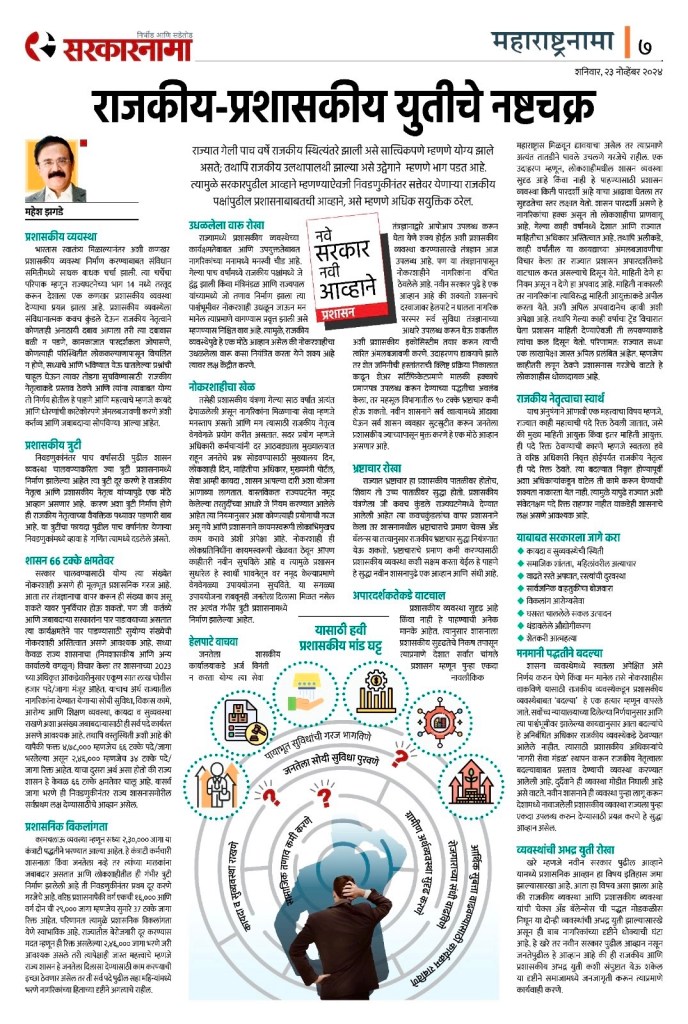
नवीन सरकारा पुढील आव्हाने:प्रशासन

( हा लेख संक्षिप्त स्वरुपात सरकारनामा मध्ये दि २३/११/२०२४ रोजी प्रकाशित झाला.)

राज्यात गेली पाच वर्षे राजकीय स्थित्यंतरे झाली असे सात्विकपणे म्हणणे योग्य झाले असते; तथापि राजकीय उलथा पालथी झाल्या असे उद्वेगाने म्हणणे भाग पडत आहे. आपण 26 जानेवारी 1950 ला प्रजासत्ताक अर्थात लोकशाही शासन व्यवस्थेचा अंगीकार केला, म्हणजेच लोकांची सत्ता असलेली व्यवस्था लागू केली. या लोकांच्या सत्तेचे रूपांतर राजकीय सत्तेत केव्हा झाले ते कळले सुद्धा नाही. त्यामुळे सरकार पुढील आव्हाने म्हणण्याऐवजी निवडणुकीनंतर सत्तेवर येणाऱ्या राजकीय पक्षापुढील प्रशासनाबाबतची आव्हाने असे असे म्हणणे अधिक सयुक्तिक ठरेल.

ही आव्हाने कोणती आहेत हा विषय एका पुस्तकाचा आहे तथापि त्यावर एक संक्षेपाणे दृष्टिक्षेप टाकण्याचा प्रयत्न करूया. लोकशाहीचा प्रथम प्रयोग ग्रीक मधील अथेन्स शहरात 2531 वर्षांपूर्वी झाला आणि सर्व शक्तिमान ‘राजाचे शासन’ या ऐवजी सर्व ‘जनतेचे शासन’ या स्वरूपामध्ये सरकारे स्थापन होऊ  लागली. अर्थात त्यावेळेस अथेन्सची लोकसंख्या कमी असल्यामुळे प्रत्येक नागरिक शासन व्यवस्थेतील सर्व निर्णय घेण्यामध्ये सहभागी होत असे. पण नंतर लोकसंख्या वाढत गेल्याने शासनाच्या प्रत्येक निर्णयात प्रत्येक नागरिकांचा सहभाग होणे हे व्यावहारिक नसल्याने बहुमताने निवडून दिलेल्या लोकप्रतिनिधी कडून ती व्यवस्था चालवण्याची लोकशाही पद्धत रुजली आणि ती प्रातिनिधिक लोकशाही आज सर्वत्र चालू आहे. अर्थात या प्रातिनिधिक लोकशाही व्यवस्थेत सर्वात मोठी त्रुटी ही होती की दर चार-पाच वर्षाने निवडून येणारे लोकप्रतिनिधी राज्यशकट चालवण्यासाठी अनुभवी, प्रगल्भ, सर्वांना समान न्याय देणारे असतीलच असे नाही आणि या त्रुटीमुळे तत्कालीन सॉक्रेटिस, अरिस्टॉटल, प्लेटोइ सारखे तत्ववेत्ते लोकशाही प्रयोगाबाबत साशंक होते. अर्थात ही शासन व्यवस्था राजेशाही किंवा अन्य कोणतेही व्यवस्थेपेक्षा चांगली असल्यामुळे त्यातील त्रुटी दूर करणे गरजेचे होते आणि या विचारातून लोकशाही सुदृढ करण्याकरिता काही व्यवस्था उदयास आल्या. त्यापैकी नोकरशाही किंवा प्रशासन ही एक होय. लोकप्रतिनिधी जरी दर पा चार-पाच वर्षांनी बदलले गेले किंवा ते शासन चालविण्यामध्ये प्रशिक्षित नसले किंवा ते कायदेविषयक बाबीत निष्णात नसले तरी नोकरशाहीच्या माध्यमातून या प्रश्नावर तोडगा काढण्यात आला आणि तो पुढे विकसित होत गेला. लोकशाही सुदृढतेच्या दृष्टीने नोकरशाही ही प्रगल्भ, प्रशिक्षित, अनुभवी, वशिल्याशिवाय त्रयस्त संस्थेकडून निवडली गेलेली, जनतेस जबाबदार असलेली अशी कायम स्वरूपाची व्यवस्था म्हणून निर्माण झाली. भारतास स्वातंत्र्य मिळाल्यानंतर अशी कणखर  प्रशासकीय व्यवस्था निर्माण करण्याबाबत संविधान समितीमध्ये साधक वादक चर्चा झाली. त्या चर्चेचा परिपाक म्हणून संविधानाच्या भाग 14 मध्ये तरतूद करून देशाला एक कणखर प्रशासकीय व्यवस्था देण्याचा प्रयत्न झाला आहे. प्रशासकीय व्यवस्थेला संविधानात्मक कवच कुंडले देऊन राजकीय नेतृत्वाने कोणताही अनाठायी दबाव आणला तरी त्या दबावास बळी न पडणे, कामकाजात पारदर्शकता जोपासणे, कोणत्याही परिस्थितीत लोककल्याणापासून विचलित न होणे, सध्याचे आणि भविष्यात येऊ घातलेल्या प्रश्नांची चाहूल घेऊन त्यावर तोडगा सुचविण्यासाठी राजकीय नेतृत्वाकडे प्रस्ताव ठेवणे आणि त्यांना त्याबाबत सचेतन करून योग्य तो निर्णय होतील हे पाहणे आणि महत्त्वाचे म्हणजे कायदे आणि धोरणांची काटेकोरपणे अंमलबजावणी करणे अशी कर्तव्य आणि जबाबदाऱ्या सोपविण्या आलेल्या आहेत.

एकंदरीतच लोकशाही व्यवस्थेत लोकप्रतिनिधी हे जरी सरकार असतील तरी ते सरकार व्यवस्थित चालवण्याची संविधानिक जबाबदारी चेक्स अँड बॅलेन्सेस या स्वरूपात प्रशासनावर आहे. त्यामुळे देशात आणि राज्यात शासन व्यवस्थे मार्फत जे काही चांगले किंवा वाईट होते त्यात प्रशासनाची मोठी  हिस्सेदारी असते.

महाराष्ट्र राज्य स्थापन झाल्यानंतर गेल्या 64 वर्षात सहा दशकांच्या प्रशासनिक कारकिर्दीचा आढावा घेतला असता एक बाब निश्चितपणे समोर येते ती म्हणजे एकेकाळी महाराष्ट्राचे प्रशासन हे देशांमध्ये सर्वोत्तम प्रशासन म्हणून नावाजलेले होते. अर्थात, ही ख्याती होण्याच्या कारणांपैकी महत्त्वाचे कारण म्हणजे राज्यातील राजकीय व्यवस्था ही लोकाभिमुख, सामाजिक गरजांची जाणीव असलेली आणि प्रशासकीय व्यवस्थेचा राज्यासाठी कसा चांगल्या प्रकारे वापर करता येऊ शकेल असा विचार करणारी होती. आज जर पुन्हा एकदा राज्यातील प्रशासकीय व्यवस्थेचे मूल्यमापन करावयाचे झाले तर देशातील सर्वोत्तम प्रशासन असे म्हणणे आता धाडसाचे ठरेल. त्याला राजकीय व्यवस्थेबरोबरच प्रशासकीय नेतृत्व देखील तितकेच जबाबदार आहे.

निवडणुका नंतर पाच वर्षासाठी पुढील शासन व्यवस्था चालवण्याकरिता ज्या त्रुटी प्रशासनामध्ये निर्माण झालेले आहेत त्या त्रुटी दूर करणे हे राजकीय नेतृत्व आणि प्रशासकीय नेतृत्व यांच्यापुढे एक मोठे आव्हान असणार आहे. अर्थात, यामध्ये ज्या त्रुटी निर्माण झालेल्या आहेत त्या दुरुस्त करण्याची मानसिकता निवडून येणाऱ्या राजकीय व्यवस्थेमध्ये असेलच अशी खात्री देता येणे शक्य नाही कारण अशा त्रुटी निर्माण होणे ही राजकीय नेतृत्वाच्या वैयक्तिक पथ्यावर पडण्यासारख्या बाबी आहेत. या त्रुटींचा फायदा पुढील पाच वर्षानंतर येणाऱ्या निवडणुकांमध्ये व्हावा हे गणित त्यामध्ये दडलेले असते. हे काहीही असले तरी, ज्या प्रशासनिक त्रुटी किंवा विकलांगता निर्माण झालेल्या आहेत त्या कोणत्या आणि त्यावर काय उपाययोजना होऊ शकतात याचा थोडक्यात उहाओह करूया.

सरकार चालवण्यासाठी योग्य त्या संख्येत नोकरशाही असणे ही मूलभूत प्रशासनिक गरज आहे. अर्थात यामध्ये कालपरत्वे बदल होऊ शकतो आणि आता तर तंत्रज्ञानाचा वापर करून ही संख्या काय असू शकते यावर पुनर्विचार होऊ शकतो. पण एक बाब निश्चित आहे की जी कर्तव्ये आणि जबाबदाऱ्या सरकारांना पार पाडावयाच्या असतात त्या कार्यक्षमतेने पार पाडण्यासाठी सुयोग्य संख्येची नोकरशाही राज्यांमध्ये अस्तित्वात असणे आवश्यक आहे. त्यासाठी किती नोकरशाही आवश्यक आहे हे प्रशासनिक नेतृत्वाने राजकीय नेतृत्वाला पटवून देऊन ती संख्या निश्चित करण्याचे प्रक्रिया असते. या प्रक्रियेनुसार सध्या केवळ राज्य शासनाचा(निमशासकीय आणि अन्य कार्यालये वगळून) विचार केला तर शासनाच्या 2023 च्या अधिकृत आकडेवारीनुसार एकूण सात लाख चोवीस हजार पदे मंजूर आहेत. याचाच अर्थ राज्यातील नागरिकांना देण्यात येणाऱ्या सोयी सुविधा, विकास कामे, आरोग्य आणि शिक्षण व्यवस्था, कायदा व सुव्यवस्था राखणे अशा असंख्य जबाबदाऱ्यासाठी ही सर्व पदे कार्यरत असणे आवश्यक आहे. तथापि वस्तुस्थिती अशी आहे की यापैकी फक्त ४,७८,००० म्हणजेच ६६% पदे भरलेली असून २,४६,००० म्हणजेच ३४% पदे रिक्त आहेत. याचा दुसरा अर्थ असा होतो की राज्य शासन हे केवळ ६६% क्षमतेवर चालू आहे. ते जर १००% क्षमतेने चालवावयाचे असेल तर सर्व शंभर टक्के पदे भरणे ही निवडणुकीनंतर राज्य शासनासमोरील सर्वप्रथम लक्ष देण्यासाठीचे आव्हान असेल. अर्थात यामध्ये कामचलाऊ व्यवस्था म्हणून २,३०,००० पदे ही कंत्राटी पद्धतीने भरण्यात आलेली आहेत. हे कंत्राटी कर्मचारी/अधिकारी शासनाला किंवा जनतेला नव्हे तर त्यांच्या मालकांना जबाबदार असतात आणि लोकशाहीतील ही गंभीर त्रुटी निर्माण झालेली आहे ती निवडणुकीनंतर प्रथम दूर करणे गरजेचे आहे. प्रशासन व्यवस्थित चालते किंवा नाही, निर्णय वेळेवर होतात की नाही इत्यादी गोष्टीसाठी वरिष्ठ प्रशासन म्हणजेच पर्यवेक्षकीय प्रशासन गरजेचे असते. वस्तूस्थिती अशी आहे की या वरिष्ठ प्रशासनापैकी वर्ग एकची १६,००० आणि वर्ग दोन ची २९,००० पदे म्हणजेच सुमारे 37% पदे रिक्त आहेत. परिणामतः त्यामुळे प्रशासनिक विकलांगता येणे स्वाभाविक आहे. राज्यातील बेरोजगारी दूर करण्यास मदत म्हणून ही रिक्त असलेले दोन २,४६,००० पदे भरणे जरी आवश्यक असले तरी त्यापेक्षाही जास्त महत्त्वाचे म्हणजे राज्य शासन हे जनतेला दिलासा देण्यासाठी काम करण्याची इच्छा ठेवणार असेल तर ती सर्व पदे पुढील सहा महिन्यांमध्ये भरणे नागरिकांच्या हिताच्या दृष्टीने अगत्याचे राहील.

दुसरे असे की राज्यातील जनतेला सोयी सुविधा पुरवणे, त्यांची आर्थिक सुबत्ता वाढवण्यासाठी योजना आणि कार्यक्रम राबविणे, पायाभूत सुविधांची गरज भागविणे, कायदा व सुव्यवस्था राखणे, सामाजिक तणाव कमी करणे, रोजगाराच्या संधी वाढविणे, ग्रामीण अर्थव्यवस्था सुदृढ करणे,आरोग्य विषयक आणि शैक्षणिक बाबतीत किफायतशीरपणे संधी उपलब्ध करून देणे अशा अगणित बाबतीत प्रशासन अत्यंत संवेदनक्षम राहून त्यांच्या १००% क्षमतेने कसे काम करतील यासाठी प्रशासकीय मांड घट्ट करणे अत्यावश्यक आहे. राज्यामध्ये कोठेही फिरून जर कानोसा घेतला तर प्रशासकीय व्यवस्थेच्या कार्यक्षमतेबाबत आणि उपयुक्ततेबाबत नागरिकांच्या मनामध्ये मनस्वी चीड आहे. प्रशासनामध्ये प्रचंड शैथिल्य आलेले आहे हे सांगण्याची ज्योतिषाची गरज नसावी. ज्यावेळेस राजकीय व्यवस्था क्षीण होते त्यावेळेस प्रशासकीय व्यवस्था त्याचा गैरफायदा घेऊ लागते आणि मन मानेल त्याप्रमाणे वागू लागते. गेल्या पाच वर्षांमध्ये राजकीय पक्षांमध्ये जे द्वंद्व झाली किंवा मंत्रिमंडळ आणि राज्यपाल यांच्यामध्ये जो तणाव निर्माण झाला त्या पार्श्वभूमीवर नोकरशाही उधळून जाऊन मन मानेल त्याप्रमाणे वागण्यास प्रवृत्त झाली असे म्हणण्यास निश्चित वाव आहे. त्यामुळे, राजकीय व्यवस्थेपुढे हे एक मोठे आव्हान असेल की नोकरशाहीचा उधळलेला वारू पुन्हा कसा नियंत्रित करता येणे शक्य आहे त्यावर लक्ष केंद्रीत करणे. अर्थात ही बाब अजिबात कठीण नाही कारण राजकीय नेतृत्वाने ठरविले तर काही आठवड्यातच त्याचे योग्य ते चांगले परिणाम दिसून येऊ लागतील.

तसेही प्रशासकीय यंत्रणा गेल्या साठ वर्षा अत्यंत ढेपाळलेली असून नागरिकांना मिळणाऱ्या सेवा म्हणजे मनस्ताप असतो आणि मग त्यासाठी राजकीय नेतृत्व वेगवेगळे प्रयोग करीत असतात. सदर प्रयोग म्हणजे अधिकारी कर्मचाऱ्यांनी दर आठवड्याला मुख्यालयात राहून जनतेचे प्रश्न सोडवण्यासाठी मुख्यालय दिन, लोकशाही दिन, माहितीचा अधिकार, मुख्यमंत्री पोर्टल, सेवा आम्ही कायदा , शासन आपल्या दारी अशा योजना आणाव्या लागतात. वास्तविकता संविधानात नमूद केलेल्या तरतुदींचे आधारे जे नियम करण्यात आलेले आहेत त्या नियमानुसार अशा कोणत्याही प्रयोगाची गरज असू नये आणि प्रशासनाने कायमस्वरूपी लोकाभिमुखच काम करावे अशी अपेक्षा आहे. नोकरशाही ही लोकप्रतिनिधींना कायमस्वरूपी खेळवत ठेवून आपण काहीतरी नवीन सुचविले आहे व त्यामुळे प्रशासन सुधारेल हे स्वार्थी भावनेतून वर नमूद केल्याप्रमाणे वेगवेगळ्या उपाययोजना सुचविते . या सगळ्या उपाययोजना राबवूनही जनतेला दिलासा मिळत नसेल तर काहीतरी अत्यंत गंभीर त्रुटी प्रशासनामध्ये निर्माण झालेल्या आहेत आणि त्या त्रुटी दूर करण्याचे आव्हान नवीन शासनासमोर असणार आहे,

शासकीय प्रक्रिया पार पाडताना एक तर अशा प्रक्रियांची गरजच भासू नये आणि गरज भासल्यासच तर जनतेला शासकीय कार्यालयाकडे अर्ज विनंती न करता योग्य त्या सेवा तंत्रज्ञानाद्वारे आपोआप उपलब्ध करून घेता येणे शक्य होईल अशी प्रशासकीय व्यवस्था करण्यासारखे तंत्रज्ञान आज उपलब्ध आहे. पण या तंत्रज्ञानापासून नोकरशाहीने नागरिकांना वंचित ठेवलेले आहे. नवीन सरकार पुढे हे एक आव्हान आहे की शक्यतो शासनाचे दरवाजावर हेलपाटे न घालता नागरिक परस्पर सर्व सुविधा तंत्रज्ञानाच्या आधारे उपलब्ध करून घेऊ शकतील अशी प्रशासकीय  इकोसिस्टीम तयार करून त्याची त्वरित अंमलबजावणी करणे. उदाहरणच द्यावयाचे झाले तर शेत जमिनीची हस्तांतरणाची क्लिष्ट प्रक्रिया निकालात काढून शेअर सर्टिफिकेट प्रमाणे मालकी हक्काचे प्रमाणपत्र उपलब्ध करून देण्याच्या पद्धतीचा अवलंब केला तर महसूल विभागातील ९० टक्के भ्रष्टाचार कमी होऊ शकतो. नवीन शासनाने सर्व खात्यामध्ये आढावा घेऊन सर्व शासन व्यवहार सुटसुटीत करून जनतेला प्रशासकीय ज्याच्यापासून मुक्त करणे हे एक मोठे आव्हान असणार आहे.

राज्यात भ्रष्टाचार हा प्रशासकीय पातळीवर होतोच, शिवाय तो उच्च पातळीवर सुद्धा होतो. प्रशासकीय यंत्रणेला जी कवच कुंडले संविधानामध्ये देण्यात आलेली आहेत त्या कवचकुंडलांचा वापर प्रशासनाने केला तर शासनामधील भ्रष्टाचाराचे प्रमाण चेक्स अँड बॅलन्स या तत्त्वानुसार राजकीय भ्रष्टाचार सुद्धा नियंत्रणात येऊ शकतो. त्यामुळे, राज्यात भ्रष्टाचार कमी करावयाचा झाल्यास संविधानात अपेक्षित केल्याप्रमाणे चेक्स अँड बॅलन्स द्वारे भ्रष्टाचाराचे प्रमाण कमी करण्यासाठी तशी प्रशासकीय व्यवस्था कशी सक्षम करता येईल हे पाहणे हे सुद्धा नवीन शासना पुढे एक आव्हान आणि संधी आहे.

प्रशासकीय व्यवस्था सुदृढ आहे किंवा नाही हे पाहण्याचे अनेक मानके आहेत. त्यानुसार शासनाला प्रशासकीय सुदृढतेचे निकष तपासून त्याप्रमाणे देशात सर्वात चांगले प्रशासन म्हणून पुन्हा एकदा नावलौकिक महाराष्ट्रास मिळवून द्यावयाचा असेल तर त्याप्रमाणे अत्यंत तातडीने पाऊल उचलणे गरजेचे राहील. एक उदाहरण म्हणून, लोकशाही मधील शासन व्यवस्था सुदृढ आहे किंवा नाही हे पाहण्यासाठी प्रशासन व्यवस्था किती पारदर्शी आहे याचा आढावा घेतला तर सुदृढतेचा स्तर लक्षात येतो. शासन पारदर्शी असणे हे नागरिकांचा हक्क असून तो लोकशाहीचा प्राणवायू आहे. गेल्या काही वर्षांमध्ये देशात आणि राज्यात  माहितीचा अधिकार अस्तित्वात आहे. तथापि अलीकडे, काही वर्षांतील या कायद्याच्या अंमलबजावणीचा विचार केला तर राज्यात प्रशासन अपारदर्शतेकडे वाटचाल करण्यात येत असल्याची दिसून येते. माहिती देणे हा नियम असून न देणे हा अपवाद आहे. माहिती नाकारली तर नागरिकांना त्याविरुद्ध माहिती आयुक्ताकडे अपील करता येते. अशी अपिल्स अपवादानेच व्हावी अशी अपेक्षा आहे. तथापि गेल्या काही वर्षाचा ट्रेंड विचारात घेता प्रशासन माहिती देण्याऐवजी ती लपवण्याकडे त्यांचा कल दिसून येतो परिणामत: राज्यात सध्या एक लाखापेक्षा जास्त  अपील्स प्रलंबित आहेत. म्हणजेच प्रशासनास काहीतरी लपून ठेवणे गरजेचे वाटते आणि ते लोकशाहीस धोकादायक आहे. हा लोकशाहीचा धोका ओळखून तो कमी करण्याकरिता प्रशासनावर वचक निर्माण करण्याची गरज किंवा आव्हान नवीन शासनापुढे असेल. याच अनुषंगाने आणखी एक महत्त्वाचा विषय म्हणजे, राज्यात काही महत्त्वाची पदे रिक्त ठेवली जातात, जसे की मुख्य माहिती आयुक्त किंवा इतर माहिती आयुक्त. ही पदे रिक्त ठेवण्याची कारणे म्हणजे स्वतःला हवे ते वरिष्ठ अधिकारी निवृत्त होईपर्यंत राजकीय नेतृत्व ही पदे रिक्त ठेवते. त्या बदल्यात निवृत्त होण्यापूर्वी अशा अधिकाऱ्यांकडून वाटेल ती कामे करून घेण्याची शक्यता नाकारता येत नाही. त्यामुळे यापुढे राज्यात अशी संवेदनक्षम पदे रिक्त राहणार नाहीत याकडेही शासनाचे लक्ष असणे आवश्यक आहे. राज्यात कायदा व सुव्यवस्था, सामाजिक व शांतता, स्त्रियांवरील अत्याचार, रस्ते अपघातांचे वाढते प्रमाण, रस्त्यांची दुरावस्था, सार्वजनिक वाहतूक व्यवस्थेचा उडालेला बोजवारा, विकलांग झालेली आरोग्यसेवा, देशातील सकल उत्पादनाबाबत राज्याचा घसरत चाललेला क्रम, थंडावलेले औद्योगीकरण, शेतकरी आत्महत्या आणि त्यांच्या समस्या अशा अगणित प्रश्नाबाबत नवीन शासनाला प्रशासनास सतर्क करून त्यावर अल्पावधीतच समाधान शोधावे लागेल.

शासना व्यवस्थेमध्ये स्वतःला अपेक्षित असे निर्णय करुन घेणे किंवा मन मानेल तसे नोकरशाहीस वाकविणे यासाठी राजकीय व्यवस्थेकडून प्रशासकीय व्यवस्थेबाबत ‘बदल्या’ हे एक हत्यार म्हणून वापरले जाते. सर्वोच्च न्यायालयाच्या दिलेल्या निर्णयानुसार आणि त्या पार्श्वभूमीवर झालेल्या कायद्यानुसार आता बदल्यांचे हे अनिर्बंधित अधिकार राजकीय व्यवस्थेकडे ठेवण्यात आलेले नाहीत. त्यासाठी प्रशासकीय अधिकाऱ्यांचे ‘नागरी सेवा मंडळ’ स्थापन करून राजकीय नेतृत्वाला बदल्याबाबत प्रस्ताव देण्याची व्यवस्था करण्यात आलेली आहे. यामुळे आकसाने किंवा अनाठायी  किंवा अन्य कारणास्तव बदल्या करण्याच्या राजकीय नेतृत्वाच्या अधिकारावर निर्बंध आले असून विनाकारणच बदल्या होऊ नये अशी व्यवस्था तयार झालेली आहे. दुर्दैवाने ही व्यवस्था मोडीत निघाली आहे असे वाटते. नवीन शासनाने ही व्यवस्था पुन्हा लागू करून देशामध्ये आवाजलेली प्रशासकीय व्यवस्था राज्यला पुन्हा एकदा उपलब्ध करुन देण्यासाठी प्रयत्न करणे हे सुद्धा आव्हान असेल.

खरे म्हणजे नवीन सरकार पुढील आव्हाने यामध्ये प्रशासनिक आव्हान हा विषय इतिहास जमा झाल्यासारखा आहे. आता हा विषय असा झाला आहे की राजकीय व्यवस्था आणि प्रशासकीय व्यवस्था यांची चेक्स अँड बॅलेन्सेस ची पद्धत मोडकळीस निघून या दोन्ही व्यवस्थांची अभद्र युती झाल्यासारखे असून ही बाब नागरिकांच्या दृष्टीने धोक्याची घंटा आहे. हे खरे तर नवीन सरकार पुढील आव्हान नसून जनतेपुढील हे आव्हान आहे की ही राजकीय आणि प्रशासकीय अभद्र युती कशी संपुष्टात येऊ शकेल या दृष्टीने समाजामध्ये जनजागृती करून त्याप्रमाणे कार्यवाही करणे.

-महेश झगडे, IAS(नि)

Standard

हा खेळ “लाल दिव्यांचा”!

अलीकडेच एका भारतीय प्रशासकीय सेवेतील (आयएएस) प्रशिक्षणार्थीने पुणे जिल्ह्यात प्रशिशिक्षण कालावधीदरम्यान स्वतःच्या खाजगी गाडीवर बिकन लाईट म्हणजेचे तांबडा-निळा-पांढरा दिवा आणि “महाराष्ट्र शासन” असे नमुद करुन ती गाडी वापरली अशी वृत्ते प्रसिद्ध झाली आणि त्याची चर्चा प्रसारमाध्यमांमध्ये देशभर झाली. अर्थात असा दिवा लावण्याबाबत आक्षेप असावा का आणि त्याबाबत नेमके नियम काय आहेत याची चर्चा सर्वसामान्यामध्ये होणे साहजिक आहे.

वाहनावर दिवे लावण्याबाबत केंद्रीय मोटर वाहन नियम १९८९ मध्ये स्पष्ट तरतुदी आहेत.या तरतुदींचे पालन केले नाही तर त्याविरुद्ध कारवाई होऊ शकते. आपल्याला आठवत असेल की या देशात रस्त्यावर लाल, अंबर रंगाचे दिवे लावलेल्या शासकीय गाड्या आणि अनेक वेळेस बेकायदेशीरपणे खाजगी गाड्या आणि कर्कश्यपणे वाजणारे सायरन मोठ्या प्रमाणात दिसून येत असत. त्याला “व्हीआयपी कल्चर” असे संबोधले जायचे. म्हणजेच रस्ता वापराबाबत समाजाची सर्वसामान्य जनता आणि व्हीआयपी लोक अशा दोन वर्गात विभागणी झालेली ती संस्कृती होती.

मी २०१५ मध्ये परिवहन आयुक्त म्हणून रुजू झाल्यानंतर या “व्हीआयपी संस्कृती”च्या विकृतीची प्रचिती आली. अनेक अधिकारी आणि खाजगी व्यक्ती असे नियमबाह्यपणे “दिवे” लावून फिरत होते. मी त्यावर नियमांचा चाप ओढल्यावर प्रक्षोभ निर्माण झाला. मला वरिष्ठ असलेल्या एका अधिकाऱ्याने त्यांचा दिवा बेकायदेशीर होता म्हणून काढण्यास माझ्या अधिकाऱ्याने सांगितल्यावर मला फोन करुन ते अड्वातड्वा बोलून(खरे म्हणजे बोली भाषेत “झापून”) तगडी समज दिली की “तुम यह जो कर रहे हो, इसके consequencesअच्छे नहीं होनेवाले”. अर्थात अशी वाक्ये प्रशासनात माझ्यासाठी केंव्हाच बोथट झालेली होती. पण मी नियमांची अंमलबजावणी करण्याच्या कारवाया चालू ठेवल्या आणि अनेक रोष ओढवून घेतले. असाच रोष मी नाशिक जिल्हाधिकारी असतांना एका साधूला २००३ चा कुंभमेळ्यात दिवा वापरू न दिल्याने ओढवून घेतलेला होता. पण त्यावेळेस तत्कालीन नाशिक महापौरांनी त्या साधूची समजूत काढून जिल्हाधिकारी असे दिवे लावूच देणार नाहीत हे स्पष्ट केल्याने चिघळत चाललेले प्रकरण निवळले गेले.

एकंदरीतच कायदा व सुव्यवस्था, संरक्षण विषयक तातडी, अग्निशमन अशा वेळेस रस्त्यावर प्राथम्यक्रम मिळवा यापेक्षा वैयक्तिक बडेजावासाठी या दिव्यांचा वापर ही संस्कृती देशात रुजली होती. काही राज्यात तर बाहुबली सुद्धा त्याचा सर्रास वापर करीत होते आणि त्याविरुद्ध कारवाई करण्यास पोलिसांची हतबलता दिसून येत होती.

यावर २०१३ मध्ये सर्वोच्च न्यालयाने एका निर्णयान्वये शासनाला या “दिव्याच्या” संस्कृतीचा गैरवापर होवू नये याप्रमाणे नियम करून त्याची अंमलबजावणी करावी असे निर्देश केंद्र शासनाला दिले होते.

केंद्र शासनाने दिनांक १९ एप्रिल २०१७ रोजीच्या मंत्रीमंडळाच्या बैठकीत निर्णय घेऊन या देशातील व्हीआयपी संस्कृती मोडीत काढण्याचा निर्णय घेतला आणि त्याबाबतची अधिसूचना १ मे २०१७ रोजी जारी करण्यात आली. केंद्रीय मोटर वाहन नियम १९८९ अंतर्गत निर्गमित केलेल्या या अधिसूचनेनुसार नियमात बदल करून त्या दिवसापासून मा राष्ट्रपती,मा पंतप्रधान सहित इतर कोणत्याही लोकप्रतिनिधी किंवा शासकीय अधिकाऱ्यास किंवा अन्य कोणाशी गाडीवर दिवा लावण्यावर बंदी घालण्यात आलेली आहे.

नियमानुसार फक्त पोलीस, संरक्षण विभाग, पॅरा मिलिटरी फोर्सेस यांना कायदा व सुव्यवस्था राखण्या साठी ज्या गाड्यांची आवश्यकता असते त्या गाड्या, तसेच नैसर्गिक आपत्ती वाहने आणि अग्निशमन बंबानाच परवानगी ठेवण्यात आलेली आहे. अर्थात ही परवानगी सुद्धा केवळ या गाड्या प्रत्यक्ष नेमून दिलेल्या कामाच्या वेळेसच तांबडा -निळा-पांढरा अशा पद्धतीचे दिवे लावू शकतील, अन्य वेळेस त्यांनाही दिवे चालू ठेवण्यापासून बंदी घालण्यात आलेली आहे. हे गाड्यावर दिवे लावणे बाबतचे नियम अत्यंत प्रखर असून संबंधित राज्याच्या परिवहन विभागाने त्या राज्यात कोणत्या प्राधिकाऱ्यास अथवा गाड्यांना परवानगी देण्यात आली आहे त्याची यादी दरवर्षी जाहीर करणेबंधनकारक केले आहे. शिवाय, ज्या प्राधिकार्‍यास ही परवानगी दिली आहे त्यांचे पदनाम आणि हा नंबर एका स्टिकर द्वारे वाहनाच्या समोर लावणे बंधनकारक आहे. सदर स्टिकर हे कोणीही डुप्लिकेट तयार करू नये यासाठी त्यावर प्रिंटेड वॉटर मार्क आणि होलोग्राम असण्याची तरतूद आहे.

सध्या असे दिवे कोणीही लावले असतील तर ते बेकायदेशीर असून त्यावर कारवाई केली जाणे अभिप्रेत आहे. या नियमान्वये, व्हीआयपी संस्कृतीचा कोणीही दुरुपयोग करू नये यासाठी परिवहन विभाग म्हणजेच आरटीओ आणि पोलीस यांनी दक्ष राहणे गरजेचे आहे. अलीकडे झाले काय आहे की आरटीओ कोणत्यातरी “अत्यंत प्रचंड” मोठ्या कामात “गुंतलेले” असल्याने केंद्र शासनाच्या या नियमांची पायमल्ली झाली तरी त्याच्याकडे लक्ष न देण्याइतपत ते निर्ढावलेले आहेत. त्यामुळे असे बेकायदेशीर दिवे लावण्याचे प्रकार दिसून येतात. ही व्हीआयपी संस्कृती मोडीत काढण्याचा निर्णय घेतल्यावर मा पंतप्रधानांनी त्यावेळेस ट्विट करुन “every Indian is special. Every Indian is a VIP” असे नमूद करुन या विषयाची जी गंभीरता आणि महत्व नमूद केले होते, त्याचे पालन अधिकाऱ्यांकडून होणे आवश्यक आहे.

Standard

The Catastrophic Threat of Antimicrobial Resistance: A Tale of Neglect and Regulatory Lapses

In the intricate ecosystem of modern medical triumphs, antimicrobials stand as a monumental thread, weaving a fabric of hope and survival against microbial infections. However, this bastion of medical progress is under siege by a formidable adversary—antimicrobial resistance (AMR). AMR poses a dire and catastrophic threat to humanity, casting a long, ominous shadow over the future of global health. Among the myriad factors contributing to this perilous situation, a notable failure lies in the non-enforcement of the provisions of the Drug and Cosmetics Act of 1940 by the Drug Controller of India and the State Food and Drug Administrations (FDAs)/Drug Controllers.

The Alarming Rise of Antimicrobial Resistance

Antimicrobial resistance occurs when microorganisms such as bacteria, viruses, fungi, and parasites evolve to resist the drugs designed to kill them. This natural phenomenon is exacerbated by the misuse and overuse of antimicrobials in humans, animals, and agriculture. The World Health Organization (WHO) has declared AMR one of the top ten global public health threats facing humanity. The statistics are alarming: a 2019 study published in The Lancet estimated that AMR directly caused 1.27 million deaths globally, with another 4.95 million deaths associated with bacterial AMR .

In India, the situation is particularly dire. The country accounts for one of the highest burdens of bacterial infections in the world, and the prevalence of AMR is rising at an alarming rate. A 2020 report by the Indian Council of Medical Research (ICMR) highlighted that resistance to commonly used antibiotics like fluoroquinolones, cephalosporins, and carbapenems is increasing among pathogens such as *Escherichia coli*, *Klebsiella pneumoniae*, and *Acinetobacter baumannii*. These bacteria are responsible for severe infections, including urinary tract infections, pneumonia, and bloodstream infections .

The Drug and Cosmetics Act of 1940: A Neglected Guardian

Amidst the burgeoning crisis of antimicrobial resistance, the Drug and Cosmetics Act of 1940 was conceived as a vigilant guardian, a sentinel poised to protect the public health of India. This Act, meticulously crafted, sought to regulate the import, manufacture, distribution, and sale of drugs and cosmetics, ensuring their safety, efficacy, and quality. It bestowed upon the Drug Controller General of India (DCGI) and State Drug Controllers the authority to enforce its provisions, which include stringent regulations on the prescription and sale of antibiotics.

Central to these protective measures is the role of pharmacists, whose presence in pharmacies is mandated by law. Their duty in the battle against antimicrobial resistance is of paramount importance. Pharmacists are entrusted with the responsibility to verify the appropriateness of prescribed drugs, their dosages, and the legitimacy of the prescribing doctor. They must ascertain whether the prescribed medicines are necessary or merely pushed by doctors under the influence of pharmaceutical companies. Moreover, they counsel patients on the correct timing and duration of medication use, thereby playing a crucial role in preventing the misuse of antimicrobials and minimizing the risk of drug resistance.

In essence, pharmacists are required to audit prescriptions and advise patients to ensure that unnecessary use of antimicrobials is avoided, thus reducing the chances of drug resistance. Regrettably, in India, regulatory bodies often fail to ensure the consistent presence of pharmacists in pharmacies. This failure stands as the most significant factor contributing to the rampant rise of antimicrobial resistance in the country.

There are, however, notable exceptions to this pervasive neglect. The tenure of Mr. Mahesh Zagade as Commissioner of the FDA in Maharashtra from 2011 to 2014 serves as a beacon of what stringent enforcement can achieve. During his tenure, Zagade rigorously implemented the provisions of the Act, prioritizing patient safety and shielding the public from the malpractices of drug manufacturers and traders. His example illustrates that with proper enforcement of the law, the threat of drug resistance can indeed be tackled effectively.

This narrative underscores the critical need for rigorous regulatory oversight and the indispensable role of pharmacists in the fight against antimicrobial resistance. It is a clarion call to fortify our defenses, uphold the provisions of the Drug and Cosmetics Act, and ensure that every pharmacy in India serves as a bulwark against this looming health crisis.

Despite this robust legal framework, the enforcement of these provisions has been woefully inadequate. This regulatory failure has significantly contributed to the rampant misuse of antibiotics, a primary driver of AMR. Over-the-counter sales of antibiotics without prescriptions are commonplace, and counterfeit or substandard drugs are alarmingly prevalent in the market. The lack of stringent enforcement and oversight has created an environment where antibiotics are used indiscriminately, leading to increased resistance.

The Failure of Enforcement: A Case Study

Consider the case of a bustling city in India, where antibiotics can be purchased as easily as over-the-counter painkillers. Here, the Drug Controller’s office, under the purview of the Drug and Cosmetics Act, is tasked with regular inspections and crackdowns on unauthorized sales. However, due to a combination of bureaucratic inertia, lack of resources, and alleged corruption, these regulations are seldom enforced.

In 2021, an investigative report by a leading national newspaper revealed that in several states, including Uttar Pradesh, Maharashtra, and Tamil Nadu, antibiotics were being sold without prescriptions in more than 70% of surveyed pharmacies . This blatant disregard for the law not only undermines the fight against AMR but also endangers public health on a massive scale.

The Human Toll: Stories from the Frontlines

The impact of this regulatory failure is not merely statistical; it is profoundly human. In rural and urban hospitals alike, doctors face the harrowing task of treating infections with dwindling therapeutic options. Take the story of Rani, a 32-year-old mother from Uttar Pradesh. She was admitted to a local hospital with a severe urinary tract infection. Despite receiving multiple courses of antibiotics, her condition worsened. The doctors eventually identified the culprit: a multi-drug resistant strain of *Escherichia coli*, resistant to all first-line antibiotics.

Rani’s story is not unique. Across India, patients suffer prolonged illnesses, higher medical costs, and increased mortality due to antibiotic-resistant infections. The economic burden is staggering, with a 2017 report by the World Bank predicting that by 2050, AMR could result in a 3.8% reduction in global GDP and push an additional 28 million people into poverty .

The Path Forward: Urgent Reforms and Global Cooperation

To avert the looming catastrophe of AMR, urgent and coordinated action is required. Strengthening the enforcement of the Drug and Cosmetics Act of 1940 must be a top priority. This involves stringent implementation of the law by the DCGI and State FDAs, enhancing surveillance and monitoring systems, and implementing stricter penalties for violations.

Moreover, public awareness campaigns are crucial to educate the populace about the dangers of antibiotic misuse. Healthcare professionals must also be trained to prescribe antibiotics judiciously, adhering to evidence-based guidelines.

International collaboration is essential in this fight. India must engage with global partners to share data, research, and best practices. The WHO’s Global Action Plan on AMR provides a comprehensive framework for countries to develop and implement national action plans. India’s National Action Plan on AMR, launched in 2017, is a step in the right direction, but its success hinges on effective implementation and enforcement.

A Call to Action

The specter of antimicrobial resistance is a dire and catastrophic threat that demands immediate attention and decisive action. The failure to enforce the provisions of the Drug and Cosmetics Act of 1940 has significantly contributed to this crisis in India. However, it is not too late to reverse the tide. With concerted efforts from government authorities, healthcare professionals, and the public, we can fortify our defenses against AMR and safeguard the health of future generations. The time to act is now, for the stakes could not be higher.

Standard

Democracy’s Decline: The Subtle Erosion Through Unscrupulous Leadership(On Voter’s Day)

In the grand ecosystem of governance, democracy stands as a venerable edifice built upon the ideals of representation and collective decision-making. Yet, within this hallowed structure, a latent menace looms—the vulnerability of voters to the artful machinations of unscrupulous leaders. Reminiscent of the timeless parable of Sitamai and Ravan, this contemporary narrative unveils a cautionary tale where the very essence of democracy weakens as citizens fall prey to leaders who, like mythological Ravan, drape themselves in virtue while harboring ulterior motives.

At the heart of this erosion lies the subtle manipulation of perception. Much akin to Ravan’s beguiling ascetic guise, today’s leaders deftly adorn themselves in the vestments of virtue. The intoxicating allure of charisma, the artful cadence of eloquence, and the careful construction of a righteous image can cast an enchanting spell upon the electorate. Entranced by grand promises and a veneer of noble intentions, voters may unwittingly bypass the nuanced examination of a leader’s true character.

The unraveling of democracy gains momentum when citizens fail to peer beyond the surface. In an era inundated with a deluge of information, the attention of the electorate is often fragmented, leaving scant room for thorough investigation. Unscrupulous leaders exploit this vulnerability, riding the swift currents of public opinion rather than enduring the meticulous scrutiny intended by the democratic process. Democracy, designed as a system of checks and balances, falters when citizens succumb to the allure of superficial charm and neglect to hold leaders accountable for their deeds.

Furthermore, the corrosion of democracy is exacerbated by the polarization that permeates political discourse. Unscrupulous leaders deftly exploit divisive issues, cultivating an ‘us versus them’ mentality that obscures rational judgment. The narrative of virtue is deftly woven to align with the biases of specific voter segments. In this climate of polarization, critical evaluation yields to tribal loyalty, further undercutting the democratic ideals of inclusivity and equitable representation.

As voters fall prey to unscrupulous leaders, the democratic process becomes susceptible to manipulation. The erosion unfolds not only in the election of leaders with dubious intentions but also in the subsequent governance. Policies shaped by self-interest rather than the common good, decisions veiled in secrecy, and the attenuation of institutions meant to check executive power all contribute to the gradual decline of democratic values.

To shield democracy from this insidious erosion, an enlightened and vigilant electorate proves indispensable. Initiatives focused on voter education, programs promoting media literacy, and the cultivation of critical thinking can empower citizens to discern beyond the veneer of virtue. Fostering a culture of open discourse and civil debate becomes an antidote to polarization, nurturing an environment where voters can make decisions grounded in a comprehensive understanding of the issues at hand.

In summation, the ebbing of democracy emerges as a complex challenge, with the susceptibility of voters to unscrupulous leaders standing as a prominent factor. As we commemorate Voter’s Day, let it be a poignant reminder of the collective duty we bear in upholding the democratic principles that form the bedrock of our societies. The parable of Sitamai and Ravan beckons us to remain vigilant, to question, and to be discerning custodians of the democratic legacy we have inherited.

Standard

निवडणुकाच नाहीत हे घटनाबाह्य

स्थानिक स्वराज्य संस्थांच्या निवडणुका या पाच वर्षांनी झाल्याच पाहीजे हे संविधानातच आहे. घटनेतच तशी तरतूद असेल तर या निवडणुकांना सर्वोच्च न्यायालय असो किंवा अन्य कोणी त्याला स्थगिती देऊ शकते का ? जोपर्यंत घटना दुरूस्ती होत नाही, तोपर्यंत राज्यांचे जे निवडणूक आयुक्त आहेत, त्यांनी या निवडणुका घेणे बंधनकारकच आहे. पण गेली तीन वर्षे जर निवडणुका घेतल्या नसतील तर हा घटना आणि संविधानाचाही भंग आहे.

१९५० साली आपण लोकशाही व्यवस्था आणली. लोकशाही म्हणजे लोकांचे राज्य. लोकशाही म्हणजे प्रत्येक नागरीकाला शासनाच्या निर्णय प्रक्रियेत स्थान मिळणे . . लोकसंख्या प्रचंड वाढल्याने प्रत्येक नागरीकाला निर्णय प्रक्रियेत सहभागी होता येत नाही, म्हणून ते लोकप्रतिनिधी निवडून देण्याची लोकशाही व्यवस्था अस्तित्वात आली . देश, राज्य, आपले शहर किंवा गाव प्रशासन, विकास यासाठी लोकप्रतिनिधीमार्फत शासन चालवले जाते. अर्थात हे करताना सर्वात महत्त्वाचे म्हणजे त्यासाठी संविधान आले, कायदे आले, त्यातून राज्य व देश कसे चालवायचे हे ठरले. १९९३ पर्यंत स्थानिक स्वराज्य संस्थांसाठी संविधानामध्ये तरतुदी नव्हत्या. फक्त ग्रामपंचायती असाव्यात एवढीच तरतूद होती. संविधानामध्ये राज्य व केंद्र शासनाचा कार्यकाल किती, आमदार , खासदार किती, मतदार संघ कसे असावेत याबाबत तरतुदी होत्या पण तशा विस्तृत तरतुदी स्थानिक स्वराज्य संस्थासाठी नव्हत्या त्याच स्वरूपाच्या तरतुदी करण्यासाठी ७३ वी व ७४ वी घटना दुरूस्ती करण्यात आल्या. . स्थानिक प्रश्न, समस्या यांची जाण आणि ते सोडविण्यासाठी स्थानिक पातळीवर काय करावे लागेल हे स्थानिकांना जास्त अवगत असते हे गृहीत धरले गेले व त्या प्रमाणे तरतुदी केल्या गेल्या. प्रश्‍न सोडवण्यासाठी नागरीकांचा सहभाग महत्त्वाचा असल्याचे पुढे आले. केवळ दिल्ली, मुंबईत बसून गाव, शहर किंवा जिल्हा पातळीवरचे प्रश्‍न सोडवता येणार नाहीत. त्यामुळे जगभर जी स्थानिक पातळीवरील व्यवस्था आहे, तशीच व्यवस्था घटना दुरूस्तीतून पुढे आल्या. त्यातून स्थानिक स्वराज्य संस्थांची निर्मिती झाली. काही राज्यात ग्रामपंचायत, जिल्हा परिषदा पूर्वीही होत्या. याबाबत महाराष्ट्र राज्य अग्रेसर होते. तथापि याबाबतच्या कायद्यात काही त्रुटी होत्या. संपूर्ण देशात प्रत्येक गाव, शहर, जिल्हा इ साठी स्थानिक स्वराज्य संस्था निर्माण करण्याचे बंधन आले. त्यानुसार प्रत्येक राज्याला कायदे करावे लागले. प्रत्येक स्वराज्य संस्थेने काय करायला पाहिजे हे निश्‍चित झाले व त्याकरिता संविधानात त् अनुसुची ११ व १२ जोडण्यात आल्या. त्यात केंद्र व राज्य सरकारने काय काम करायचे याच धर्तीवर या सुचीनुसार स्थानिक स्वराज्य संस्थांचे काम निश्‍चित करण्यात आले.

याअनुषंगाने संविधानात बदल करतांना दोन-तीन तरतुदी अतिशय महत्त्वाच्या आहेत. एक तर ठराविक त्या भौगोलिक क्षेत्रासाठी भागानुसार एक लोकप्रतिनिधी निवडून देण्यासाठी मतदारसंघाची रचना, जेणेकरून तिथल्या नागरीकांचे जे प्रश्‍न असतील ते संबंधित लोकप्रतिनिधी त्यात स्थानिक स्वराज्य संस्थेत मांडेल. दुसरी तरतूद सुद्धा अतिशय महत्वाची असून ती म्हणजे या संस्थांचा कार्यकाल पाच वर्षाच अनिवार्य करण्यात आला.

पुर्वी महाराष्ट्रात स्थानिक स्वराज्य संस्था ही जरी व्यवस्था असली तरी बऱ्याचवेळी या संस्थांचे काम पाच वर्षापेक्षा जास्त काळ म्हणजे कधी कधीदहा, पंधरा वर्षे चालायचे व ते लोकशाहीच्या प्रणालीशी विसंगत होते. पाच वर्षांनी निवडणुका घेतल्याचं पाहिजेत असे संविधानात्मक बंधन नव्हते. आता स घटनेमध्ये त पाच वर्षांनी निवडणुका घेणे बंधनकारक करण्यात आले आहे आणि त्याकरिता तशा तरतुदी अनुच्छेद २४३-ई हे ग्रामीण तर २४३-यु हे शहरी भागासाठी तरतूद करण्यात आल्या आहेत. या तरतुदीअन्वये या स्थानिक संस्थांचा कार्यकाल पाच वर्षांचाच असेल असेल हे अनिवार्य झाले आहे. त्यात अर्थात स्थानिक स्वराज्य संस्था नव्याने निर्माण होणे , त्यांचे विभाजन होणे किंवा अन्य कोणत्याही कारणामुळे जर त्यांचा कार्यकाळ संपुष्ठात आणणे आवश्यक झाले तर काय करावे हा प्रश्न निर्माण होऊ शकतो व त्यावर तोडगा म्हणून देखील तरतुदी करण्यात आल्या आहेत. स्थानिक स्वराज्य संस्था बरखास्त झाली तर त्याठिकाणी सहा महिन्यात निवडणुका घेणे हे संविधानानुसार बंधनकारक आहे. यापेक्षा महत्त्वाची तरतूद अशी आहे, कि एखाद्या संस्थेचा पाच वर्षाचा कार्यकाल अमूक एका तारखेला संपत असेल तर तत्पुर्वी निवडणूक प्रक्रिया पूर्ण होऊन तिथे लोकप्रतिनिधी निवडून आले पाहीजेत! ही महत्त्वाची तरतूद आहे. म्हणजे कार्यकाल संपल्याच्या दुसऱ्या दिवशी नवे सभागृह येणे कायद्याने आवश्‍यक आहे. ही घटनात्मक तरतूद आहे. ही केवळ कायद्यातील तरतूद नसून संविधानात्मक तरतूद असल्याने जोपर्यंत घटना दुरुस्ती होत नाही तोपर्यंत , त्यात कोणी बदल करू शकत नाही.

कांही वर्षांपूर्वी नागरीकांचा मागास प्रवर्गासाठी जे राजकीय आरक्षण दिले होते, त्याबाबत एक कर्नाटक राज्याचा सर्वोच्च न्यायालयाचा निर्णय आला होता. त्यात नागरीकांचा मागास प्रवर्गासाठी राजकीय आरक्षण देण्यासाठी एक प्रक्रिया निर्देशित केली होती. पण बहुतेक राज्यांनी त्याकडे दुर्लक्ष केले. महाराष्ट्रात याबाबत एका अर्जदाराने सर्वोच्च न्यायालयाच्या निर्णयानुसार प्रक्रिया राबवण्याची मागणी केली. ओबीसींची लोकसंख्या किती, त्या प्रमाणात त्यांना आरक्षण द्यावे अशी ती मागणी होती. यात ओबींसींचे आरक्षण एकूण जागेच्या पन्नास टक्क्यापेक्षा जास्त जाऊ नये असाही एक मुद्दा होता. मग हे प्रकरण सर्वोच्च न्यायालयात गेले. काही संस्थांचा कार्यकाल संपल्याने सर्वोच्च न्यायालयाने महाराष्ट्रातील स्थानिक स्वराज्य संस्थाच्या निवडणुकांना स्थगिती दिली. मग हे दृष्टचक्र सुरू झाले. त्यात मग शासनाने एक आयोग नेमला. या आयोगाने सर्वोच्च न्यायालयाच्या म्हणण्यानुसार ओबींसींचे आरक्षण किती असावे ते सांगितले. हा अहवाल दिल्यानंतर सर्वोच्च न्यायालयाने ही स्थगिती उठवली. जुलै २०२२ मध्ये दिलेल्या या निर्णयाने निवडणुका घेण्याचा मार्ग मोकळा झाला.

या निर्णयालाही काहींनी आव्हान दिले. वॉर्ड रचना, आरक्षण यासारख्या अन्य कारणांमुळे हे प्रकरण लांबत गेले. ही स्थगिती आजतागाया तशीच चालू आहे.

स्थगिती उठविण्यासाठी राज्य शासनाच्या पातळीवर याचा पाठपुरावा झाला का नाही हे माहित नाही.

लोकशाहीमध्ये शासन म्हणजे लोकप्रतिनिधींनी तयार केलेली व्यवस्था म्हणजेच शासन आणि त्यात लोकप्रतिनिधींचे असणे हा मूळ गाभा आहे. . लोकशाहीमध्ये लोकप्रतिनिधी आणि प्रशासन हे एका रथाची दोन चाके असे म्हटले जाते पण खरे म्हणजे लोकप्रतिनिधींमधून तयार झालेली व्यवस्था हे वशासनकर्ते व त्याला सहाय्यभूत ही प्रशासकीय व्यवस्था असते. त्यामुळे लोकप्रतिनिधीविना व्यवस्था हि लोकशाहीला अभिप्रेत व्यवस्था नसून जितका काही काळ प्रशासक असतील तितका काळ लोकशाही ही संस्थगित झालेली आहे सत्य मान्यच करावे लागेल.

संविधानात प्रशासक फक्त सहा महिनेच असे असू शकते असे प्रावधान केले आहे. त्यामुळे सहामहिन्यापलिकडे जो काही कार्यकाल झाला आहे तो असंविधानिक आहे. लोकप्रतिनिधी आणि प्रशासकीय यंत्रणा हि एकमेकांना पूरक तसेच एकमेकांवर वचक ठेवणारी व्यवस्थाही असते. आता केवळ प्रशासक असल्याने तेच सर्वेसर्वा असतात आणि त्यांच्यावर असलेला लोकप्रतिनिधींचा वचक संपुष्ठात आल्याने तेच स्थायी समिती, सर्व समित्या, सर्वसाधारण सभा, आयुक्त अशी परिस्थिती असते. . त्यामुळे हे लोकशाही प्रक्रिया नसलेली संस्था तिथे चालू आहे. अर्थात त्यावर कायदा, शासन यांचे बंधन असते. शासन इतकी मोठी व्यवस्था आहे की शासन स्तरावर त्यांना स्थानिक संस्थांच्या दैनंदिन कामकाजात लक्ष घालणे शक्य नसते.

इंग्लंडचा लॉर्ड एक्टन नावांच्या एका विचारवंतांनुसार सत्ता हि भ्रष्टतेकडे झुकविते आणि अनिर्बंध सत्ता पूर्णपणे भ्रष्ट करू शकते. ( Power tends to corrupt, and absolute power corrupts absolutely. आपल्याकडे असे घडते का ते माहित नाही. काही अधिकारी चांगले काम करतही असतील. पण असे घडण्याची शक्यता नाकारता येत नाही. म्हणून लोकशाहीत एकमेकांवरील नियंत्रण महत्त्वाचे असते. लोकप्रतिनिधींचा वचक प्रशासनावर आणि प्रशासनाकडून चुकीच्या गोष्टी घडत असतील तर जनकल्याणासाठी त्यावर लोकप्रतिनिधींकडून नियंत्रण आणले गेले पाहीजे.हे सर्व जनतेच्या भल्यासाठी आवश्‍यक आहे. लोकप्रतिनिधींची अमर्याद सत्ता नको म्हणून तिथे प्रशासकीय व्यवस्था असते. पण प्रशासकीय व्यवस्था अमर्याद नको म्हणून तिथे लोकप्रतिनिधी गरजेचे असतात. यातील एक बाजू सध्या अस्तित्वातच नाही. प्रशासकीय यंत्रणेची मानसिकता ही बहुतांश वेळेस साचेबंद पध्दतीने काम करण्याची असते. पण लोकप्रतिनिधी हे राजकीय व्यवस्थेतून जे तळागाळातून नेतृत्त्व तयार होऊन येते, जे निवडणुकीतून पुढे येतात, त्यांना आपले गांव, शहर, राज्य, देश कसा असावा याची एक व्यापक भुमिका तयार असते. सर्वसाधारण असे दिसते या देशात जे काही भव्यदिव्य, चांगले, लोकोपयोगी, लोकाभिमुख घडले ते काही चांगल्या लोकप्रतिनिधींच्या प्रयत्नातून घडले आहे हे मनी करावे लागेल. हे सर्व प्रशासनावर सोडले असते तर कदाचित असे घडलेच असते असे नाही. अधिकारी हे त्यांच्या प्रशासकीय व्यवस्थेला जबाबदार असतात. त्याचप्रमाणे लोकप्रतिनिधी हे जिल्ह्याचे, राज्याचे, देशाच्या नेत्यांच्या व्यवस्थेला जबाबदार असतात. त्यांच्या संपर्काचा, राजकीय संबंधांचा फायदा त्या गावाला शहराला होतो. यामधून सर्वांगीण विकासासाठी विविध बाबतीत मग ते निधी मिळवणे असो, प्रकल्प आणणे, पायाभूत सुविधा तयार करायच्या असतील यासाठी लोकप्रतिनिधींचा जो रेटा असता तितका रेटा प्रशासकीय अधिकारी करू शकेलच असे नाही.

घटनेमध्ये केंद्र, राज्य शासन व स्थानिक स्वराज्य संस्थेच्या बाबतीत व्यवस्था म्हणून समान संविधानिक तरतुदी आहेत. मग केवळ स्थानिक स्वराज्य संस्थांच्या पातळीवरच प्रशासक व्यवस्था सापत्न वाटत नाही का ?केंद्राच्या पातळीवर कॅबिनेट सचिव किंवा राज्यात मुख्य सचिव प्रशासक म्हणून तीन वर्षे ठेवणे योग्य होईल का ? अर्थातच याचे उत्तर नाही असे आहे. मग स्थानिक पातळीवरच प्रशासक का ? हा प्रश्‍न जनतेला का पडू नये. माझे निरीक्षण असे आहे की, नागरीकांना हा विषय राजकीय काही तरी आहे, आपल्याशी काही संबंध नाही असे वाटते. त्यामुळे छोट्या- छोट्या गोष्टीसाठी आवाज उठवणारे नागरीक स्थानिक पातळीवरील लोकशाही हिरावून घेतली गेली याबाबत ते कमालीचे निरूत्साही आहेत. हा लोकशाहीबाबतचा निरूत्साह चालूच राहीला तर काळ सोकावेल.

(सौजन्य: दै सकाळ. मूळ लेख दै सकाळ मध्ये दि १/१/२०२४ रोजी प्रकाशित झाला.)

Standard

A Regressive Odyssey: The Paradox of Humanity’s Return to Tribal Conflict

In the grand tapestry of human history, there is an eerie resonance with the primal beats of the prehistoric past. A disquieting feeling creeps in, suggesting that humanity, in its relentless march through time, is retracing the footsteps of a bygone era—the epoch of prehistoric culture when living in bands defined our existence. However, rather than embodying the harmonious coexistence one might expect, these modern bands are marked by bloody conflicts, echoing along the lines of geography, ethnicity, ideologies, religions, castes, political affiliations, and the economic stratification of the rich and poor. It appears that, as we progress through time, the vision of a homogenous human species devoid of conflict remains an elusive dream, overshadowed by the stark reality of our proclivity for discord.

The concept of living in bands, reminiscent of our prehistoric ancestors, initially seems like a nostalgic return to communal roots. However, the dark underbelly of this regression unfolds in the form of incessant conflicts that permeate every facet of our existence. From the skirmishes on geographical borders to the ideological battlegrounds that divide societies, humanity seems to be eagerly seeking and nurturing opportunities for strife.

As time progresses, one might have anticipated a natural evolution towards a global society characterized by homogeneity, where the diverse threads of humanity interweave into a harmonious fabric. Alas, the unfolding narrative is a stark contradiction to this utopian vision. The human species, endowed with reason and intellect, appears entangled in a web of divisions that defies the very essence of progress.

The roots of conflict run deep, branching into the soil of human existence and intertwining with the complex tapestry of identity. Geographical boundaries, once mere lines on maps, have transformed into trenches where nations engage in territorial disputes, their conflicts fueled by historical grievances and a quest for supremacy. Ethnic, religious, and caste divisions, instead of fading into antiquity, persist as fault lines that fracture societies along lines of identity, breeding animosity and intolerance.

Ideologies, be they political or philosophical, manifest not as bridges of understanding but as walls that divide. Political parties, instead of serving as instruments of collective welfare, morph into battlegrounds where the clash of egos and ideologies takes precedence over the well-being of the populace. The very economic systems designed to foster prosperity have birthed a chasm between the rich and poor, becoming breeding grounds for resentment and class-based conflicts.

The paradox lies in the fact that as we progress technologically and intellectually, the fundamental lessons of cohabitation seem to elude us. The prehistoric bands, which thrived on cooperation and mutual dependence for survival, are mirrored in the complex societies of today. However, instead of evolving into harmonious communities, these modern bands are marked by a propensity for conflict, often driven by a toxic cocktail of fear, mistrust, and avarice.

It was imperative, as time progressed, that humanity would outgrow the primal instincts that once dictated our survival. The dream was of a species capable of living together on this pale blue dot in space, transcending artificial divisions and embracing the commonality of our shared humanity. Instead, the pages of history are stained with the blood spilled in the name of nationalism, religion, and power.

To address this paradox, humanity must embark on a collective journey of introspection and enlightenment. It is not a call to reject diversity but to celebrate it without letting it become a source of discord. The mosaic of human existence is rich and vibrant, with each individual contributing a unique hue to the larger canvas. Yet, this diversity should not be wielded as a weapon to perpetuate conflict but as a source of strength that enriches the collective human experience.

Education plays a pivotal role in unraveling the paradox of our regression into tribal conflicts. It is a tool that can dismantle the walls erected by ignorance and prejudice, fostering a global perspective that transcends the narrow confines of geography and identity. The curriculum should not merely impart knowledge but instill values of empathy, tolerance, and a shared responsibility for the well-being of the planet and its inhabitants.

Furthermore, fostering open dialogue and understanding is crucial. Humanity must engage in conversations that go beyond the surface, addressing the root causes of conflicts. This necessitates a willingness to listen, learn, and empathize—a departure from the entrenched positions that often characterize disputes. It requires recognizing the shared aspirations, fears, and dreams that unite us as a species.

To cohabit the planet sans conflicts, humanity must overcome the divisive forces that seek to exploit our differences. The challenge is not to erase diversity but to redefine the narrative, transforming our differences into a source of strength rather than division. It requires a collective commitment to justice, equality, and a sustainable coexistence that prioritizes the well-being of the planet and its inhabitants over narrow self-interests.

In conclusion, the paradox of humanity’s regression into tribal conflicts, despite the march of time and progress, is a pressing issue that demands introspection and concerted efforts for change. As we revisit the echoes of prehistoric culture, let us not replicate the bloody conflicts of our ancestors but strive for a collective evolution that transcends the divisive tendencies ingrained in our nature. It is a journey towards a future where humanity, united in diversity, thrives in the harmonious symphony of shared existence.

Standard

The symphony of ‘One Nation – One Election’.

The symphony of ‘One Nation – One Election’ resonates through the diverse political landscapes of India, where elections for the Lok Sabha and various state assemblies unfold as disjointed chapters rather than a harmonious narrative. A fervent discourse on making the concept of simultaneous elections, encapsulated by ‘one Nation, one election,’ a reality has permeated the national dialogue. Recently, on the 1st of September 2023, Union Parliamentary Affairs Minister Shri Pralhad Joshi announced a committee, with the esteemed former President Shri Ram Nath Kovind at its helm, entrusted with the weighty task of deliberating upon the prospect of “One Nation – One Election.”

The concept itself is not a novel composition; it carries the echoes of discussions initiated by the Bharatiya Janata Party and Prime Minister Shri Narendra Modi since 2014. Prime Minister Modi, during his 2019 Independence Day address, seamlessly wove the success of ‘One Country One Taxation’ through the implementation of GST into the rising crescendo of ‘One Nation – One Election.’ The Law Commission, parliamentary ensembles, and historical precedents have all played their roles in this enduring overture.

Tracing the historical notes, until 1967, the ballet of elections for the Lok Sabha and state assemblies danced in harmony. However, since that temporal fracture, the rhythm has been disrupted, prompting varied responses from the political orchestras. The Bharatiya Janata Party, wielding brass instruments, champions the composition, citing potential cost savings and administrative harmony. On the opposing stage, the Congress and an ensemble of regional players raise their instruments in dissent, fearing dissonance that might disturb India’s federal harmony.

In the dimly lit corridors of political drama, protagonists argue that synchronized elections would be a melodic cadence, saving significant expenditures and minimizing administrative cacophony. Yet, antagonists fear that such synchrony might cast a shadow over regional nuances, diminishing the spotlight on local concerns and elevating leaders of national resonance.

The perennial electoral spectacle, reminiscent of an endless Shakespearean act, presents governance with its soliloquies. The ceaseless politicking throughout the annual seasons has raised a tragic question: is the democratic narrative being overshadowed by the political subplot?

Implementing ‘One Nation – One Election,’ akin to a complex literary masterpiece, demands constitutional amendments, alterations in electoral librettos, and adaptations in the terms of various elected protagonists. The initial act might necessitate transient changes, a prelude to the grand crescendo of permanent adjustments in institutional tenures.

All in all, the concept of ‘One Nation – One Election,’ akin to a literary opus, has emerged as a leitmotif in the narrative of Indian democracy. Its execution, a nuanced dance of political elements, requires the delicate choreography of constitutional amendments and strategic adjustments. If orchestrated masterfully, this literary composition could rewrite the electoral sonnet and infuse a new cadence into the democratic soul of India.

Standard

The Journey of Humanity: From Hunter-Gatherers to Conflict-Stricken Societies(Israel-Hamas conflict)

Just about 600 generations ago, humanity roamed the Earth as hunter-gatherers, living in harmony with nature. This era was marked by simplicity, absence of organized religions, castes, or border disputes, and relatively few conflicts. Over time, human societies underwent significant transformation, leading to the emergence of complex civilizations, religions, and social hierarchies. Let’s delve into the fascinating journey of humanity, exploring the transition from a simpler, conflict-free existence to the complex and often contentious societies we see today.

The Era of Hunter-Gatherers

Approximately 15,000 years ago, humans lived as nomadic hunter-gatherers. This period, often referred to as the Paleolithic Age, was characterized by small, tight-knit communities that depended on foraging, hunting, and fishing for sustenance. There was no concept of organized religion, castes, or border disputes. Societies were based on the principle of cooperation and mutual survival, with little need for hierarchies or complex governance systems.

Key Features of Hunter-Gatherer Societies:

1. Egalitarianism: Hunter-gatherer communities operated on principles of equality. Decisions were typically made collectively, and there was little room for hierarchies or power imbalances.

2. Minimal Conflict: With no organized religions or territorial disputes, conflicts were relatively rare. Interactions with neighboring tribes were often based on trade and cooperation rather than conquest.

3. Nomadic Lifestyle: Hunter-gatherers constantly moved to find food and resources, which limited the accumulation of property and wealth. As a result, there was little incentive for social inequalities to develop.

The Transition to Agriculture

The Neolithic Revolution, which began around 10,000 years ago, marked a crucial turning point in human history. During this period, humans transitioned from nomadic hunter-gatherer lifestyles to settled farming communities. The shift from hunting and gathering to agriculture fundamentally changed the social, economic, and cultural landscape.

Factors Contributing to the Transition:

1. Agricultural Surplus: Agriculture allowed for the surplus production of food, which led to population growth and the establishment of permanent settlements.

2. Property Ownership: The concept of land ownership emerged with agriculture. This, in turn, gave rise to social hierarchies and wealth disparities.

3. The Birth of Religions: As societies became more complex, religious beliefs and practices began to take shape. The need for social cohesion and order led to the development of organized religions.

The Emergence of Conflict

With the advent of agriculture, the dynamics of human societies changed significantly. As populations grew and settled into fixed territories, conflicts and disputes became more common. The following factors contributed to the rise of conflicts:

1. Property Disputes: Ownership of agricultural land led to property disputes, and the concept of personal and communal property created tensions within communities.

2. Religious Differences: Organized religions emerged, and they often served as a source of both unity and division. Religious beliefs and rituals sometimes led to conflicts between different groups.

3. Social Hierarchies: As wealth and property accumulated, social hierarchies developed. This led to inequalities and conflicts between different classes within society.

4. Territorial Expansion: The need for arable land and resources pushed societies to expand, often resulting in conflicts with neighboring communities. This marked the beginning of border disputes and territorial conflicts.

The Modern Era

Over the centuries, human societies have continued to evolve and become increasingly complex. The world is now divided into nations with borders, and conflicts rooted in religion, caste, and territorial disputes persist. However, it’s important to note that progress has also been made in promoting peace, understanding, and cooperation.

In a nutshell, the journey of humanity from hunter-gatherer societies to our complex modern world has been marked by a profound transformation. While early humans lived in relative harmony, the transition to agriculture brought about social hierarchies, property disputes, and the birth of organized religions. These changes laid the foundation for the conflicts and divisions we see today. Understanding our history can help us reflect on the causes of our modern conflicts and perhaps find ways to foster a more peaceful and cooperative world. Despite the challenges, it’s essential to recognize the progress we’ve made in promoting global peace and cooperation, with the hope that we can continue to build a more harmonious future.

Standard

Mahatma Gandhi’s Philosophy of Inclusivity and Its Discontent Among Sectarian Mindsets

Mahatma Gandhi, the iconic leader of India’s struggle for independence, is celebrated globally for his philosophy of inclusivity and nonviolence. Gandhi’s unwavering commitment to principles such as religious harmony, social justice, and unity has left an indelible mark on the world. However, it is important to acknowledge that Gandhi’s philosophy of inclusivity has not been embraced by some minor sections. Sectarian mindsets, which prioritize narrow interests and divisive ideologies, have often found Gandhi’s approach deeply unsettling. Let’s explore Gandhi’s philosophy of inclusivity and the reasons why individuals with sectarian mindsets may harbor animosity toward him.

1. Introduction

Mahatma Gandhi’s life and teachings are synonymous with the principles of inclusivity, non-violence, and tolerance. Throughout his public life, Gandhi strived to unite a diverse and complex society, advocating for harmony among different religious, social, and cultural groups. His philosophy of inclusivity, while revered by many, has faced criticism and resistance from individuals and organisations with sectarian mindsets, who view it as a threat to their narrow agendas.

2. Gandhi’s Philosophy of Inclusivity

Gandhi’s philosophy of inclusivity was deeply rooted in his belief in the inherent dignity and worth of every individual. He recognized the diversity of Indian society and aimed to create a nation where every person, regardless of their background, felt valued and included. Key aspects of Gandhi’s philosophy of inclusivity include:

a. Religious Pluralism: Gandhi believed that all religions were equally valid paths to truth, and he actively promoted interfaith harmony. His message of religious tolerance sought to transcend religious divides and foster a sense of unity among people of different faiths.

b. Social Equality: Gandhi was a vocal advocate for the eradication of caste-based discrimination and untouchability. He worked tirelessly to uplift the marginalized and ensure that everyone had equal access to opportunities and resources.

c. Nonviolence and Peace: Central to Gandhi’s philosophy was the principle of nonviolence (Ahimsa). He believed that nonviolent resistance was a powerful tool for achieving social and political change without causing harm to others.

d. Decentralized Governance: Gandhi’s vision for India included decentralized governance structures that empowered local communities to make decisions about their own development. This approach aimed to ensure that every voice was heard and valued.

3. Sectarian Mindsets and Their Discontent

Individuals and social outfits with sectarian mindsets often oppose Gandhi’s philosophy of inclusivity for several questionable reasons:

a. Threat to Dominance: Sectarian ideologies thrive on division and the dominance of one group over others. Gandhi’s calls for unity, social justice, and equal rights challenge the hegemony of sectarian groups, causing resentment.

b. Fear of Change: Sectarian mindsets are resistant to change and seek to maintain the status quo, even if it perpetuates inequality or injustice. Gandhi’s inclusive vision calls for transformation and a departure from entrenched power structures.

c. Loss of Influence: Gandhi’s emphasis on decentralized governance and grassroots empowerment diminishes the centralized control that sectarian mindsets and their leaders may enjoy. This threatens their influence and authority.

d. Challenging Prejudices: Gandhi’s fight against social prejudices, including caste discrimination and religious intolerance, exposes the irrationality and bigotry that underpin sectarian ideologies, leading to discomfort among those who hold such inhuman traits.

In a nutshell, Mahatma Gandhi’s philosophy of inclusivity remains a guiding light for advocates of peace, justice, and social harmony. However, it is crucial to recognize that individuals with sectarian mindsets often harbor animosity toward him due to the threat posed by his inclusive ideals to their divisive agendas. Gandhi’s enduring legacy reminds us of the importance of embracing inclusivity, even in the face of opposition, to create a more just and compassionate world.

Standard

Capitalism’s Chokehold: Mega Corporations vs. Governments

In a world increasingly shaped by globalization and rapid economic transformation, a startling revelation that mega corporations now wield economic power so immense that they employ more individuals than entire governments. For example, with a population of approximately 140 million, Maharashtra employs a mere 1.9 million people, while one private enterprise behemoth like Walmart employs a staggering 2.1 million individuals. This stark contrast illuminates the alarming concentration of economic power in the hands of a few mega corporations, marking a perilous shift of power from governments to capitalist forces. This shift poses a grave threat to the foundations of democracy.

The undeniable dominance of mega corporations like Walmart in employment numbers raises serious questions about the role of governments in shaping their own destinies and ensuring the welfare of their citizens. The traditional concept of a government serving as the primary employer and provider of livelihoods is being gradually eclipsed by these corporate giants, fundamentally altering the balance of power in society.

One of the most ominous implications of this shift is the erosion of the democratic fabric of nations. Democracy, as an ideal, thrives on a system of checks and balances where power is distributed among different institutions to prevent any single entity from becoming all-powerful. When mega corporations amass the financial clout to employ millions of individuals, they become more than mere economic actors; they become political forces in their own right, capable of exerting undue influence over governments and policies. This influence extends to areas as diverse as taxation, labor laws, environmental regulations, and even foreign policy, effectively subverting the will of the people.

The rise of mega corporations as the new titans of employment also exacerbates income inequality. Such corporations often prioritize profit maximization over equitable distribution of wealth. This can lead to a situation where a vast majority of citizens depend on a handful of corporations for their livelihoods, and these corporations, driven by their profit motive, may not adequately address the needs and concerns of their employees.

Moreover, the increasing reliance on mega corporations for employment creates a precarious situation for workers. These corporations often have significant bargaining power, which can result in the exploitation of labor, with little room for employees to demand fair wages, safe working conditions, or job security.

To safeguard democracy and prevent further consolidation of economic power, governments must take proactive measures. First and foremost, they must implement policies that promote small and medium-sized businesses, as they are a vital source of employment and economic diversity. Strengthening labor laws and protecting workers’ rights is another crucial step to ensure that employees are not subjected to exploitation.

Furthermore, governments must exercise rigorous oversight over mega corporations to prevent them from becoming unchecked powerhouses that undermine the democratic process. This oversight should encompass areas such as antitrust enforcement, corporate taxation, and campaign finance reform.

In conclusion, the striking disparity in employment numbers between the state of Maharashtra and Walmart underscores a disconcerting trend: the ascendance of mega corporations at the expense of governments. This shift not only threatens the principles of democracy but also deepens income inequality and jeopardizes the rights of workers. To address this growing crisis, it is imperative for governments to reassert their role as protectors of the public interest and champions of a fair and equitable society. Only then can we hope to restore the balance of power and ensure that democracy remains the bedrock of our societies.

Standard

जागतिक फार्मासिस्ट दिनाच्या शुभेच्छा.

आज आंतरराष्ट्रीय फार्मासिस्ट दिन आहे. या दिनानिमित्त एक बाब देशातील सर्व रुग्णांनि आणि त्यांच्या नातेवाईकांनी लक्षात घेणे आवश्यक आहे.मी 2011 मध्ये ज्यावेळेस आयुक्त अन्न व प्रशासन म्हणून रुजू झालो त्यावेळेस ज्या गोष्टी निदर्शनास आल्या त्या नमूद करीत आहे.
औषधांच्या दुकानात फार्मासिस्ट असणे कायद्याने बंधनकारक करण्यात आलेले आहे. शिवाय सदर फार्मासिस्ट तेथे कोण आहे ते रुग्णांना समजावे म्हणून सकृतदर्शनी फार्मासिस्टच्या फोटोसहित त्याचे फार्मासिस्ट असण्याबाबतचे सर्टिफिकेट ठेवणे बंधनकारक आहे. हे यासाठी की जे औषध डॉक्टर देतात ते औषध सदर रुग्णाला योग्य आहे किंवा नाही, त्याची मात्र योग्य आहे किंवा नाही, त्यासाठी ते किती दिवस घ्यायचे तो कालावधी नमूद केला आहे तो योग्य आहे किंवा नाही, रुग्णांचे वजन वय या सापेक्षतेत आहे किंवा नाही, या औषधाचे दुष्परिणाम काय असतात, ते औषध कधी आणि कसे घ्यायचे इ बाबतचा सल्ला फार्मासिस्ट यांनी रुग्णांना द्यावयाचा असतो. जर औषध चुकीचे असेल किंवा चुकीच्या पद्धतीने घेतले तर ते रुग्णाच्या जीवावर बेतू शकते किंवा कालांतराने त्याचे दुष्परिणाम जे होऊ शकतात ते रुग्णास समजणे कठीण असते. त्यामुळे यासाठी फार्मसीचा सल्ला घेण्याबाबत जगभर कायदे असून तसाच कायदा भारतामध्येही आहे. दुसरे असे की फार्मसी च्या स्वाक्षरीनेच प्रेस्क्रीप्शन औषधे विकण्याचे बंधनकारक केलेले आहे.तिसरे असे की बिलाशिवाय औषधे विक्री करू नये असा कायदा असून त्या बिलावर फार्मासिस्टची स्वाक्षरी असणे बंधनकारक आहे. हे करण्याचे कारण म्हणजे रुग्णाला जरी डॉक्टरांनी औषध घेऊन दिले असले तरी फार्मसीस्टचा सल्ला आणि जे औषधे विकले जातात ते कंपन्यांनीच निर्माण केलेली आहेत किंवा ते बनावट आहेत हे समजण्यासाठी फार्मासिस्टची स्वाक्षरी ही बंधनकारक केलेली आहे. आपण कधी औषधांच्या दुकानात गेला असाल तर तेथे आपणास फार्मासिस्ट कधी दिसला आहे का?
मी ज्यावेळेस 2011 मध्ये आयुक्त, अन्न व औषध प्रशासन म्हणून काम पाहण्यास सुरुवात केली त्यावेळेस एक बाब निदर्शनास आले की बहुतांश दुकानात फार्मासिस्ट नव्हतेच, त्यांचे केवळ सर्टिफिकेट सकृत दर्शन टांगलेले असायचे. सदर सर्टिफिकेट हे रुपये पाचशे रुपया पासून पंधराशे पर्यंत भाड्याने, होय भाड्यानेच दुकानदाराने घेतलेले असायचे आणि संबंधित फार्मासिस्ट हा इतरत्र काम करायचा किंवा तो बेरोजगार असायचा. मी यामध्ये कायद्याने बंधनकारक केल्याप्रमाणे फार्मासिस्ट असण्याबाबत कडक धोरण स्वीकारले आणि त्याचे परिणाम चांगले झाले.(अर्थात औषध विक्रेत्या संगठना यांना ते न आवडल्याने त्यांनी माझी बदली करण्यासाठी तीन राज्यव्यापी संप केले.) त्याचा एक परिणाम म्हणजे रुग्णांना जी सेवा कायद्यात अपेक्षित आहे ती मिळू लागली; दुसरे म्हणजे फार्मासिस्टचा रोजगार वाढून त्यांच्या पगारांमध्ये घसघशीत वाढ झाली. एक काळ असा होता की फार्मसीचा तुटवडा सुद्धा जाणू लागला होता. त्याचे दृश्य स्वरूपात परिणाम म्हणजे फार्मासिस्ट महाविद्यालयांतील प्रवेशांमध्ये पूर्वी ज्या सीट्स रिक्त राहत होत्या त्या मी आयुक्त म्हणून रुजू झाल्यानंतर पूर्ण भरल्या जाऊन त्यावेळेस फार्मासिस्टच्या महाविद्यालयात प्रवेश घेण्यासाठी मोठी स्पर्धा निर्माण झाली होती. काल मी याबाबत माहिती घेतली असता असे दिसते की आता पुन्हा या महाविद्यालयामध्ये बऱ्याचशा सीट्स रिक्त राहत आहेत. याचाच अर्थ औषधांच्या दुकानात फार्मसीस्टची मागणी पूर्वीप्रमाणे राहिलेली नाही. याचे गंभीर परिणाम हे देशातील रुग्णाच्या आरोग्यावर होऊन त्याचे समाजावर मोठे विपरीत परिणाम होऊ शकतात.
याकरिता आपण सर्वांनी स्वतःच्या आणि कुटुंबियांच्या आरोग्यासाठी काही गोष्टी ज्या कायद्याने आपणास दिलेल्या आहेत त्या पाळूयात:
“1. औषधांच्या दुकानात गेल्यानंतर तेथे फार्मासिस्ट असेल तरच औषधे घ्यावीत अन्यथा त्या दुकानातून औषधे खरेदी करू नये.

  1. दुसरे औषधे घेतल्यानंतर त्यासाठी बिल मागावे आणि त्या बिलावर फार्मासिस्ट ची स्वाक्षरी आहे याची खात्री करावी.
  2. आणि तिसरी आणि सर्वात महत्त्वाची गोष्ट म्हणजे जे औषधे डॉक्टरांनी लिहून दिलेली आहेत ती कशी घ्यायची कधी घ्यायची किती घ्यायची त्याचे दुष्परिणाम काय याबाबतचा सल्ला घ्यावा कारण त्यासाठी त्यांना जो पगार मिळतो तो खर्च हा औषधांच्या किमतीमध्ये अंतर्भूत असतो हे लक्षात घ्यावे त्यामुळे यापुढे ही काळजी बाळगावी.
  3. ऑनलाइन औषधांची खरेदी करू नये ते आपल्या जीवावर बेतू शकते. ग्राहकांनो जागे व्हा, कायद्याने आपल्याला जे दिले आहे त्याचा वापर करा, अन्यथा एक निरक्षर देश म्हणूनच जगायचे की काय असा प्रश्न कायमस्वरूपी उभा राहील!
    -महेश झगडे

Standard