श्रद्धेच्या जंजाळात अडकलेली शुद्ध हवा : कबुतरांना खाद्य घालण्याच्या हट्टामागील अंधश्रद्धा 

कुठल्याही समाजाच्या अधोगतीचा एक निश्चित टप्पा असतो — जिथे श्रद्धा आणि शहाणपण यांच्यातली सीमारेषा कायमची पुसून जाते. आणि ती रेषा आपल्या शहरांच्या फूटपाथांवर, खिडक्यांच्या सिल्ल्यांवर आणि घरांच्या गॅलऱ्यांमध्ये — कबुतरांच्या विष्ठेच्या थरांमध्ये अडकलेलीदिसते.

हो, कबुतरं — ही तथाकथित “पवित्र” जीवं. पवित्रतेच्या पंखावर विराजमान झालेले रोगांचे वाहक. काहीजण त्यांना दैवी समजतात, काही धार्मिकतेचे प्रतीक. पण आजच्या काळात ती झाली आहेत शहरांच्या श्वासमुक्तीवर बसलेली जीवघेणी सावली.

कोर्टांनी कबुतरांना खाद्य घालण्यावर बंदी घातली आहे, डॉक्टरांनी इशारे दिले आहेत, आणि आरोग्य तज्ज्ञांनी स्पष्ट सांगितले आहे की यामुळे फुफ्फुसांचे आजार, एलर्जी, श्वसनदोष आणि अनेक बुरशीजन्य रोग वाढत आहेत. पण या सर्व ज्ञानावर पंखात घेत — काही स्वयंघोषित धर्मरक्षक अजूनही बिनधास्त गहू, बाजरी, तांदूळ रस्त्यावर उधळत फिरतात.

त्यांच्यासाठी ही फक्त श्रद्धा नाही, ही एक हट्टाने फुलवलेली अंधश्रद्धा आहे, जी आता सामाजिक हानीचे रूप घेत आहे.

सामाजिक  अधिकार की सामाजिक आतंक?

श्रद्धा वैयक्तिक आहे. पण जिथे तुमची श्रद्धा इतरांच्या आरोग्याचा घात करत असेल, तिथे ती श्रद्धा नसून स्वार्थी हट्ट ठरतो. आज घरोघरी श्वसनाच्या तक्रारी, सततची खोकली, डोळ्यांची खाज, आणि अ‍ॅलर्जीक अ‍ॅस्थमा वाढत आहे, त्यामागे या कबुतरांच्या विष्ठेचे सूक्ष्म कण आहेत — जे हवेत मिसळून शरीरात शिरतात आणि आजारांचा कहर घडवतात.

कबुतरं रोज एक-दोन नव्हे तर शेकडो वेळा विष्ठा करतात. ती विष्ठा इमारतींचे प्लास्टर कुरतडते, पाईपलाइन堵 करते, बाल्कनी अडवते, आणि एकंदरीत नागरिक जीवनाचा श्वास रोखून टाकते.

आणि या सर्व संकटांवर उपाय करायला गेले की, काही तथाकथित धर्मप्रेमी, धर्माची ढाल पुढे करत ओरडतात — “आमचा श्रद्धेचा अधिकार आहे!”

हो का? मग इतरांचा श्वास घेण्याचा अधिकार कुठे गेला?

‘कबुतरखान्यांचा’ कलंक

शहरांतील तथाकथित ‘कबुतरखान्यां’ मध्ये रोज हजारो कबुतरं अन्नासाठी गोळा होतात. तेथील दृश्य म्हणजे पुण्याच्या  नावावर उभारलेली जैविक महामारी. पिंजऱ्यात घातलेल्या रोगांपेक्षा या उघड्या कबुतरखान्यांतून फैलावणारे आजार जास्त धोकादायक.

सगळ्यात हास्यास्पद म्हणजे — जे लोक ही कबुतरं खाद्य घालतात, तेच त्यांना स्पर्शही करत नाहीत. घराच्या गॅलऱ्यांत जाळ्या लावतात, स्पाईक्स लावतात, पण सकाळी तांदूळ टाकतात. ही कुठली श्रद्धा? ही तर संवेदनशून्य दांभिकता आहे.

आरोग्य, विज्ञान आणि न्यायालये – या तिघांनाही झिडकारणे

जेव्हा न्यायालये निर्णय देतात, डॉक्टर सल्ला देतात, महापालिका सूचना करते — तेव्हा ही मंडळी त्या सगळ्यांना “धर्मद्रोही” ठरवतात. कारण त्यांना त्यांची श्रद्धा विज्ञान, कायदा आणि आरोग्याच्या हितापेक्षा जास्त श्रेष्ठ वाटते.

हे श्रद्धा आहे की हट्ट? भक्ती आहे की बिनडोकपणा?

कोणत्याही धार्मिक ग्रंथात “कबुतरांना विष्ठा करु दे, आणि आजूबाजूचे श्वास घेऊ शकत नसले तरी चालेल”, असे कुठेही लिहिलेले नाही.

‘पवित्रता’ की ‘पॉईझनिंग’?

कोणी पक्ष्यांना खाऊ घालणं चुकीचं नाही — पण जिथे ते सार्वजनिक आरोग्यावर घात करत असेल, तिथे ते अपराध आहे.
कोणालाही अन्नदान करायचं असल्यास शहराबाहेर, नियोजित पक्षी-आहार केंद्रांमध्ये, योग्य पद्धतीने करा.
पण घरांच्या खिडक्यांवर, रहिवासी संकुलांच्या कंपाऊंडमध्ये, किंवा रुग्णालयांच्या बाहेर कबुतरांवर अन्नवर्षाव करणं म्हणजे जनतेच्या आरोग्यावर थुंकणं होय.

शेवटी…

श्रध्देचा  उपयोग माणूस उन्नत करण्यासाठी व्हायला हवा — त्याच्या श्वासावर गुदमरवण्यासाठी नव्हे.

कबुतरांना खाद्य घालण्याचा हट्ट हा श्रद्धेचा नाही, समाजघातक अंधश्रद्धेचा मुद्दा आहे. तो थांबला पाहिजे. अन्यथा आपल्या शहरांचे भविष्य मंदिरासारखे पवित्र नव्हे, तर कबरस्तानासारखे निःशब्द असेल.

चला, पंख झाडूया — पण या अंधश्रद्धेचे, नाहीतर उद्याची हवा उरलेली नसेलच.

-महेश झगडे

Standard

A Second Chance at Enlightenment: Rewriting India’s Educational Destiny

History is a river with many tributaries—some clear, some murky, all converging to form the complex current of the present. The educational voyage of the Indian subcontinent is precisely such a river. It has never flowed in a single, unified stream; rather, it has bent, broken, merged, and meandered under the pressures of culture, conquest, and cosmic beliefs. Now, as the tides of global transformation swell, India finds herself at a decisive bend—offered, perhaps for the first time in millennia, a chance to re-script the very grammar of learning and rectify the historical wrongs inflicted upon the collective intellect of her people.

In the Beginning: A Landscape of Learning

Long before scripts were inked on bark or stone, the seeds of scientific curiosity were sown in the alluvial soils of what would become India. The great migrations from Africa to South Asia, occurring roughly 40,000 to 60,000 years ago, brought with them not merely survival instincts but rudimentary sparks of reasoning and observation. The ruins of Mohenjo-daro and Harappa whisper of minds that could orchestrate intricate urban planning, systematic water management, sewage system and civil engineering. This was not mere instinct but the expression of an organized epistemology—a silent testimony to an educational framework that predated priests and psalms.

Though we have no surviving scrolls from those eras, the evidences etched in fired bricks and drainage channels suggest the presence of a culture rooted in empirical and scientific understanding. It would not be far-fetched to infer that learning, in those times, was experiential, inclusive, and pragmatic—traits any modern education system would envy.

The Fork in the Path: When the Abstract Replaced the Analytical

But then, somewhere around 1500 BCE, the winds from Central Asia carried new waves of settlers bearing the Vedic worldview—an intricate tapestry of spiritual verses, cosmologies, and rituals. With them came Sanskrit, a beautiful but inaccessible tongue to the majority, and with it, the doctrine that knowledge was the privilege of a chosen few. The earlier scientific and civic bent of Indian learning began to buckle under the growing weight of metaphysical abstraction and priestly exclusivity.

The shift was not just philosophical; it was architectural—structuring a society where learning was no longer a right but a ritualistic inheritance. The Manusmriti, that grim ledger of social hierarchies, encoded knowledge into a tightly guarded vault, locked with caste, and guarded with gender. For centuries, the Indian intellect, save a slender echelon of pseudo upper-class males, was systematically starved.

Sanskrit, which might have become the language of logic and law, was instead weaponized as a gatekeeper of knowledge. Women, Shudras, Dalits—vast oceans of potential—were excommunicated from the very pursuit that defines humanity: the quest to know. The consequence? A continent of thinkers reduced to reciters; a civilization of makers, turned into mystics.

A Struggle Rekindled: Modernity Pierces the Cloister

The 19th and 20th centuries were not merely epochs of rebellion—they were a resuscitation of reason. When Jyotiba Phule opened the first school for girls, when Savitribai Phule braved abuse to teach them, when Vidyasagar challenged orthodoxy, when Dr. Ambedkar rose from untouchability to rewrite India’s Constitution—they were not just fighting for access to books. They were liberating the Indian mind.

Even the British, though their motives were coloured by imperial convenience, introduced an education system that breached the old fortresses. It brought English, not as a tool of cultural dominance alone, but as a bridge to modernity. Science, rationalism, and a sense of global belonging slowly returned to Indian classrooms.

Independence brought with it not merely self-rule but the constitutional guarantee of education as a fundamental right. The establishment of IITs, IIMs, national research centres, and public universities heralded a new dawn—an India willing to invest in its intellect once more. And the fruits were swift: from nuclear science to space exploration, from software exports to startups, India began to reclaim her rightful place in the global intellectual arena.

And Yet, The Shadows Persist

But here lies the paradox: a country that now boasts the world’s largest youth population still struggles to answer a foundational question—education, for what?

Are we merely churning out degree-holders for an increasingly narrow job market? Are our institutions preparing students for a life of inquiry and innovation, or merely survival? The answer, sadly, is ambivalent.

Curricula too often lack vision. The marketplace dictates educational priorities more than societal needs. Worse still, troubling reports suggest attempts to dilute scientific temper and sneak back archaic, faith-based ideologies into classrooms under the guise of “cultural renaissance.” Such regression is not a revival—it is a betrayal.

The goal of education must not be restricted to employability; it must awaken empathy, instill ethics, provoke imagination, and nurture reason. The child who enters Class I today will graduate into a world ruled by artificial intelligence, genomic manipulation, and machine-human hybrids. If their education is shackled to rote learning and spiritual fatalism, they shall be adrift in a future they neither comprehend nor control.

Correcting the Course: The Mandate of the Next 25 Years

The next quarter century is not a planning horizon; it is a destiny window. If we fail now, the costs will be civilizational.

India must design education policies that are future-ready and philosophically sound. The curriculum must be dynamic, multilingual, and multicultural, but rooted in scientific methodology. Pedagogy must shift from memorization to exploration. Skills must be interwoven with values—creating citizens, not just workers.

Moreover, our institutions must begin producing intellectual property at a scale that reflects our demographic strength. With 17% of the world’s population, we contribute a negligible fraction of global patents. That is not a statistical quirk—it is the legacy of millennia of intellectual suppression.

To reverse this, we must invest not just in education but in educated environments—libraries, labs, makerspaces, public science forums, community colleges, vocational hubs. The goal must be clear: transform India from a consumer of global knowledge to a creator of global paradigms.

The Ethical Imperative: Education with Humanity

And let us not forget: the best minds can also become the most dangerous when devoid of moral compass. Our emphasis must be not just on what is taught, but how it shapes the soul. Compassion, critical thinking, collaboration—these must become the cornerstones of every school and university.

For too long, education in India was a weapon of exclusion. Now it must become an instrument of inclusion.

For too long, learning was a ladder only for the few. Now it must become a bridge for the many.

A Call to Conscience

We stand today with history in our hands. It has offered us a second chance—rare, precious, and perhaps final. If we ignore the lessons of the past and allow ignorance to wear the garb of tradition, we will have not only failed ourselves, but betrayed the memory of those who fought to educate us.

But if we act—deliberately, inclusively, and courageously—we may yet become the society we once aspired to be: curious, just, luminous with knowledge.

Let this be the century in which India does not merely reclaim her lost legacy of learning, but redefines what it means to educate a nation—and through it, the world.

-Mahesh Zagade

Standard

The Croaking Retiree: A Bureaucrat’s Eulogy to Ignorance

In the grand theatre of governance, where wisdom and prudence were once considered the pillars of administrative service, emerges a voice from the abyss—an erstwhile high-ranking bureaucrat, whom we shall, for the sake of brevity, call the Retiree. This distinguished specimen of public service has taken it upon himself to issue a diktat to the nation: Thou shalt not question the omniscience of the IAS officer in power today, for they are the harbingers of all knowledge and governance.

The Retiree, once perched on the tallest branches of administration, now finds himself croaking from the depths of irrelevance. His proclamations reek of a devotion not to public service, but to a brand of ideological servitude that blinds him to reason, morality, and even the faintest echoes of reality. He has found his true calling not in post-retirement reflection but in a self-righteous crusade against intelligence, progress, and above all, the idea that power should ever be questioned.  

The Gospel According to the Retiree

According to this self-anointed oracle of bureaucracy, any discussion about the plight of farmers, the destitute, or the socially disadvantaged is not an exercise in governance but an act of sedition. To even suggest measures that may alleviate their suffering is, in his lexicon, to flirt with the ghost of Karl Marx. Indeed, the mere act of questioning economic disparity or proposing a fairer system he maligns such an individual with the most damning of all titles—A Communist!  

One would imagine that a person who once wielded the pen of policy and the sword of executive power would at least grasp the basic tenets of governance. But no, the Retiree sees the world through a peculiar prism, where stark ignorance is wisdom, mental derailment is intellectual prowess, and logic is but an unfortunate affliction of the weak-minded. His convictions, as unshakable as a weathered bureaucratic file gathering dust in a forgotten ministry, are not merely wrong but stunningly oblivious to their own contradictions.  

Trump, Putin, and the Retiree’s Political Waltz

The Retiree’s ideological compass points resolutely to the extreme right, and his devotion to the gospel of Donald Trump is near religious. Why? Because Trump, like Retiree, thrives on the belief that knowledge is overrated, that institutions exist to be dismantled, and that those who question authority are to be ridiculed rather than heard. But here lies the comedy of it all: while the Retiree worships Trump as the supreme leader of the far-right, he conveniently ignores the rather inconvenient reality that Trump himself now embraces Vladimir Putin, a man who—by any stretch of the Retiree’s fevered imagination—would qualify as an extreme communist.  

But such glaring contradictions do not trouble the fortified walls of the Retiree’s mind, for inside that citadel of circular logic, only one rule exists: I am right, because I say so. The fact that Trump, his ideological messiah, is dancing a diplomatic tango with a leader the Retiree would otherwise despise does not cause him the slightest distress. No, because to acknowledge such paradoxes would require a cognitive flexibility that he has long since abandoned in favor of the simple, comfortable dogma of the far-right echo chamber.  

The Bureaucratic Landmines in India’s Progress

The Retiree’s existence is not merely a minor embarrassment to the IAS fraternity; he is a cautionary tale, a stark reminder of how the corridors of power sometimes breed men who mistake their titles for infallibility. The Indian Administrative Service, for all its imperfections, has been the backbone of governance for nearly eight decades. It has weathered crises, delivered policies, and, at times, served as the last line of defense against political waywardness.  

But then, there are anomalies like the Retiree—bureaucratic landmines, waiting to explode with ignorance, bigotry, and an inexplicable hostility to progress. Such individuals do not merely fail to serve the people during their tenure; they continue their reign of intellectual terror long after retirement, spreading their warped legacy with the enthusiasm of a zealot.  

A Nation’s Imperative: Shun the Croakers

If India is to move forward, it must learn to distinguish between administrators and ideological zealots, between wisdom and dogma, and most importantly, between governance and hollow grandstanding. The Retiree represents the rot that festers when power is mistaken for intelligence, when ideology eclipses logic, and when the civil services, meant to be impartial and rational, become breeding grounds for blind allegiance to extremism.  

We must not merely reject such individuals—we must hold them accountable for the damage they do, both in service and in retirement. The true measure of an administrator is not in the power they wield, but in the integrity with which they wield it. And by that measure, the Retiree, in all his croaking glory, is nothing more than a lamentable footnote in the annals of bureaucracy—a relic best left in the past, as India strides toward a future where governance is dictated not by ideology, but by reason and justice.

Standard

Of Machines and Men: The Dehumanizing Vision of Endless Toil  

In the ceaseless march of industrial progress, where technology promises to alleviate human drudgery, the remarks of Larsen & Toubro (L&T) chairman S.N. Subrahmanyan jar like a discordant note in a symphony of supposed advancement. Addressing employees in a video that has sparked widespread outrage, Mr. Subrahmanyan proposed a grueling 90-hour work week, dismissed the sanctity of Sundays, and trivialized personal relationships with a flippant, patriarchal jest: “How long can you stare at your wife?” His statement is not merely controversial; it is emblematic of a regressive vision that reduces human existence to mechanical toil, disregards gender equity, and undermines the essence of what it means to live a fulfilling life.  

The Commodification of Human Labor  

Mr. Subrahmanyan’s exhortation is rooted in a utilitarian philosophy that views humans as mere components in a vast corporate machine. This ideology champions productivity above all else, stripping away the multidimensional nature of life and reducing individuals to their capacity to labor. It is the apotheosis of “hustle culture,” a modern malady that glorifies overwork while neglecting its devastating consequences.  

Decades of research expose the perils of such relentless labor. The World Health Organization has linked excessive work hours to myriad health issues, from cardiovascular disease to chronic stress. Burnout—a term that once described engine failure—has become a ubiquitous human condition, a lamentable badge of honor in workplaces that equate self-sacrifice with commitment. By advocating a 90-hour work week, Mr. Subrahmanyan champions a model that history and science have repeatedly discredited, one that prioritizes corporate gain over individual well-being and societal harmony.  

Sundays and the Wholeness of Life  

The suggestion that employees forego Sundays is a rejection of the wholeness of human existence. Life’s richness lies in its balance—a mosaic of work, leisure, family, and introspection. Sundays, for many, represent a sacred pause, a time for spiritual reflection, familial bonding, and the pursuit of passions that infuse life with meaning.  

To dismiss this is to deny the inherent need for rest and renewal. The creative spark often kindled during moments of leisure is vital not only to personal fulfillment but also to professional ingenuity. Far from being an indulgence, time away from work is an investment in human potential. Mr. Subrahmanyan’s flippant remark about “staring at one’s wife” trivializes not just marital bonds but the foundational relationships that sustain emotional health and social cohesion.  He’s forgetting that due to Narayan Meghaji Lokhande’s efforts in 1890, workers started getting a weekly holiday on Sunday.

The Patriarchal Undertones  

Equally troubling is the patriarchal assumption embedded in Mr. Subrahmanyan’s rhetoric. By imagining a male-dominated workforce with wives relegated to domestic roles, his remarks resurrect the specter of antiquated gender norms. This worldview not only marginalizes women but also fails to recognize the evolving realities of modern households, where both partners often share professional and domestic responsibilities.  This also echoes the regressive tenets of Manusmriti, an ancient Indian text that relegates women to subservience and confines them to the domestic sphere. Had Mr. Subrahmanyan been genuinely egalitarian in his worldview, he might have posed the inverse question: “How long can women stare at their husbands?”  In a society striving for gender parity, such regressive commentary does more than offend; it undermines decades of progress toward equality and inclusion.  

The Fallacy of Corporate Overreach  

Underlying Mr. Subrahmanyan’s vision is a broader trend of corporate overreach that prioritizes profit over people, treating employees as expendable resources rather than stakeholders in a shared enterprise. Yet, the premise that longer hours yield greater productivity is demonstrably flawed. Research consistently shows that overwork diminishes efficiency, increases errors, and stifles innovation.  

Furthermore, Mr. Subrahmanyan’s remarks betray a profound disconnection from the realities of India’s workforce. Over 90% of employment in India lies in the informal sector, encompassing agriculture and unregulated industries. These workers toil under harsh conditions, often without the protections or privileges afforded to their corporate counterparts. Suggesting that India’s path to development requires more labor from its formal workforce ignores the systemic inequities and entrenched hardships already borne by millions.  

Economic, scientific, and social progress is not tied to excessive work hours. The United States, a global economic leader, thrives on innovation, efficiency, and work-life balance—not a 90-hour work week as wrongly suggested by S.N. Subrahmanyan. True progress stems from nurturing creativity and well-being, not relentless toil.

A Call for Humanity  

The public outcry against Mr. Subrahmanyan’s remarks reflects an evolving societal ethos. Today, there is a growing recognition that the true measure of progress lies not in GDP growth or corporate profits but in the well-being of individuals and communities. As the world confronts crises of mental health, climate change, and inequality, the need for compassionate leadership has never been greater.  

Leaders must embrace a vision of work that enhances, rather than diminishes, life. This means fostering environments that value balance, creativity, and respect for human dignity. It means rejecting the dehumanizing ethos of endless toil and instead celebrating the richness of human experience in all its forms.  

Beyond Machines  

Mr. Subrahmanyan’s comments are not just an affront to common decency; they are a stark reminder of the dangers of unchecked corporate ambition. In a world increasingly dominated by machines, humanity’s greatest challenge is to preserve its essence: the ability to love, to reflect, and to find meaning beyond material achievement.  

As we navigate the complexities of a rapidly evolving society, let us reaffirm our commitment to a future where work serves humanity, not the other way around. Let us envision workplaces that nurture, leaders who inspire, and a culture that honors the full spectrum of human life. Only then can we hope to transcend the dehumanizing vision of endless toil and embrace the profound potential of machines and men working in harmony—not as masters and slaves, but as partners in the grand endeavor of progress.  

-Mahesh Zagade, IAS(rtd)

Standard

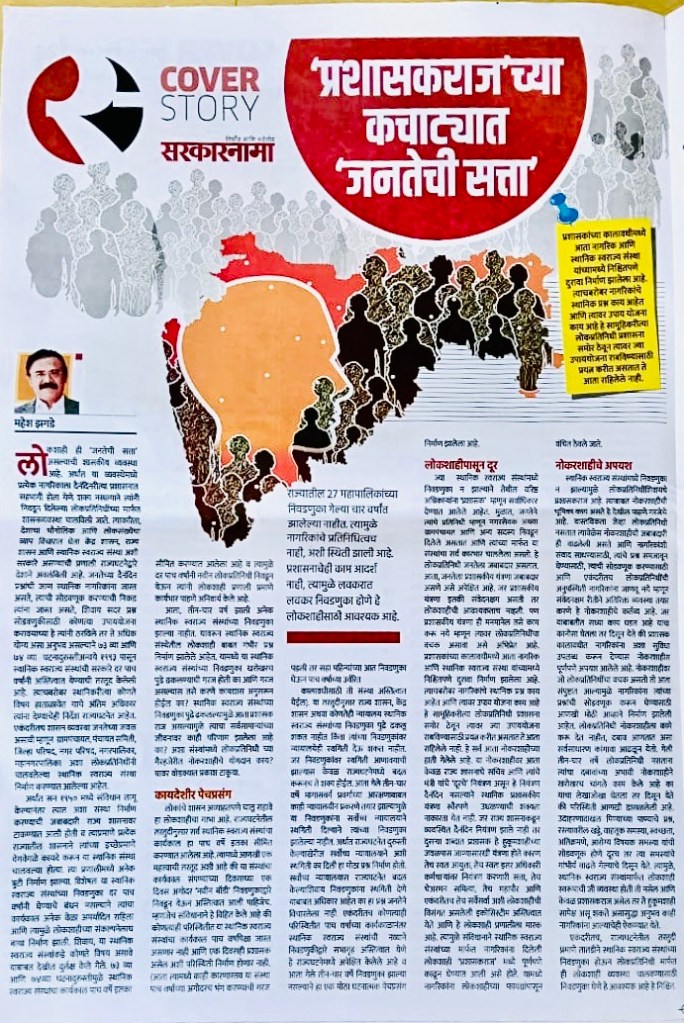
‘प्रशासकराज’ च्या कचाट्यात ‘जनतेची सत्ता’

(सौजन्य: हा लेख सरकारनामा या वृत्तपत्राची COVER STORY म्हणून प्रकाशित झाला होता.)

लोकशाही ही “जनतेची सत्ता” असल्याची शासकीय व्यवस्था आहे. अर्थात या व्यवस्थेमध्ये प्रत्येक नागरिकाला दैनंदिनरीत्या प्रशासनात सहभागी होता येणे शक्य नसल्याने त्यांनी निवडून दिलेल्या लोकप्रतिनिधींच्या मार्फत शासन व्यवस्था चालवली जाते. त्याकरिता, देशाचा भौगोलिक आणि लोकसंख्येचा व्याप विचारात घेता केंद्र शासन, राज्य शासन आणि स्थानिक स्वराज्य संस्था अशी सरकारे असण्याची प्रणाली संविधानाद्वारे देशाने अवलंबिली आहे. जनतेच्या दैनंदिन प्रश्नांची जाण स्थानिक नागरिकांना जास्त असते, त्याची सोडवणूक करण्याची निकड त्यांना जास्त असते, शिवाय सदर प्रश्न सोडवणुकीसाठी कोणत्या उपाययोजना करावयाच्या हे त्यांनी ठरविले तर ते अधिक योग्य असा अनुभव असल्याने ७३ व्या आणि ७४ व्या घटनादुरुस्तीअन्वये १९९३ पासून स्थानिक स्वराज्य संस्थांची सरकारे दर पाच वर्षांनी अस्तित्वात येण्याची तरतूद केलेली आहे. त्याचबरोबर संविधानात त्यांना स्थानिक रित्या कोणते विषय हाताळावेत याचे अंतिम अधिकार देण्याचेही निर्देश आहेत. एकंदरीतच शासन व्यवस्था जनतेच्या जवळ असावी म्हणून ग्रामपंचायत, पंचायत समिती, जिल्हा परिषद, नगर परिषद, नगरपालिका, महानगरपालिका अशा लोकप्रतिनिधींनी चालवलेल्या स्थानिक स्वराज्य संस्था निर्माण करण्यात आलेल्या आहेत.

अर्थात सन १९५० मध्ये संविधान लागू केल्यानंतर त्यात अशा संस्था निर्माण करण्याची जबाबदारी राज्य शासनावर टाकण्यात आली होती व त्याप्रमाणे प्रत्येक राज्यातील शासनाने त्यांच्या इच्छेप्रमाणे वेगवेगळे कायदे करून या स्थानिक संस्था चालवल्या होत्या. त्या प्रणालीमध्ये अनेक त्रुटी निर्माण झाल्या. विशेषतः या स्थानिक स्वराज्य संस्थांच्या निवडणुका दर पाच वर्षांनी घेण्याचे बंधन नसल्याने त्यांचा कार्यकाल अनेक वेळा अमर्यादित राहिला आणि त्यामुळे लोकशाहीच्या संकल्पनेलाच बाधा निर्माण झाली. शिवाय, या स्थानिक स्वराज्य संस्थांकडे कोणते विषय असावे याबाबत देखील दुर्लक्ष केले गेले. ७३ व्या आणि ७४व्या घटनादुरुस्तीमुळे स्थानिक स्वराज्य संस्थांचा कार्यकाल पाच वर्षे इतका सीमित करण्यात आलेला आहे व त्यामुळे दर पाच वर्षांनी नवीन लोकप्रतिनिधी निवडून येऊन त्यांनी लोकशाही प्रणाली प्रमाणे कार्यभार पाहणे अनिवार्य केले आहे.

आता, तीन-चार वर्ष झाली अनेक स्थानिक स्वराज्य संस्थांच्या निवडणुका झाल्या नाहीत. यावरून स्थानिक स्वराज्य संस्थेतील लोकशाही बाबत गंभीर प्रश्न निर्माण झालेले आहेत. यामध्ये या स्थानिक स्वराज्य संस्थांच्या निवडणुका खरोखरच पुढे ढकलण्याची गरज होती का आणि गरज असल्यास तसे करणे कायद्यास अनुसरून होईल का? स्थानिक स्वराज्य संस्थांच्या निवडणुका पुढे ढकलल्यामुळे आता प्रशासक राज असल्यामुळे त्याचा सर्वसामान्यांच्या जीवनावर काही परिणाम झालेला आहे का? अशा संस्थांमध्ये लोकप्रतिनिधी च्या गैरहजेरीत नोकरशाहीचे योगदान काय? यावर थोडक्यात प्रकाश टाकूया.

लोकांचे शासन अव्यहातपणे चालू राहावे हा लोकशाहीचा गाभा आहे. संविधानातील तरतुदीनुसार सर्व स्थानिक स्वराज्य संस्थांचा कार्यकाल हा पाच वर्षे इतका सीमित करण्यात आलेला आहे. त्यामध्ये आणखी एक महत्त्वाची तरतूद अशी आहे की या संस्थांचा कार्यकाल संपण्याच्या दिवसाच्या एक दिवस अगोदर नवीन बॉडी निवडणुकाद्वारे निवडून येऊन अस्तित्वात आली पाहिजेच. म्हणजेच संविधानाने हे विहित केले आहे की कोणत्याही परिस्थितीत या स्थानिक स्वराज्य संस्थांचा कार्यकाल पाच वर्षापेक्षा जास्त असणार नाही आणि एक दिवसही प्रशासक असेल अशी परिस्थिती निर्माण होणार नाही.(आता त्यामध्ये काही कारणास्तव या संस्था पाच वर्षांच्या अगोदरच भंग करण्याची गरज पडली तर सहा महिन्याच्या आत निवडणुका घेऊन पाच वर्षाच्या उर्वरित कालावधीसाठी ती संस्था अस्तित्वात येईल). या तरतुदीनुसार राज्य शासन, केंद्र शासन अथवा कोणतेही न्यायालय स्थानिक स्वराज्य संस्थांच्या निवडणुका पुढे ढकलू शकत नाहीत किंवा त्यांच्या निवडणुकांवर न्यायालयेही स्थगिती देऊ शकत नाहीत. जर निवडणुकावर स्थगिती आणावयाची झाल्यास केवळ संविधानामध्ये बदल करूनच ते शक्य होईल. आता गेले तीन-चार वर्ष मागासवर्ग प्रवर्गाच्या आरक्षणाबाबत काही न्यायालयीन प्रकरणे तयार झाल्यामुळे या निवडणुकांना सर्वोच्च न्यायालयाने स्थगिती दिल्याने त्यांच्या निवडणुका झालेल्या नाहीत. अर्थात संविधानात दुरुस्ती केल्या खेरीज सर्वोच्च न्यायालयाने अशी स्थगिती का दिली हा मोठा प्रश्न निर्माण होतो. सर्वोच्च न्यायालयास संविधानात बदल केल्याशिवाय निवडणुकांना स्थगिती देणे याबाबत अधिकार आहेत का हा प्रश्न जनतेने विचारलेला नाही. एकंदरीतच कोणत्याही परिस्थितीत पाच वर्षाच्या कार्यकाळानंतर स्थानिक स्वराज्य संस्थांची नव्याने निवडणुकाद्वारे बॉडी अस्तित्वात येणे हे संविधानामध्ये अपेक्षित केलेले आहे व आता गेले तीन-चार वर्ष निवडणुका झाल्या नसल्याने हा एक मोठा घटनात्मक पेचप्रसंग निर्माण झालेला आहे.

ज्या स्थानिक स्वराज्य संस्थांमध्ये निवडणुका न झाल्याने तेथील वरिष्ठ अधिकाऱ्यांना “प्रशासक” म्हणून सर्वाधिकार देण्यात आलेले आहेत. मुळात, जनतेने त्यांचे प्रतिनिधी म्हणून नगरसेवक अथवा ग्रामपंचायत आणि अन्य सदस्य निवडून दिलेले असतात आणि त्यांच्या मार्फत या संस्थांचा सर्व कारभार चाललेला असतो. हे लोकप्रतिनिधी जनतेला जबाबदार असतात. आता, जनतेला प्रशासकीय यंत्रणा जबाबदार असणे असे अपेक्षित आहे. जर प्रशासकीय यंत्रणा इतकी संवेदनक्षम असती तर लोकशाहीची आवश्यकताच नव्हती. पण प्रशासकीय यंत्रणा ही मनमानेल तसे काम करू नये म्हणून त्यावर लोकप्रतिनिधींचा वचक असावा असे अभिप्रेत आहे. प्रशासकांच्या कालावधीमध्ये आता नागरिक आणि स्थानिक स्वराज्य संस्था यांच्यामध्ये निश्चितपणे दुरावा निर्माण झालेला आहे. त्याचबरोबर नागरिकांचे स्थानिक प्रश्न काय आहेत आणि त्यावर उपाय योजना काय आहे हे सामूहिकरित्या लोकप्रतिनिधी प्रशासना समोर ठेवून त्यावर ज्या उपाययोजना राबविण्यासाठी प्रयत्न करीत असतात ते आता राहिलेले नाही. हे सर्व आता नोकरशाहीच्या हाती गेलेले आहे. या नोकरशाहीवर आता केवळ राज्य शासनाचे सचिव आणि त्यांचे मंत्री यांचे “दूरचे” नियंत्रण असून हे नियंत्रण दैनंदिन नसल्याने स्थानिक प्रशासकीय यंत्रणा स्वैरपणे  उधळण्याची शक्यता नाकारता येत नाही. जर राज्य शासनाकडून व्यवस्थित दैनंदिन नियंत्रण झाले नाही तर दुसऱ्या शब्दात प्रशासक हे हुकूमशाहीच्या जवळपास जाण्यासारखी यंत्रणा होते कारण तेच स्वतः आयुक्त, तेच स्वतः इतर अधिकारी कर्मचाऱ्यांवर नियंत्रण करणारी सत्ता, तेच चेअरमन समित्या, तेच महापौर आणि एकंदरीतच तेच सर्वेसर्वा अशी लोकशाहीची विसंगत असलेली इकोसिस्टीम अस्तित्वात येते आणि हे लोकशाही प्रणालीला मारक आहे. त्यामुळे संविधानाने स्थानिक स्वराज्य संस्थांच्या मार्फत नागरिकांना दिलेली लोकशाही “प्रशासकराज” मध्ये पूर्णपणे काढून घेण्यात आली असे होते. यामध्ये नागरिकांना लोकशाहीचे फायदे यापासून वंचित ठेवले जाते.

स्थानिक स्वराज्य संस्थांमध्ये निवडणुका न झाल्यामुळे लोकप्रतिनिधीशिवायचे प्रशासकराज आहे. त्याबाबत नोकरशाहीची भूमिका काय असते हे देखील पाहणे गरजेचे आहे. वास्तविकता जेव्हा लोकप्रतिनिधी नसतात त्यावेळेस नोकरशाहीची जबाबदारी ही वाढलेली असते आणि नागरिकांशी संवाद साधण्यासाठी, त्यांचे प्रश्न समजावून घेण्यासाठी, त्याची सोडवणूक करण्यासाठी आणि एकंदरीतच लोकप्रतिनिधींची अनुपस्थिती नागरिकांना जाणू नये म्हणून संवेदनक्षम रीतीने अतिरिक्त व्यवस्था तयार करणे हे नोकरशाहीचे कर्तव्य आहे. जर याबाबतीत सध्या काय घडत आहे याचा कानोसा घेतला तर दिसून येते की प्रशासक कालावधीत नागरिकांना अशा सुविधा उपलब्ध करून देण्यास नोकरशाहीस पूर्णपणे अपयश आलेले आहे. नोकरशाहीवर जो लोकप्रतिनिधींचा वचक असतो तो आता संपुष्टात आल्यामुळे नागरिकांना त्यांच्या प्रश्नांची सोडवणूक करून घेण्यासाठी आणखी मोठी आव्हाने निर्माण झालेली आहेत. लोकप्रतिनिधी नोकरशाहीला कामे करू देत नाहीत, दबाव आणतात असा सर्वसाधारण कांगावा आढळून येतो. गेले तीन-चार वर्ष लोकप्रतिनिधी नसताना त्यांचा दबावांच्या अभावी नोकरशाने खरोखरच चांगले काम केले आहे का ह्याचा लेखाजोखा घेतला तर दिसून येते की परिस्थिती आणखी ढासळलेली आहे. उदाहरणादाखल पिण्याच्या पाण्याचे प्रश्न, रस्त्यावरील खड्डे, वाहतूक समस्या, स्वच्छता, अतिक्रमणे, आरोग्य विषयक समस्या यांची सोडवणूक होणे दुरच तर त्या समस्यांचे गांभीर्य वाढले गेल्याचे दिसून येते. त्यामुळे, स्थानिक स्वराज्य संस्था मार्फत लोकशाही स्वरूपाची जी व्यवस्था होती ती नसेल आणि केवळ प्रशासकराज असेल तर ते हुकूमशाही सापेक्ष असू शकते असा सुद्धा अनुभव काही नागरिकांना आल्याचेही ऐकण्यात येते.

एकंदरीतच, संविधानातील तरतुदी प्रमाणे तातडीने स्थानिक स्वराज्य संस्थांच्या निवडणुका होऊन लोकप्रतिनिधी मार्फत ही लोकशाही व्यवस्था चालवण्यासाठी निवडणुका घेणे हे आवश्यक आहे हे निश्चित.

-महेश झगडे, IAS (नि)

Standard

The Illusion of Privilege: Reflections on the Intellectual Stagnation of an Exclusively Educated Pseudo-Elite

In an era when social media has given voice to millions across cultural, economic, and social divides, an unexpected observation has emerged: a few members of a supposedly select ethnic elite, who for nearly three millennia enjoyed exclusive access to educational and societal privileges, often display a surprising lack of intellectual and cultural refinement online. A careful examination of this phenomenon raises profound questions about the impact of prolonged privilege on intellectual growth, social decency, and cultural evolution, revealing that exclusivity in education alone does not inherently cultivate wisdom, depth, empathy, decency or sophistication.

Historical Context of Exclusive Privilege

The foundation of this privileged group’s position traces back millennia, wherein access to knowledge, ritual, and power was cordoned off from the masses. Systems that reinforced hierarchy—such as caste structures, feudal patronage, and inherited authority—ensured that learning and decision-making remained confined to this minority and within the minority only to the males of an elite group. Over time, the separation became deeply embedded in social expectations, ritual traditions, and legal codes, reinforcing the perception that this elite alone was capable of interpreting and safeguarding knowledge, whether sacred or otherwise.

This exclusive access also placed members of this group in roles that shaped society’s moral, educational, and philosophical frameworks. They became arbiters of culture and guides to societal values, shaping the ethics, beliefs, and behaviors of broader society. However, as time passed and societal structures evolved, this monopoly became increasingly disconnected from the realities of a changing world. One might expect that such extended access to learning would have cultivated a distinctive depth of thought or a nuanced appreciation of human experience; yet, this does not seem to be the case.

The Exposure of Intellectual Stagnation in the Digital Age

With the advent of social media, individuals from all strata of society gained the ability to express themselves freely, offering a unique, unfiltered view into their thinking, beliefs, and personalities. One might have expected that the descendants of supposedly educated elite—long nurtured on philosophical texts, classical literature, and moral doctrines—would bring to the digital realm a distinct voice: one marked by discernment, restraint, and an elevated perspective. Instead, what often emerges is quite the contrary.

The comments, expressions, and interactions seen on social media from individuals within this group often betray a startling superficiality. Rather than fostering respectful discourse or promoting a nuanced worldview, their engagements frequently reflect narrow-mindedness, necrotic thought processes, overt defensiveness, and a marked lack of critical thought. Many appear to cling to outdated perspectives, wielding their historical privileges with a tone of entitlement rather than humility or cultural sophistication. 

Educational Exclusivity and Its Limitations on Intellectual Evolution

True intellectual growth thrives on a cross-pollination of ideas, experiences, and perspectives. When knowledge is confined to an isolated group, it becomes a closed loop, increasingly insular and resistant to new ideas. While traditional teachings and classical education may have their own reasons, without engagement with other knowledge systems, the approach to learning becomes stagnant. Furthermore, when education becomes synonymous with privilege rather than purpose, the pursuit of wisdom fades into complacency, and curiosity is overshadowed by a sense of inherited pseudo-superiority.

Over generations, this isolation likely stunted the intellectual evolution of this privileged class. They were afforded an education that excluded rigorous debate and the accountability of competing perspectives. Instead, they became accustomed to a cultural feedback loop that continually reaffirmed their own beliefs and societal status. Such an environment seldom rewards introspection or self-improvement but instead reinforces a narrow worldview.

Decency, Respect, and Social Maturity in Decline

The challenge posed by these observations is not limited to intellect alone; it extends to basic social decency and respect. The frequency of caustic, arrogant, or intolerant responses often displayed by members of this group on social media suggests an erosion of basic interpersonal respect. The lack of open-mindedness reflects not only a cognitive stagnation but also a moral one. The attitude exhibited on such platforms exposes a failure to evolve socially or emotionally alongside the rest of society, indicating that exclusive access to education has not imbued this group with a corresponding level of cultural or moral growth.

The erosion of interpersonal decency raises deeper questions about the purpose of education itself. Is education meant to solely inform, or does it also have a role in nurturing empathy, respect, and an appreciation for others’ perspectives? If the answer is the latter, then the legacy of this group’s privileged education appears sorely lacking. The apparent inability to engage with respect, decency, and open-mindedness reflects a deeply entrenched intellectual and ethical myopia.

The Broader Implications for Society

When a pseudo-elite group, ostensibly educated and culturally sophisticated, exhibits such traits, it casts doubt on the broader societal value of inherited privilege. A society that ties intellectual worth to social status risks fostering an environment where genuine talent and moral courage are undervalued. In the digital age, this pseudo-elite can no longer insulate itself from public scrutiny. Their engagement—or lack thereof—shows how inherited privilege without a foundation of openness or intellectual curiosity leads not to refinement but to stagnation.

If the modern era teaches us anything, it is that the strength of a society’s intellectual character lies in diversity and inclusion. Privilege and exclusivity, rather than enhancing intellectual and moral sophistication, often become cages, limiting growth and leading to an intellectual lethargy that is neither impressive nor inspiring. 

Toward a Reassessment of Privilege and Education

The tale of this privileged group is a cautionary one, underscoring the risks of intellectual isolation and the limitations of inherited status. As social media continues to democratize voice and influence, it exposes the fallacies of those who cling to their ancestral privilege without contributing to the advancement of thought, decency, or cultural integrity. To adapt to the modern world, education must be reframed not as a legacy but as a responsibility—a continuous, interactive, and inclusive journey rather than a static entitlement.

True progress and enlightenment demand intellectual courage, humility, and a readiness to question, adapt, and grow. For this privileged class, the path forward lies in shedding the illusion of inherent pseudo-superiority and embracing the richness that only comes from genuine engagement, critical thinking, and the acknowledgment that wisdom is, ultimately, a shared endeavor.

Standard

Red Lights of VIP Kind!

In the bustling streets of Pune, where the ancient and modern collide in a delightful cacophony, an incident both curious and illuminating recently transpired. An Indian Administrative Service (IAS) trainee, cloaked in the armor of officialdom, sallied forth in her private chariot, festooned with a beacon light—a dazzling triad of red, blue, and white—proclaiming “Government of Maharashtra” to all who would dare notice. Naturally, this spectacle set tongues wagging and media buzzing from the northern hills to the southern shores.

It’s only natural that such a flamboyant display prompts the common folk to ponder: Why all the fuss over a mere lamp on a car? What ancient scriptures or modern codes dictate the dos and don’ts of these vehicular illuminations?

The Luminescence of Law

Let us delve into the annals of the Central Motor Vehicle Rules, 1989. Here lies the holy scripture that ordains the use and misuse of these vehicular illuminations. Non-compliance with these legal decrees invites the wrath of the law. Cast your mind back to days of yore, when the thoroughfares teemed with government cars bedecked with red and yellow lights, and private cars blaring sirens in a symphony of illegality. This phenomenon, dear reader, was christened “VIP culture,” a division as stark as the line between the haves and the have-nots.

The Transport Commissioner’s Quixotic Quest

In the year 2015, I assumed the mantle of Transport Commissioner. It was then that I bore witness to the grotesque visage of this “VIP culture.” Many a dignitary, both official and clandestine, flaunted these forbidden “lights.” When I dared to brandish the sword of regulation, an uproar akin to a tempest ensued. A senior officer, his lamp deemed illicit, unleashed a tirade upon me: “Tum yah jo rahe ho, isake consequences achche nahi honewale.” Ah, such threats were but dulcet whispers to my battle-hardened ears. Undeterred, I pressed on, sowing the seeds of order and reaping the harvest of ire.

In a similar vein, during my tenure as the Collector of Nashik, I faced the wrath of a sadhu during the 2003 Kumbh Mela for denying him the privilege of a lamp on his car. The situation, poised on the edge of a knife, was diffused only by the sagacity of the then Mayor of Nashik, who convinced the sadhu of the inevitability of a stubborn Collector.

A Nation’s Illumination

The predilection for these beacon lights for personal grandeur rather than their intended purpose of law and order, defense emergencies, and firefighting had become a malignancy in the nation’s fabric. Even in states where the rule of law should reign supreme, the mighty Baahubali would flaunt these lights, and the police, those guardians of order, were rendered as bystanders.

But hark! In 2013, the Supreme Court, in its wisdom, decreed that the Central Government must forge new rules to curtail this abuse of luminous power. Thus, in a Cabinet meeting on the 19th of April, 2017, the Central Government resolved to dismantle this VIP culture, and on the 1st of May, 2017, a proclamation was issued. The edict, under the aegis of the Central Motor Vehicle Rules, 1989, mandated that from that day forth, not even the President, Prime Minister, nor any public representative or government official shall adorn their vehicles with such beacon lights.

Exceptions to the Rule

Of course, there are exceptions, as there must be in any tale of regulation. The police, defense departments, paramilitary forces, and vehicles tasked to perform during natural calamities and extinguishing infernos retain the right to these lights, but only during their duties. At all other times, these lights must remain dark, a symbol of their dormancy and a non-VIP culture.

The rules, rigorous and unyielding, also dictate that each state’s Transport Department must annually publish a list of those authorized to use such lights by the police, defense departments, paramilitary forces, etc. Furthermore, a sticker bearing the designation of the authority and a number must be affixed to the vehicle, complete with a printed watermark and hologram to thwart forgery.

The Current Conundrum

Today, any vehicle flaunting these beacon lights unlawfully stands in defiance of the law and must be met with the full force of justice. The vigilance of the Transport Department, the RTO, and the police is paramount to ensure that this VIP culture does not rear its head once more. Alas, it appears the RTOs, engrossed in their “monumental” tasks, have become apathetic, turning a blind eye to the transgressions against central edicts.

Every Indian a VIP

In conclusion, let us recall the poignant words of our esteemed Prime Minister, who, in his clarion call to dismantle this VIP culture, tweeted, “Every Indian is special. Every Indian is a VIP.” It is incumbent upon the authorities to heed this clarion call, to uphold the gravity and significance of these words, and to ensure that every Indian, regardless of their station, is accorded the respect and equality they deserve.

Thus, the saga of the red light, a mere beacon on the surface, illuminates the deeper ethos of our society. Let us extinguish the flames of vanity and bask in the light of equality and justice.

(A shorter version of this Article was published in Times of India on 17/07/2024)

Standard

Dharavi: Beyond the Stereotypes

Dharavi, often labeled as Asia’s largest slum, has long been a subject of fascination and misconceptions. As the former Commissioner of the Food and Drug Administration (FDA), my frequent excursions into Dharavi, both in an official and unofficial capacity, aimed to unravel the intricate layers of its ecosystem. Contrary to popular beliefs, Dharavi is not merely a cluster of impoverished dwellings but a vibrant community with a story to tell. Dharavi is once again in the news for its mega Development project and opposition for this development. I do not want to join the cacophony raised by this controversy, however, it has refreshed my memories and, therefore, I can’t resist myself from diving into the nuanced facets of Dharavi, shedding light on its economic, social, and environmental dimensions.

1. The Breadwinners of Dharavi

Dharavi emerges as a unique model that sustains those struggling to make ends meet. In a world often divided along economic lines, Dharavi stands as a testament to resilience and self-sufficiency. Beyond the bare necessities, its inhabitants manage to eke out a living, providing for their families in ways that extend beyond the stereotypical image of poverty.

2. The Economic Tapestry: Masses Over Classes

At the heart of Dharavi beats an economic pulse that defies conventional wisdom. Unlike systems skewed in favor of the privileged elite, Dharavi’s economy is a testament to the power of the masses. The entrepreneurial spirit thrives here, with small-scale enterprises fueling a dynamic economic landscape. This stands in stark contrast to the prevailing notion that economic success is the exclusive domain of the elite.

3. Skills Forged in the Crucible of Necessity

One of the most remarkable aspects of Dharavi is the inherent ability of its residents to acquire skills independently. Devoid of formal training in prestigious institutions, the inhabitants forge their expertise through hands-on experience. The result is a community that can produce world-class products, challenging the notion that excellence is the sole prerogative of those with access to formal education.

4. Asset Creators, Not Economic Parasites

Dharavi’s residents defy the stereotype of being economic burdens on society. Instead, they emerge as creators of assets, contributing to the economic tapestry of Mumbai and, by extension, the nation. This shift in perspective challenges preconceived notions and urges a reconsideration of the value Dharavi adds to the broader economic framework.

5. Integral Components of Mumbai’s Economic Landscape

Beyond its geographical boundaries, Dharavi is intricately woven into the economic fabric of Mumbai. The contributions of its residents extend far beyond their immediate surroundings, highlighting their indispensable role in sustaining the larger urban economy. Recognizing this interconnectedness is crucial in understanding the true impact and potential of Dharavi.

6. The Environmental Footprint: A Lesson in Sustainability

In an era where environmental concerns weigh heavily on global consciousness, Dharavi stands out for its minimal carbon footprint per capita. The resourcefulness of its inhabitants translates into sustainable practices that challenge the wasteful norms of modern living. Examining these practices not only offers insight into environmental sustainability but also prompts reflection on the broader implications for urban planning and development.

7. Unveiling Downsides: A Shared Responsibility

Acknowledging the existence of downsides is imperative in any honest exploration of Dharavi. However, it is equally crucial to recognize that these challenges are not solely the burden of its inhabitants. The shortcomings stem from a complex interplay of factors involving civic and government authorities, as well as the political system. To address these issues effectively, a collective effort is required to ensure sustainable solutions that empower the community rather than perpetuate a cycle of dependency.

In conclusion, Dharavi, often reduced to a stereotype, reveals itself as a multifaceted community with a narrative that extends far beyond its physical boundaries. As we peel back the layers of misconception, we uncover a story of resilience, entrepreneurship, and sustainability. The lessons from Dharavi challenge our preconceived notions and beckon us to view marginalized communities not as problems to be solved but as founts of innovation and potential. In redefining our understanding of places like Dharavi, we may discover new pathways to inclusive development and a more equitable future.

Standard

Unraveling the Historical Tapestry: Dr. Babasaheb Ambedkar’s Lifelong Struggle Against the Original Naxalism in India

In the intricate web of India’s socio-political landscape, the caste system has been a perennial force shaping the destinies of millions. Surprisingly, the roots of this deeply entrenched social hierarchy trace back to an unexpected source that could be the original Naxalism! Let’s delve into the historical nuances, unraveling the connection between the perpetrators of the caste system and the early proponents of Naxalism in India. A central figure in this narrative is Dr. Babasaheb Ambedkar, whose lifelong struggle against this original Naxalism remains an enduring testament to his commitment to social justice.

I. The Caste System: An Ancient Web

The caste system, a hierarchical social structure based on birth, has woven itself into the fabric of Indian society for centuries that has left the Indians fragmented in perpetuity. Its origins are obscured in the mists of time, with scholars pointing to ancient scriptures as the foundation. However, an intriguing revelation emerges when we explore the genesis of the caste system within the context of the Naxalite movement.

II. Naxalism: Seeds of Dissent

The Naxalite movement, which emerged in the late 1960s, was initially perceived as a response to agrarian issues and social injustices. However, a closer inspection reveals a correlation between the ideology of the original Naxalites and the perpetuation of the caste system. Some early minor but scheming and cunning insurgents, driven by a fervent desire for societal supremacy, became the architects of a system that further entrenched the divisions among India’s diverse population are the original Naxalites of the country!

III. Dr. Babasaheb Ambedkar: A Beacon of Resistance

At the heart of the struggle against the original Naxalism stands Dr. Babasaheb Ambedkar, a visionary leader, jurist, and social reformer. Born into an oppressed caste, he experienced firsthand the oppressive nature of the caste system. His intellectual prowess and unwavering determination became instrumental in challenging the status quo and envisioning a society free from the shackles of caste-based discrimination.

IV. Ambedkar’s Ideological Confrontation

Dr. Ambedkar’s confrontation with the original Naxalism was both ideological and pragmatic. While he empathized with the socio-economic struggles that fueled any social movements, he vehemently opposed any ideology that perpetuated caste-based discrimination. Ambedkar’s vision extended beyond mere economic reforms; he aimed for a complete dismantling of the caste system, recognizing it as a formidable barrier to social progress.

V. Lifelong Struggle: Ambedkar’s Battle Against Original Naxalism

Dr. Ambedkar’s struggle against the original Naxalism was not confined to theoretical debates but manifested in concrete actions. Through the framing of the Indian Constitution, Ambedkar sought to establish a framework that would ensure social justice and equality, undermining the very foundations of the caste system propagated by the early Naxalites.

VI. Legacy of Resistance: Navigating Beyond Caste

As we reflect on Dr. Ambedkar’s legacy, we observe that his lifelong struggle against the original Naxalism extends far beyond the boundaries of caste-based resistance. His vision encompassed the creation of a society where every individual, irrespective of caste or creed, could aspire to their fullest potential. Ambedkar’s teachings continue to inspire movements advocating for social justice and inclusivity, transcending the limitations imposed by the original Naxalites.

VII. Contemporary Relevance: Navigating the Complex Terrain

In contemporary India, the echoes of the caste system persist, albeit in evolving forms. The Naxalite movement has transformed, splintering into various factions with distinct agendas. However, the underlying issues of social inequality and economic disparity persist, necessitating a nuanced approach that addresses the root causes while learning from the historical interplay between the caste system and Naxalism.

It’s a fact that the intertwining of the caste system and the original Naxalites in India presents a complex historical narrative. Dr. Babasaheb Ambedkar emerges as a pivotal figure, navigating the treacherous terrain of ideologies to forge a path towards a more equitable society. As we grapple with the challenges of the present, Ambedkar’s legacy beckons us to confront the remnants of the original Naxalism, fostering a society where the ideals of justice, equality, and fraternity prevail over the divisive forces that seek to perpetuate the caste system.

Standard

The Journey of Humanity: From Hunter-Gatherers to Conflict-Stricken Societies(Israel-Hamas conflict)

Just about 600 generations ago, humanity roamed the Earth as hunter-gatherers, living in harmony with nature. This era was marked by simplicity, absence of organized religions, castes, or border disputes, and relatively few conflicts. Over time, human societies underwent significant transformation, leading to the emergence of complex civilizations, religions, and social hierarchies. Let’s delve into the fascinating journey of humanity, exploring the transition from a simpler, conflict-free existence to the complex and often contentious societies we see today.

The Era of Hunter-Gatherers

Approximately 15,000 years ago, humans lived as nomadic hunter-gatherers. This period, often referred to as the Paleolithic Age, was characterized by small, tight-knit communities that depended on foraging, hunting, and fishing for sustenance. There was no concept of organized religion, castes, or border disputes. Societies were based on the principle of cooperation and mutual survival, with little need for hierarchies or complex governance systems.

Key Features of Hunter-Gatherer Societies:

1. Egalitarianism: Hunter-gatherer communities operated on principles of equality. Decisions were typically made collectively, and there was little room for hierarchies or power imbalances.

2. Minimal Conflict: With no organized religions or territorial disputes, conflicts were relatively rare. Interactions with neighboring tribes were often based on trade and cooperation rather than conquest.

3. Nomadic Lifestyle: Hunter-gatherers constantly moved to find food and resources, which limited the accumulation of property and wealth. As a result, there was little incentive for social inequalities to develop.

The Transition to Agriculture

The Neolithic Revolution, which began around 10,000 years ago, marked a crucial turning point in human history. During this period, humans transitioned from nomadic hunter-gatherer lifestyles to settled farming communities. The shift from hunting and gathering to agriculture fundamentally changed the social, economic, and cultural landscape.

Factors Contributing to the Transition:

1. Agricultural Surplus: Agriculture allowed for the surplus production of food, which led to population growth and the establishment of permanent settlements.

2. Property Ownership: The concept of land ownership emerged with agriculture. This, in turn, gave rise to social hierarchies and wealth disparities.

3. The Birth of Religions: As societies became more complex, religious beliefs and practices began to take shape. The need for social cohesion and order led to the development of organized religions.

The Emergence of Conflict

With the advent of agriculture, the dynamics of human societies changed significantly. As populations grew and settled into fixed territories, conflicts and disputes became more common. The following factors contributed to the rise of conflicts:

1. Property Disputes: Ownership of agricultural land led to property disputes, and the concept of personal and communal property created tensions within communities.

2. Religious Differences: Organized religions emerged, and they often served as a source of both unity and division. Religious beliefs and rituals sometimes led to conflicts between different groups.

3. Social Hierarchies: As wealth and property accumulated, social hierarchies developed. This led to inequalities and conflicts between different classes within society.

4. Territorial Expansion: The need for arable land and resources pushed societies to expand, often resulting in conflicts with neighboring communities. This marked the beginning of border disputes and territorial conflicts.

The Modern Era

Over the centuries, human societies have continued to evolve and become increasingly complex. The world is now divided into nations with borders, and conflicts rooted in religion, caste, and territorial disputes persist. However, it’s important to note that progress has also been made in promoting peace, understanding, and cooperation.

In a nutshell, the journey of humanity from hunter-gatherer societies to our complex modern world has been marked by a profound transformation. While early humans lived in relative harmony, the transition to agriculture brought about social hierarchies, property disputes, and the birth of organized religions. These changes laid the foundation for the conflicts and divisions we see today. Understanding our history can help us reflect on the causes of our modern conflicts and perhaps find ways to foster a more peaceful and cooperative world. Despite the challenges, it’s essential to recognize the progress we’ve made in promoting global peace and cooperation, with the hope that we can continue to build a more harmonious future.

Standard

The Sign of a Very Ill Society: Nurturing Conscience Illiteracy.

Society serves as the foundation upon which individuals grow, interact, and flourish. It is meant to foster values, ethics, and a collective conscience that guides individuals towards empathy, compassion, and justice. However, when a society fails to cultivate these qualities and instead nurtures what can be called “conscience illiteracy,” it is a clear sign of deep-seated social problems. Let’s explore the detrimental effects of conscience illiteracy on society and emphasizes the importance of fostering a moral compass for the betterment of our collective well-being.

Understanding Conscience Illiteracy:

Conscience illiteracy refers to a state in which individuals lack the ability to recognize and distinguish right from wrong, and lack the moral understanding necessary for making ethical choices. It is a condition where individuals prioritize self-interest, disregarding the impact of their actions on others and society as a whole. Conscience illiteracy often leads to a society plagued by injustice, indifference, and a lack of empathy.

Effects of Conscience Illiteracy on Society:

1. Erosion of Trust: When conscience illiteracy becomes pervasive in a society, trust between individuals and institutions deteriorates. People become skeptical, suspicious, and hesitant to rely on others, hindering the development of a strong social fabric.

2. Increased Inequality: Conscience illiteracy fosters a culture that prioritizes personal gain over the welfare of others. This mindset perpetuates social and economic inequalities, as those with power and privilege exploit the vulnerabilities of others for their own benefit.

3. Lack of Social Cohesion: A society that neglects to nurture ethical awareness and responsibility experiences a decline in social cohesion. The absence of a shared moral framework leads to division, polarization, and conflicts based on self-interest rather than the common good.

4. Injustice and Exploitation: Conscience illiteracy enables a climate where injustice and exploitation thrive. Individuals disregard the rights and well-being of others, leading to systemic discrimination, human rights abuses, and the perpetuation of social injustices.

Addressing Conscience Illiteracy:

1. Education and Awareness: One of the fundamental ways to combat conscience illiteracy is through education. Educational institutions should prioritize teaching values, ethics, and empathy alongside academic subjects, instilling a sense of moral responsibility in individuals from a young age.

2. Role Models and Leadership: Society needs strong role models and ethical leaders who exemplify and promote values such as compassion, integrity, and justice. By celebrating and supporting those who demonstrate ethical behavior, we can inspire others to follow suit.

3. Promoting Empathy and Inclusivity: Encouraging empathy and inclusivity is crucial in developing a society that values the well-being and dignity of all its members. Promoting dialogue, fostering understanding, and dismantling biases are essential steps toward creating a compassionate and empathetic society.

4. Accountability and Consequence: Conscience illiteracy can only be curbed through accountability and consequence. Establishing strong legal frameworks, ensuring fair justice systems, and holding individuals accountable for their actions are vital in discouraging unethical behavior and promoting a culture of responsibility.

In conclusion, let’s accept that a society that nurtures conscience illiteracy is in a state of profound illness, where the well-being and dignity of individuals are compromised. Recognizing the detrimental effects of conscience illiteracy is the first step towards fostering positive change. By prioritizing education, promoting empathy, and holding individuals accountable for their actions, we can work towards creating a society that upholds ethical values, justice, and compassion. It is our collective responsibility to cultivate a moral compass that guides us towards a more just, inclusive, and empathetic future.

Standard

Perceptions of Justice:The Dichotomy between Ideal and Realised Justice.

Introduction:

The concept of justice holds a significant place in human societies, embodying the fundamental principles of fairness, equality, and moral rightness. However, the perception and experience of justice often differ between the idealistic notion and the practical realisation. The intriguing dichotomy that justice is not solely defined by its inherent qualities but rather by the outcomes individuals actually receive within a given societal context. Justice, as a fundamental principle, is often associated with notions of fairness, equality, and the rule of law. While subjectivity has been acknowledged as an inherent element in the interpretation and application of justice, the proposition that striving for objectivity in justice can enhance its integrity and alleviate potential biases should not be ignored. By exploring the factors influencing the interpretation of justice and examining the implications of this distinction, we gain valuable insights into the complex dynamics that shape our understanding of justice.

Justice, as an abstract and multifaceted concept, is subject to diverse interpretations and contextual influences. It represents an ideal state of affairs, characterised by equitable treatment, impartiality, and adherence to ethical principles. However, the reality of justice is far from a universal experience, as it is contingent upon numerous socio-cultural, economic, and political factors. Let’s try to shed light on the intricate interplay between the ideal and realised dimensions of justice, emphasising the significance of outcome-based perceptions in evaluating the fairness of a given system.

Ideal Justice:

Ideal justice embodies the vision of a perfect and morally upright society, where every individual is treated fairly, rights are protected, and the rule of law prevails. Rooted in philosophical and ethical frameworks, this conception of justice serves as a benchmark against which societies measure the quality of the human existence. It encompasses theories such as distributive justice, retributive justice, and procedural justice, all seeking to establish a framework that ensures fairness and equality.

Realised Justice: Contextual Factors and Disparities:

The realisation of justice is contingent upon various contextual factors, including socio-economic disparities, cultural norms, historical legacies, and the functioning of legal and political institutions. The application of justice in practice often faces challenges such as bias, corruption, unequal access to legal recourse, and systemic inequalities. These factors contribute to the divergence between the idealised vision of justice and the outcomes experienced by individuals within a given society.

The Role of Perception:

Perceptions of justice are subjective and influenced by personal experiences, social conditioning, and cultural values. The gap between ideal justice and realised justice can lead to disillusionment, frustration, and a loss of trust in the system. Individuals’ perceptions of justice are shaped not only by their direct encounters with the legal system but also by societal narratives, media representation, and collective experiences. Moreover, the unequal distribution of justice can perpetuate social divisions, engendering feelings of marginalisation and injustice.

Perceptions and Subjectivity:

Individual perceptions of justice are subjective and can vary based on personal experiences, cultural background, and societal norms. The outcomes people receive directly impact their perception of justice, as they evaluate the fairness of the system based on the tangible results they observe or experience. Recognising the subjective nature of justice can lead to a deeper understanding of the diverse ways in which individuals engage with and assess justice in their lives.

Implications for Justice Systems:

Embracing an outcome-based perspective on justice has significant implications for the design and functioning of justice systems. It highlights the importance of creating mechanisms that ensure equitable outcomes, rather than solely focusing on the procedural aspects of justice. This necessitates addressing systemic biases, disparities in access to legal resources, and empowering marginalised communities to ensure fairness in outcomes.

Promoting a Just Society:

Acknowledging the connection between justice and outcomes encourages a proactive approach to fostering a just society. This requires continuous evaluation, reform, and the pursuit of policies that aim to improve outcomes for all individuals. Efforts should be directed towards reducing disparities, addressing systemic injustices, and ensuring that the justice system operates in a manner that promotes fairness and equality.

The Societal Ecosystem: Elements and Interactions:

The societal ecosystem comprises various interconnected elements, including cultural values, norms, power structures, economic systems, and legal frameworks. These elements interact and influence one another, creating a dynamic environment that shapes the understanding and implementation of justice. Cultural beliefs and traditions, for instance, inform notions of right and wrong, while economic disparities can impact access to legal resources and representation.

Norms and Power Structures:

Norms, both explicit and implicit, play a crucial role in shaping societal expectations and behaviour. They contribute to the establishment of standards for justice, dictating what is considered fair and acceptable within a given society. Power structures within the societal ecosystem, such as political systems and social hierarchies, can influence the distribution of justice, often resulting in inequalities and differential treatment.

Legal and Political Systems:

The legal and political systems within a society serve as key mechanisms for delivering justice. These systems are designed to interpret and enforce laws, resolve disputes, and safeguard individual rights. However, the functioning of legal and political institutions is influenced by the broader societal ecosystem. Factors such as corruption, bias, and systemic inequalities can undermine the impartiality and effectiveness of these systems, impacting the realisation of justice.

Inequalities and Marginalisation:

The existing societal ecosystem can perpetuate inequalities and marginalisation, leading to a skewed distribution of justice. Discrimination based on factors such as race, gender, socioeconomic status, or caste can create systemic barriers, limiting access to justice for marginalised communities. The interplay between societal power dynamics and justice can further entrench social divisions and contribute to the perpetuation of injustice.

Justice cannot be viewed in isolation from the societal ecosystem in which it operates. The existing social, cultural, economic, and political dynamics significantly shape the understanding, application, and realisation of justice. By recognising and addressing the complexities and challenges within the societal ecosystem, societies can work towards creating a more just and equitable system. Achieving justice requires a holistic approach that encompasses legal reforms, cultural shifts, and a commitment to dismantling systemic barriers.

Implications and Moving Forward:

Recognising the gap between ideal and realised justice is crucial for fostering a more just society. Efforts should be directed toward minimising disparities and ensuring that legal frameworks and institutions are designed to deliver equitable outcomes. Strengthening transparency, accountability, and inclusivity within the justice system is paramount. Additionally, promoting legal literacy and empowering marginalised communities can help bridge the divide between ideal justice and its realisation. In a nutshell, the understanding of justice goes beyond its conceptual definition. It encompasses the tangible outcomes individuals experience within the socio-cultural, economic, and political contexts in which they live. By acknowledging and addressing the disparities between ideal and realised justice, societies can strive towards a more inclusive and equitable system. Achieving justice requires continuous reflection, reform, and collective action to bridge the divide and ensure that justice is not just an abstract ideal, but a tangible reality for all.

Keywords: #justice, #ideal_justice, #realised_justice, #fairness, #equality, #perception, #socio-cultural_factors, #legal_system, #disparities, #social_divisions, #inclusivity.

Standard